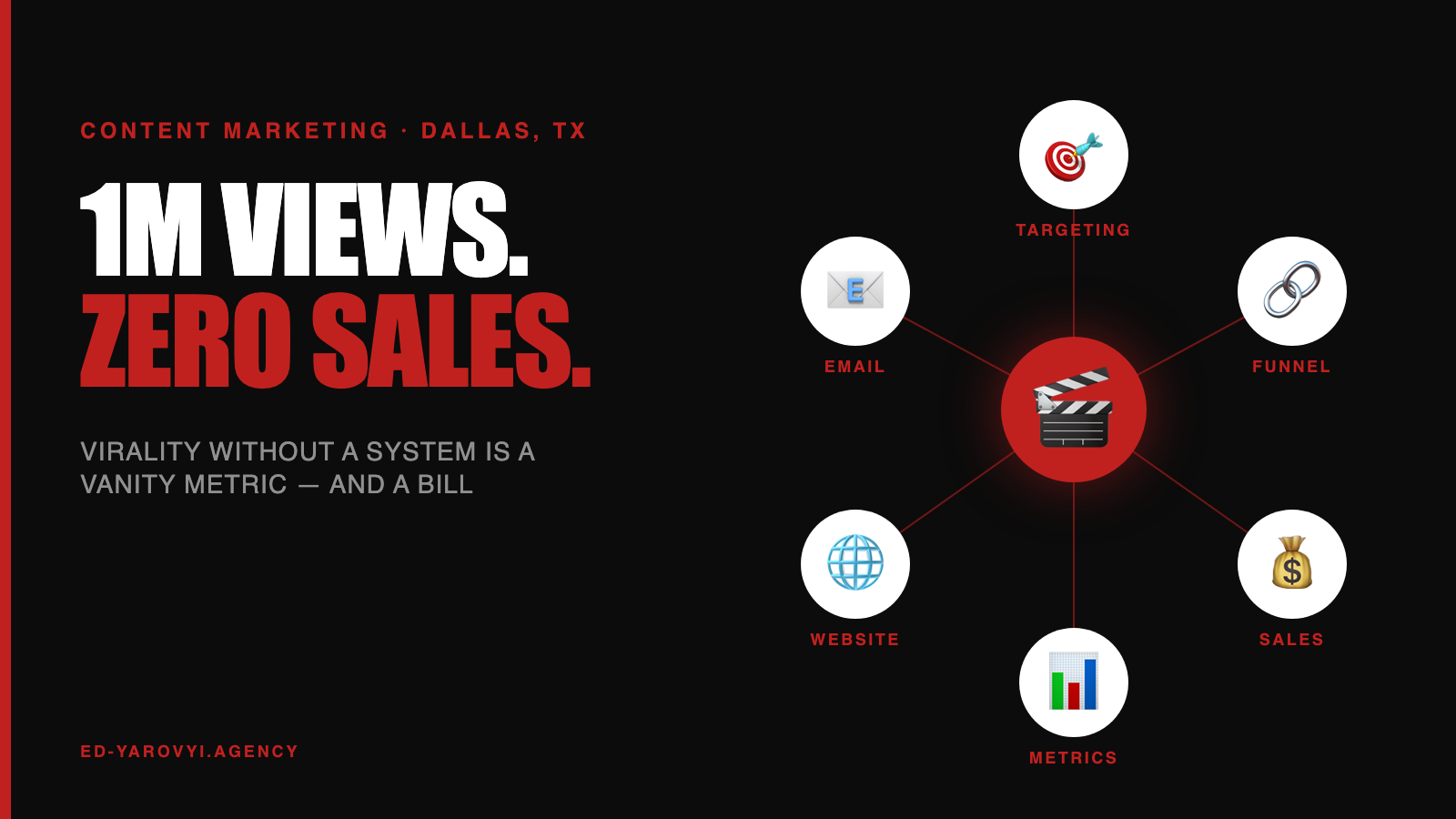
In Dallas content marketing, every local business owner dreams of this exact morning. A million views. Hundreds of thousands of likes. Comments, reposts, mentions. Your business went viral on social media this morning. The phone is blowing up with congratulations from colleagues.
Then you open your CRM. Look at the charts and graphs — and the numbers look exactly like last season at this time.
In this article, I’ll share my perspective on how viral content should be optimized, how to avoid turning your team into a toxic environment, how to build an effective funnel, and how to align positioning with a clear end goal.
In This Article
- Virality Is an Over-the-Counter Drug
- The Car Dealership That Made a Viral Video
- The Coffee Shop With 50 Million Views — And Empty Tables
- A Real Example — Content Marketing Dallas at Scale
- Set a Hard Goal — Before the First Video
- Bloom Nutrition: When Virality Is the Strategy
- FAQ — Content Marketing Dallas
Virality Is an Over-the-Counter Drug
Social media has trained us to think that views equal success. In other words, if a million people saw you, something is working and generating a positive impact on revenue. However, a view is not an action. In fact, a view is one second of attention from a person scrolling through their feed in line for coffee. As a result, they didn’t remember you. Nobody landed on your website. In short, no one bought.
Moreover, social media platforms compete for viewer attention by throwing up obstacles — marketplaces, verification systems, complicated paths to clicking your link, bans, and more. In short, the platform wants the swipe to continue forever. Meanwhile, your battlefield for attention ranges from content shot on a smartphone front camera for $0 to a Super Bowl ad that costs a million.
Before you take action, you need to understand the full cycle through SWOT. Yes — you know what that is, and it sounds basic. But have you actually done it with full seriousness, objectively, with a cool head? Probably not.
In short, the problem is that viral content builds an audience of viewers, not buyers. As a result, you gather people who came to be entertained — not to solve a problem. However, when you later try to sell them something, they may be caught completely off guard.
In fact, the reason is your poorly configured engagement funnel. First, was it ever properly built? Second, is there clarity on “What will 1 million views actually give me?” So, let’s look at a few examples before we move to the hypothesis.
The Car Dealership That Made a Viral Video — And Likely Didn’t Increase Sales
Above all, car sales is always a fairly eccentric business. In fact, every one of us has experienced the flood of spam and calls after signing up for a test drive. Moreover, the business is constantly pulling every string it can, especially with your personal data. However, that’s not necessarily bad — but the industry is cutthroat.
Who comes up with the idea doesn’t matter at this point — at least not right now. Let’s recreate a viral social media video from a Houston dealership. Take a clip where a bull chases a person and headbutts them in the backside. Edit it so that a millisecond before the impact, you cut to your video — a female employee in the same pose on one of your cars, delivering a call to action for your dealership.
As a result, millions of views. Then the account grows every day. Moreover, you get congratulations from friends and hundreds of pitches to make more videos just like it. However, then there’s reality.
The problem nobody saw in the briefing room
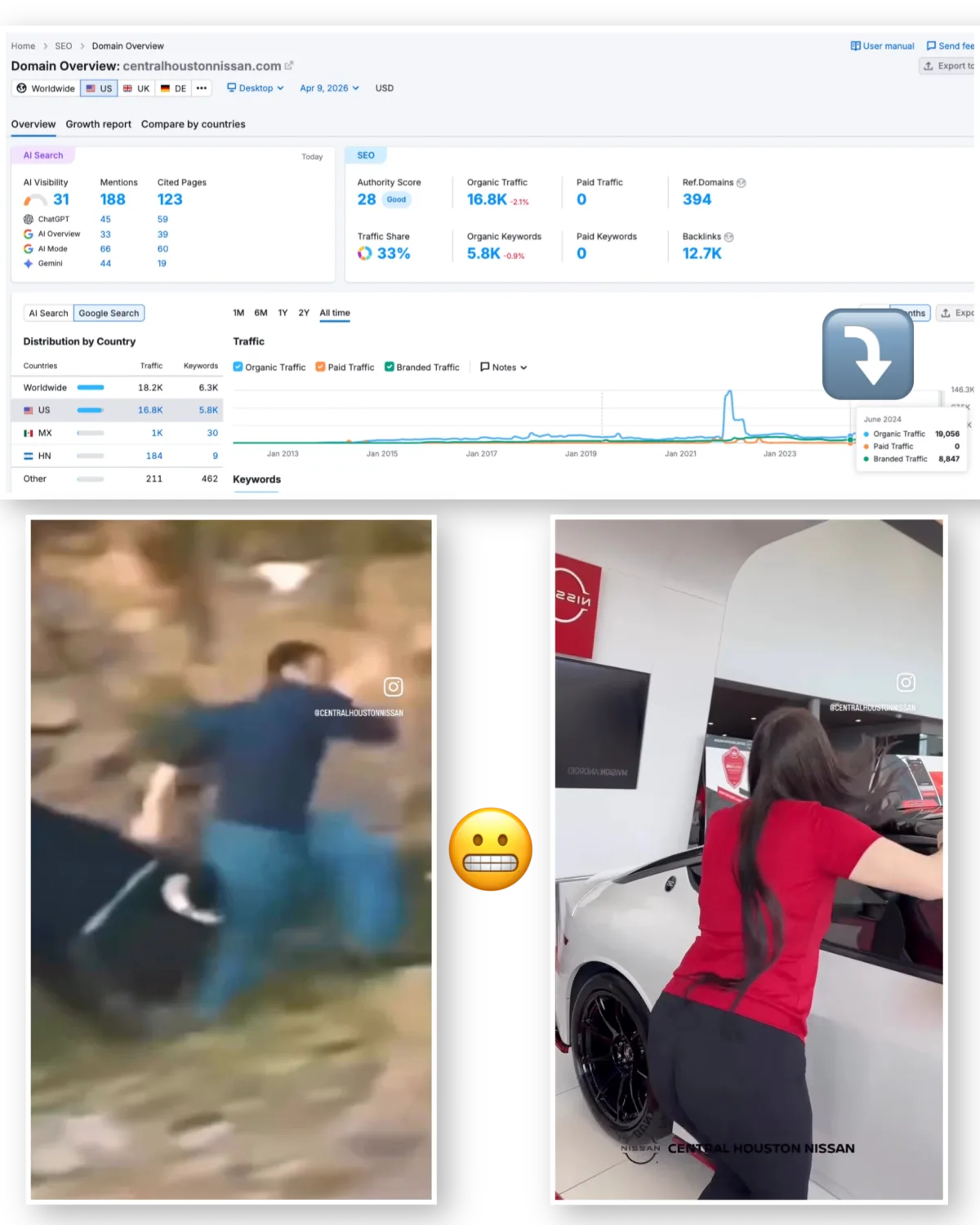
In short, the problem: the audience is teenagers aged 16–22 who don’t buy cars. In other words, they watch because it’s funny. Not because they want a Honda Civic. As a result, the algorithm picked up humor — and delivered it to people who like humor. On the other hand, not to people who need a car. However, AIDA worked — but the “action” that actually matters on social media is sending it to a friend.
You didn’t account for the side effects.
There is a newer wrinkle worth knowing about: more people now get their answer from an AI summary instead of clicking through at all. Generative engine optimization is the work of becoming a source those systems cite, which is quietly where reach is moving.
Association & motivation — the team-level risks
Additionally, a separate issue is the association between your content and your business. After watching this content — what will the customer think? What will the employee think?
Here’s how to address it:
The Coffee Shop With 50 Million Views — And Empty Tables
The second example is even tougher.
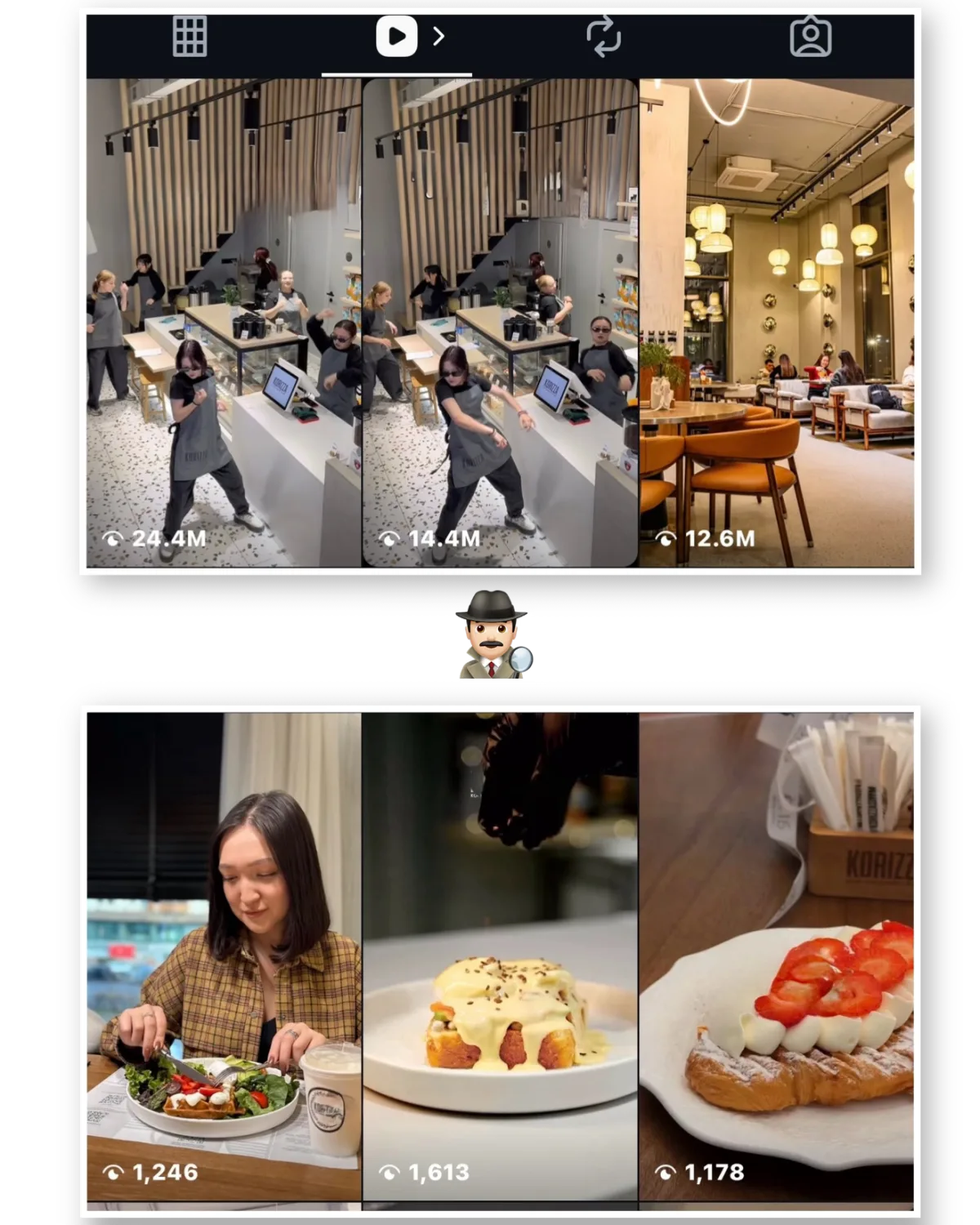
A small coffee shop in a residential neighborhood. The owner films a clip where the barista makes latte art shaped like a customer’s dog. The video gets 50 million views. Fifty million. That’s more than most major brand advertising campaigns generate in a year.
What happened next? People started commenting from other cities, countries, continents. The account grew. Everyone was impressed. But no more people actually came to the coffee shop. Because 99.9% of the audience lives thousands of miles away. They couldn’t come even if they wanted to.
When virality works for the algorithm, not the business
However, the owner later said he expected a line out the door after that video. Instead, he got the same average check and the same number of daily customers. In other words, virality worked — but not for him. As a result, it worked for the algorithm. Moreover, it partially damaged his account — because it got labeled as entertainment and dance content, not a coffee shop.
As a result, they decided to keep going with the dance content — because the audience was already there and stopping would kill the momentum. However, now they’re slowly mixing in coffee-related posts, trying to shift the perception without losing the followers they gained. In short, it’s a delicate balance — on one hand, you can’t pivot too hard or the algorithm drops you; on the other hand, you can’t stay pure entertainment forever if you want customers, not viewers.
This resonance only got leveraged when the owner converted it into a comment on the topic, and local media picked it up from there.
In short, you need to understand not just how to make 1 or 10 million views on a video, but what those views will actually do. For instance, why would a business in Plano need 10 million views on a funny video when their target audience is the DFW area? As a result, the answer is — only if you understand that out of those 10 million, there’s maybe 1% from your area. Moreover, your metrics need to be accurate. However, sometimes it’s better to invest in dallas content marketing that targets your actual audience — and shoot videos that get 100K views but from your real customers.
A Real Example — Content Marketing in Dallas at Scale
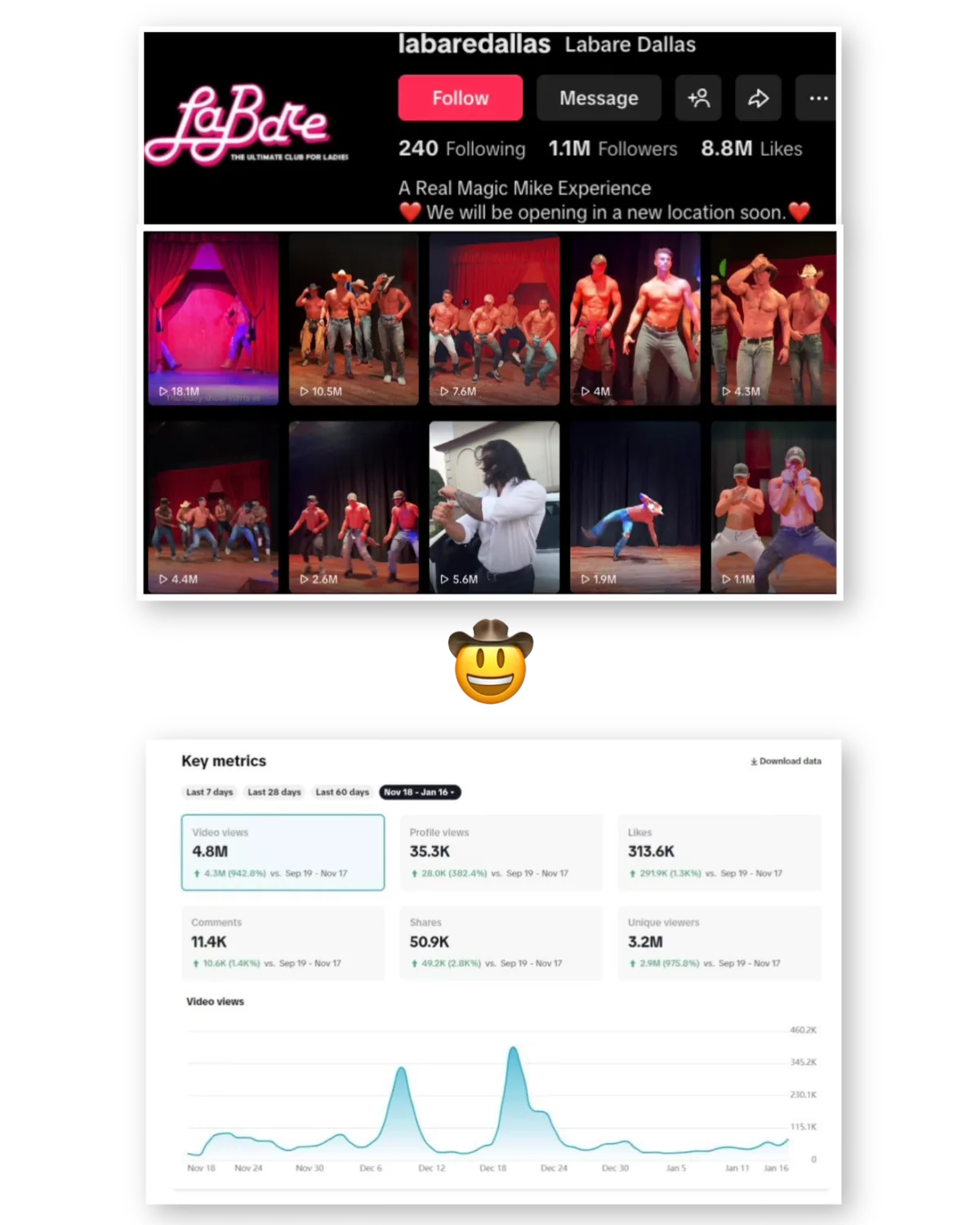
For instance, 15 million organic views sounds like a dream. In fact, we did that for La Bare Dallas (@labaredallas on TikTok, read the full La Bare case study) in 4 months — zero ad spend. In other words, that is what content marketing DFW looks like when it is run as an operation, not a one-off campaign. However, here’s what I learned: views by themselves are worth nothing. Literally zero. In short, between attention and money there’s a system, and if that system doesn’t exist — you’re just free entertainment content for someone else’s audience.
First, the test was a hypothesis — to restore the former popularity of an account with a serious 1.1 million followers. Moreover, the business owner became a real friend of mine, and he’s genuinely brilliant. Then concept and content production came together — with optimization at every step. However, every metric we chased landed — but it didn’t fully convert into new people walking through the door and buying tickets.
What I wish we had built differently
I can’t reveal the details of the process, but I can say what didn’t work from my perspective. We didn’t build a proper conversion funnel beyond the show itself. Additional monetization sources and multiple engagement layers were missing — retention sequences, segmented offers, reactivation campaigns. My original plan covered a lot more. Still, I was hired for a specific scope. Four months to test a content marketing in Dallas hypothesis. Delivery was clean — everyone was satisfied. Even so, I wanted to extract a lesson.
In short, you need to look beyond just the metric of views and what millions mean. Moreover, you need to understand what you’re giving to those viewers at different stages — and from that, you build your multi-layered monetization. For reference, the full system that wraps viral content — auto-DM, SEO-ready website, follow-up, CRM integration, owner dashboard — is laid out in detail in One Photo, Seven Systems — the real content marketing Dallas architecture for local service business.
Set a Hard Goal — Before the First Video
Here’s what you need to understand before you start creating content.
First of all, if your end goal is sales, you have to be selling from day one. In other words, not “first I’ll build an audience, then I’ll sell.” Similarly, not “first I’ll get popular, then I’ll monetize.” As a result, that doesn’t work. However, it works in one out of a thousand cases, and that one case usually looks completely different from what you think.
By contrast, when a business is built for sales and positions itself as a business that sells — it has a specific offer, a specific funnel, a specific path from view to purchase. In short, every video, every post, every story is a step toward the deal. However, not necessarily a direct one. Still, a step.
On the other hand, when that kind of business accidentally goes viral with entertainment content — it gets a million views from people who aren’t looking for its product. As a result, converting them back into buyers is virtually impossible. In fact, the algorithm has already decided who you are. In short, you’re entertainment. Not a store. Moreover, nothing close to a service. In other words, far from a solution to a problem.
Pre-launch — what has to exist before you press record
So, here’s what should be in place before you press record:
What starts with a clear goal also carries the logic for monetization.
Bloom Nutrition: When Virality Is the Strategy — Not the Accident
However, there’s one case where virality as the primary strategy worked — and it’s worth studying because the founders understood exactly what they were doing.
Bloom Nutrition — Mari Llewellyn and Greg LaVecchia, Austin, Texas. Mari shared her 90-pound fitness transformation on social media. No product, no brand — just a personal journey that grew to 1.7 million followers. Their paid ads said “Go follow Mari” — not “Buy our greens.” Every dollar went into promoting a person, not a supplement.
Moreover, the fitness PDFs and guides along the way weren’t a product launch — they looked like normal blogger income. In fact, nothing aggressive, nothing that breaks trust. Then, when Bloom finally launched as a supplement — it felt like Mari’s next chapter, not an ad. As a result, $150 million in revenue in four years. In short, zero investors at the start. From Austin, TX — right here in our state.
However, for most local businesses that model doesn’t apply directly. On the other hand, the principle is universal: the audience needs to trust the person before they’ll buy the product. In short, that’s the difference between building a brand and just making noise.
For turning one video into a week of posts, see how to repurpose content.
FAQ — Content Marketing in Dallas
Does viral content work for content marketing Dallas businesses?
Only if it’s connected to a system — a funnel, a conversion path, and a retention layer. However, without that, viral views are a vanity metric. In short, dallas content marketing that generates revenue requires every piece of content to be a step toward a measurable action, not just reach.
What’s the difference between viral content and content marketing strategy?
First, viral content is an event — unpredictable and usually untargeted. By contrast, content marketing in Dallas is a system — consistent, measurable, and built to convert. In short, a marketing consultant Dallas businesses work with builds the system first, then uses virality as fuel — not the other way around.
Should a local business try to go viral or focus on dallas social media marketing?
First, focus on dallas social media marketing that reaches your actual customers. In fact, 100K views from your area is worth more than 10 million from people who will never visit. In short, a dallas content marketing approach targets the audience that can buy — not the audience that can watch.
How long before organic content actually starts converting?
In practice, six to twelve weeks of daily output before you see repeatable conversion, not hype. First, the first two weeks the algorithm is learning you. Then weeks three through eight, audience quality sharpens. Finally, from week nine the landing page Dallas sees matching traffic, and the email list starts producing repeat buyers. However, any content marketing agency dallas promising faster results is either lying or running paid ads underneath.
Can small local businesses compete with viral giants?
Yes — but not on viral. Instead, compete on local relevance. For instance, a Dallas bakery does not need to beat a 50-million-view food creator. Rather, it needs to own DFW — Plano, Frisco, Arlington. In short, tight geographic targeting plus a working funnel beats raw reach every time. As a result, that is the content marketing services dallas model that fits small local business.
What is the minimum budget for a real content marketing system?
In short, the system itself does not need a retainer from big marketing companies in dallas. Instead, it needs a content producer (internal or freelance), a website that converts, an email tool, and an operator who wires it together and reads the weekly numbers. First, start with one platform, one landing page, one email sequence. Then scale when the numbers tell you to. Ultimately, the budget question is less about dollars and more about who actually owns the output.