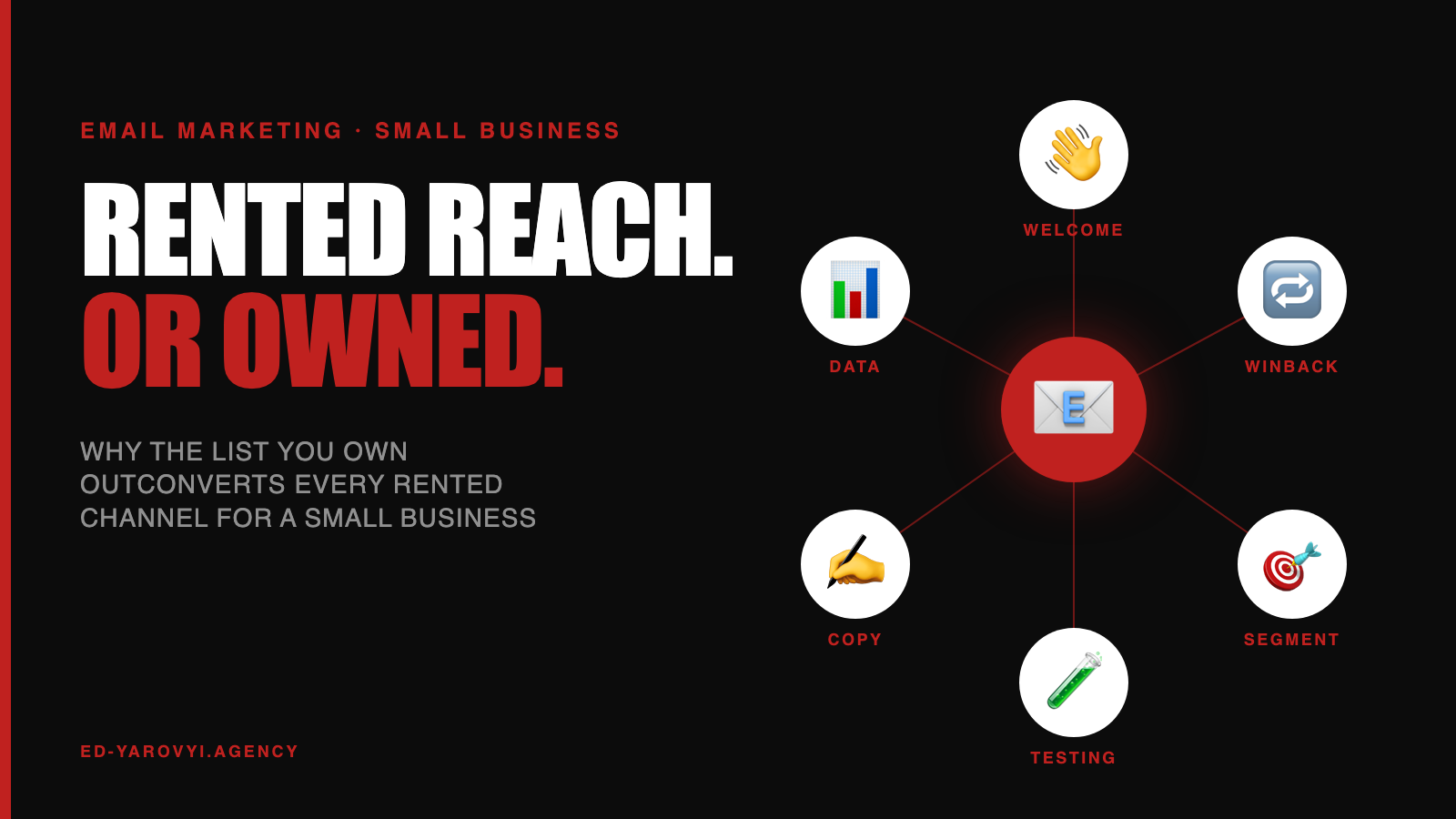
Email marketing for small business is the most underrated channel there is, because it is the only one you actually own. Social platforms rent you an audience and change the rules whenever they like; your email list is yours, and it converts better than anything else. Yet most small businesses either ignore it or blast the occasional newsletter and call it done. The U.S. Bureau of Labor Statistics tracks the growing value of marketing expertise, and email is where that expertise quietly produces some of the highest returns in the whole mix.
I have built email and retention systems for 20 years — sequences, segmentation, offer testing, and copy that actually converts. So this guide breaks down what email marketing for small business really looks like when it works in 2026 — the systems that drive revenue, what to skip, and why the money is in retention, not just acquisition.
Why email marketing for small business still wins
Every other channel is rented. You can lose your social reach overnight to an algorithm change, and paid ads stop the moment you stop paying. Email is the one asset you own outright — a direct line to people who already raised their hand. That is why, dollar for dollar, it consistently returns more than any other channel for a small business.
Five reasons email marketing for small business outperforms
- You own the audience — no algorithm sits between you and your customers
- It reaches people who already know you — warm subscribers convert far better than cold traffic
- It is built for retention — bringing an existing customer back costs a fraction of finding a new one
- It is measurable and testable — you can see exactly what drives revenue and refine it
- It scales without scaling cost — sending to a thousand or ten thousand costs about the same
The businesses that quietly win are the ones that treat email as a revenue system, not an occasional broadcast.
Deliverability: getting into the inbox
The best email in the world earns nothing if it lands in spam. Deliverability — actually reaching the inbox — is the invisible foundation of email marketing for small business, and ignoring it quietly wastes everything else you do.
A few habits protect it. Send only to people who genuinely opted in, because spam complaints are what wreck sender reputation. Remove inactive subscribers regularly, since a list full of dead addresses drags down deliverability for everyone. Use a proper email platform rather than a personal account, authenticate your domain so providers trust you, and avoid the spammy tricks — all caps, misleading subject lines, too many images — that trip filters.
Writing emails people actually open
Once you reach the inbox, the email has to earn the open and the click, and this is where most small business email falls flat.
The subject line does most of the work — it decides whether the email is opened at all, so it should spark curiosity or promise clear value in a few words. The first line matters nearly as much, because it previews in the inbox. From there, keep the message focused on one idea and one action; an email trying to say five things gets none of them done. Write the way you talk, make the call to action obvious, and respect the reader’s time.
Good email marketing for small business does not feel like marketing. It feels like a useful, human message from a business the reader chose to hear from. That tone is what keeps a list engaged for years, and an engaged list is the asset that quietly outperforms every rented channel you could buy instead.
Where email fits with the rest of your marketing
Email is most powerful when it is not a silo. It should connect to everything else: social and content bring people in, email captures and nurtures them, and the website converts. A subscriber who found you on social, got a helpful welcome sequence, and received a well-timed offer is far more likely to buy than someone hit with a cold ad. The channels reinforce each other, and email is the thread that ties the relationship together over time. That is why I build email as part of one connected system rather than a standalone task — the retention layer that makes every other marketing dollar work harder.
Acquiring a new customer costs far more than keeping one, and email is the cheapest retention tool there is. For most small businesses, the fastest revenue lift is not more traffic — it is a system that brings existing customers back.
The email systems that actually drive revenue
Email marketing for small business is not about sending more emails — it is about the right automated sequences running in the background. Here are the systems that matter, roughly in order of return.
1. The welcome sequence
The moment someone joins your list is when they care most. An automated welcome sequence introduces your business, builds trust, and makes a first offer while attention is high. This single sequence often produces a large share of email revenue, and most small businesses do not have one.
2. Retention and win-back sequences
This is where the real money lives. Automated sequences that bring past customers back — a check-in, a reminder, a returning-customer offer — reactivate revenue you already earned once. Win-back flows that re-engage lapsed customers are among the highest-return automations a small business can run.
3. Segmentation
Blasting the same email to everyone is why most lists underperform. Segmenting by behavior, purchase history, or interest means each subscriber gets relevant messages, which lifts opens, clicks, and revenue dramatically. Segmentation is the difference between spam and a message that feels personal.
4. Offer testing and campaigns
On top of the automated flows, periodic campaigns — launches, seasonal offers, announcements — keep the list active and drive spikes. Testing subject lines, offers, and timing turns each campaign into data that makes the next one perform better.
Building a list worth emailing
None of the systems matter without a list, and the way you build it determines whether email works. A small list of genuinely interested subscribers beats a huge list of people who never opted in. Quality over size, always.
- Offer a real reason to subscribe — a useful guide, a discount, or genuine value, not just “join our newsletter”
- Capture at the right moments — at checkout, after a great experience, or when someone is clearly interested
- Never buy lists — purchased lists hurt deliverability and convert nobody
- Keep it clean — removing inactive subscribers protects your deliverability and your metrics
A clean, engaged list is an asset that produces revenue for years, which is exactly why email belongs in every small business marketing mix.
What to skip in small business email marketing
Knowing what to skip protects your list and your reputation. These are where small businesses go wrong.
- Buying email lists — it destroys deliverability, converts nobody, and can get you blacklisted
- Only sending sales blasts — a list that only hears from you when you want money tunes you out fast
- No automation — relying on manual sends means the highest-return sequences never run
- Ignoring segmentation — one-size-fits-all emails leave most of the revenue on the table
Here is my honest take: most small businesses are sitting on an email list that could be producing real revenue and doing almost nothing with it. The welcome sequence and a win-back flow alone would change their numbers, and neither is expensive to build.
Building an email system that runs itself
The goal is not to spend your evenings writing emails — it is to build automated sequences that run in the background and campaigns that are quick to send because the system is in place. Set up once, refined with data, an email system becomes one of the most reliable revenue channels a small business has.
This is what I build end-to-end: the sequences, the segmentation, the offer testing, and the copy, handled by one operator with no handoffs. The marketing cost Dallas breakdown covers what it costs, and the marketing budget Dallas guide covers funding it alongside your other channels.
The two questions owners ask first are answered in how to build an email list and is email marketing worth it.
Is email marketing still effective for small business in 2026?
More than ever. Email is the only channel you own outright — no algorithm between you and your customers — and it consistently returns more per dollar than any other. For email marketing for small business, the value is in owned, direct access to warm subscribers.
What email sequences should a small business set up first?
Start with a welcome sequence for new subscribers and a win-back sequence for lapsed customers. These two automated flows produce a large share of email revenue and run in the background, yet most small businesses have neither in place.
How do I grow an email list the right way?
Offer a real reason to subscribe, capture at high-interest moments like checkout, never buy lists, and keep the list clean. A small, engaged list of people who opted in beats a huge list of uninterested addresses every time.
How often should a small business email its list?
Consistently enough to stay familiar without wearing out your welcome — a mix of value and offers, not just sales blasts. Automated sequences handle the highest-return moments, while periodic campaigns keep the list active between them.
How long until email marketing produces results?
Automated sequences like welcome and win-back flows can produce revenue almost immediately once live. List growth and campaign optimization compound over 3 to 6 months as the list builds and the system is refined with data.
How do I build an email list without a website?
Collect emails wherever you already meet customers: at checkout, in person with a simple sign-up form or QR code, through a link in your social profiles, and at events. Most email platforms offer a hosted sign-up page, so you do not need your own site to start. Offer something useful in return, like a discount or a helpful guide.
How long should a marketing email be?
Long enough to deliver one idea and one clear action, and no longer. For most small business emails that means a short subject line, a strong first sentence, and a few paragraphs at most. A focused email with one call to action almost always outperforms one trying to say five things.
How much does email marketing cost for a small business?
The software is usually inexpensive and priced by list size, with many platforms offering a free tier for small lists. The real cost is the time to set up sequences and write good emails. Since a welcome sequence and a win-back flow run automatically once built, email is one of the lowest-cost channels per dollar of revenue.