Ask five Dallas small business owners what they pay for marketing and you will get five completely different answers. One spends $1,200 a month on a freelance Google Ads manager. Another spends $14,000 a month on a mid-market agency. A third runs everything in-house and pays $0 in fees but $30,000 in annual time. None of them know whether they are overpaying or underspending. That uncertainty is the most expensive thing in small business marketing.
This piece is what marketing cost in Dallas actually looks like in 2026 — broken out by revenue tier, by channel, and by what is hidden inside the retainer. Numbers come from active engagements I have run or audited in the last twelve months across Dallas, Plano, Frisco, McKinney, and Allen. Not surveyed averages. Real signed dollar amounts attached to real businesses doing real revenue.
What “Marketing Cost in Dallas” Actually Means
Marketing cost in Dallas in 2026 is not one number. It is at least four numbers stacked on top of each other, and most owners only see one of them clearly.
The four layers:
- Agency or consultant fees. Monthly retainer, project price, or hourly. The headline number most owners track.
- Ad spend. What you give to Google, Meta, programmatic platforms — separate from the agency fee. Often equal to or larger than the retainer.
- Tool stack. CRM, email platform, SEO tools, design software, reporting dashboards. $400–$1,500 per month for a Dallas small business.
- Content and asset production. Photography, video, copywriting beyond agency scope, web hosting, photography of staff and locations. $200–$2,000 per month depending on category.
When a Dallas owner says “I spend $5,000 a month on marketing,” they almost always mean the retainer. Real total marketing cost is typically 1.5×–2.5× the retainer. A $5,000 retainer often means $9,000–$12,000 total. Knowing the gap between sticker and real is the first step toward managing it.
Real Marketing Cost in Dallas by Revenue Tier
Here are the numbers I see most often in 2026 Dallas engagements, sorted by annual revenue.
| Annual revenue | Total marketing/month | % of revenue | Typical agency tier |
|---|---|---|---|
| $300K–$700K | $1,200–$4,700 | 4–8% | Solo / boutique |
| $700K–$1.5M | $2,800–$10,000 | 4–8% | Solo / boutique |
| $1.5M–$3M | $5,000–$20,000 | 4–8% | Boutique / mid-market |
| $3M–$8M | $12,000–$53,000 | 4–8% | Mid-market |
| $8M–$15M | $26,000–$100,000 | 4–8% | Mid-market / fractional CMO |
| $15M+ | Custom | 3–7% | Full-time CMO + agency |
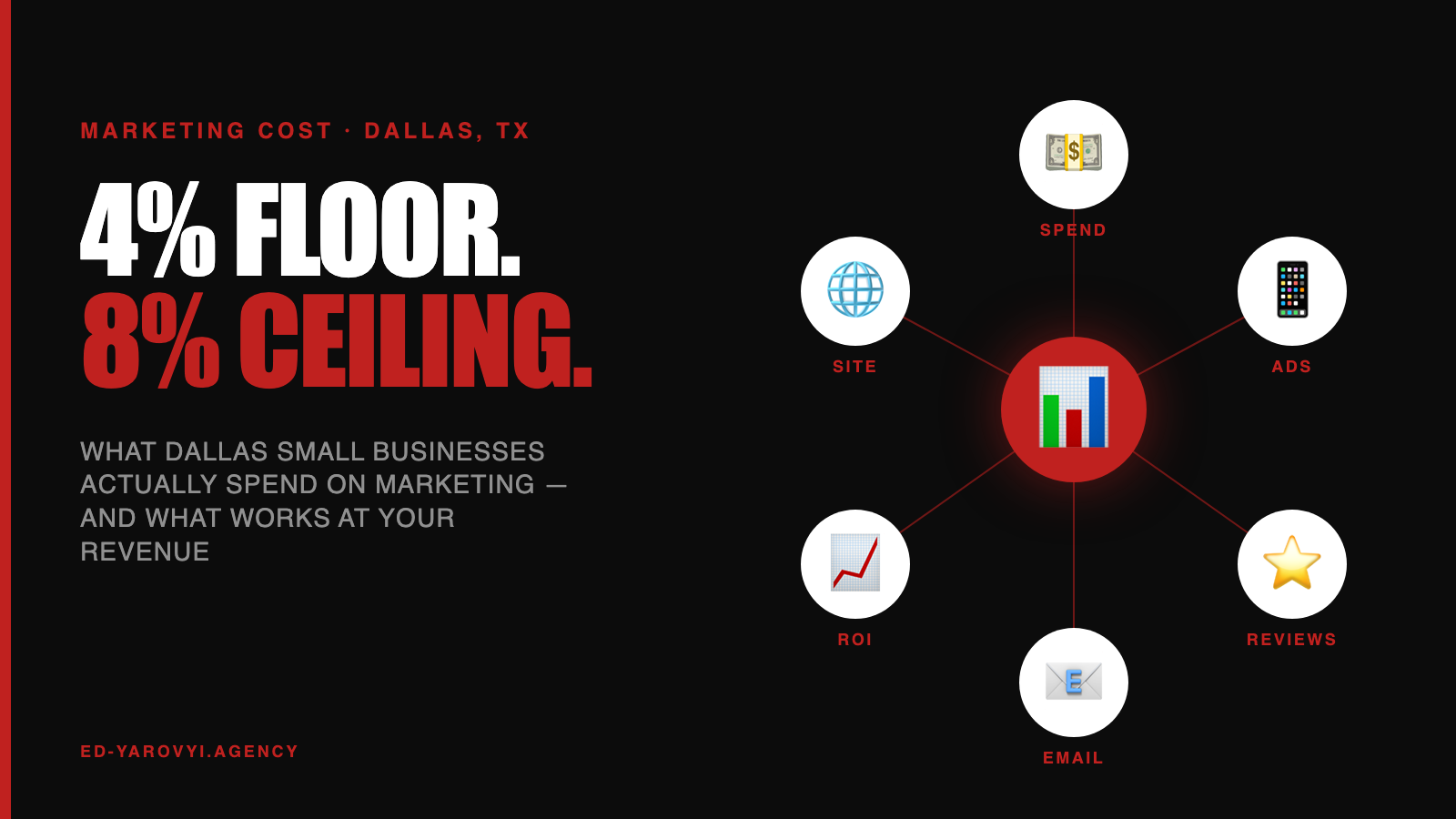
The 4–8% band holds across most small business categories in Dallas. Higher within that range for growth-mode businesses, lower for steady-state cash flow businesses. Below 4% in Dallas, you are usually under-investing and competitors are quietly winning your customers. Above 8% you are either in launch mode or you are burning capital faster than it can return.
Marketing Cost in Dallas by Channel — What Each One Actually Costs
Where the money goes inside that total budget, channel by channel.
Google Business Profile + reviews. Free if you do it yourself. $300–$900 per month if outsourced. Highest leverage per dollar of any channel in Dallas. If this is not the first channel built, the marketing cost in Dallas math is broken from the start.
Local SEO and content. $1,200–$4,500 per month. Includes keyword research, page-per-suburb-and-service content, schema markup, internal linking. Slow channel — meaningful traffic in 3–6 months — but compounds.
Website development and conversion. One-time $4,500–$18,000 build, then $200–$800 per month for ongoing maintenance and conversion optimization.
Paid search (Google Ads). $1,500–$15,000 per month in ad spend depending on category and geography. Add 10–20% management fee on top if outsourced. High-intent categories like “emergency plumber Dallas” cost $18–$45 per click in 2026; brand-aware categories run $4–$12.
Paid social (Meta / Instagram / TikTok). $800–$8,000 per month in ad spend. Generally lower cost per click than Google but lower intent, so cost per booking can be similar. Better for awareness in dense neighborhoods like Bishop Arts, Deep Ellum, Plano corporate corridors.
Email and SMS retention. $200–$1,200 per month for tools and management. The cheapest revenue lift in the stack — existing customers cost 7–12× less to retain than to acquire. According to Census Annual Business Survey data on small businesses, retention spend is among the most under-invested categories nationally, and Dallas matches that pattern.
Photography and video. $400–$2,500 per month or per-project equivalents. Underrated. A Dallas restaurant with quality menu photography outperforms one with phone snapshots by 30–60% in click-through from social to booking.
Hidden Costs Most Dallas Businesses Forget When Budgeting Marketing Cost
Four cost categories that show up after the contract is signed.
Tool stack pass-throughs. Agencies bill the cost of their software — HubSpot, Klaviyo, SEMrush, Hootsuite, reporting dashboards. $400–$1,500 per month added on top of the retainer for a Dallas mid-market agency engagement.
Ad spend management fees. 10–20% of ad spend on top of the retainer. A $10,000 monthly Google Ads budget at 15% management adds $1,500 per month. Easy to overlook when comparing two quotes.
Setup and onboarding fees. $1,500–$8,000 one-time at the start. Sometimes legitimate. Often inflated. Real audits take 8–20 hours of senior time, not 80.
Scope creep upcharges. Every “that is outside the original scope” conversation costs $200–$400 per hour of additional work. A Dallas mid-market agency engagement averages $1,500–$4,000 per quarter in unanticipated scope fees in my experience.
A friend in McKinney signed what she thought was a $6,500/month engagement. Her actual cash out the door averaged $11,200/month over the first six months once tools, ad management, and two scope creeps were added in. The contract did not lie. She did not read it carefully because the retainer number anchored her attention. The hidden layer is where marketing cost in Dallas quietly inflates.
What’s Reasonable Marketing Cost in Dallas as a Percent of Revenue
The 4–8% of revenue band is the operating principle. Underneath it are five judgment calls.
Where in 4–8% you should land depends on growth stage. Steady-state Dallas businesses (no major expansion plans, mature customer base): 4–5%. Growth-mode businesses (expanding, opening locations, entering new categories): 6–8%. Launch-mode businesses (under 18 months old): 8–12% temporarily until stable.
Category matters. Service businesses with high lifetime value (legal, medical, financial) can sustain 6–8%. Low-margin retail or food service typically lives at 4–5%. Home services with strong word-of-mouth often run lean at 3–5%.
Channel split inside the percent. A reasonable split: 35–50% to agency or consultant fees, 30–45% to ad spend, 10–15% to tools and platforms, 5–10% to content production. Skew the split based on what is broken — if your website is the bottleneck, allocate more to web. If your reviews are thin, more to retention and reputation.
Local context shapes the floor. Dallas-Fort Worth ad costs run 10–20% higher than national averages, partly because of elevated marketing talent costs in the Dallas-Plano-Irving metropolitan area. Budget at the higher end of national averages.
The right number is one that produces positive ROI within 4–9 months. If after nine months your CAC has not dropped or your monthly revenue has not climbed measurably, the percent does not matter — something else is broken. Marketing cost in Dallas is downstream of strategy. Wrong strategy at any percent burns money.
Why Dallas Marketing Costs Differ From National Averages
Three Dallas-specific factors push marketing cost in Dallas higher than published national averages.
First, talent. The DFW metro has been one of the fastest-growing job markets in the US for marketing roles since 2021. Senior marketing operators command coastal-level salaries without the coastal cost-of-living offset. That pushes agency operating costs up, which pushes pricing up.
Second, suburb density. Dallas-Plano-Frisco-McKinney-Allen-Richardson collectively form one of the densest small business clusters in Texas. More businesses chasing the same customer base means higher cost per click on paid channels and more competitive organic markets. A “dentist Plano” Google Ads cost per click in 2026 runs $14–$28; the national average for “dentist” is closer to $8–$15.
Third, no state income tax. Texas operators retain more revenue, which means more tolerance for higher marketing spend. That tolerance pulls quoted prices up across the agency landscape.
The net: budget 10–20% higher than national averages for equivalent scope, and treat that gap as the price of operating in a high-growth, high-competition metro. Trying to hit national average marketing cost in Dallas typically means under-investing relative to what the local market actually requires.
Marketing Cost in Dallas Across Specific Small Business Industries
The 4–8% rule holds at the macro level. At the industry level, the right number shifts based on margin structure, customer lifetime value, and competitive density. Six common Dallas small business categories and what their marketing cost in Dallas typically lands at in 2026.
Dental practices and medical clinics. 5–8% of revenue. Higher patient lifetime value and longer customer relationships support higher marketing investment. Most Dallas dental practices that grow steadily spend in the $4,500–$12,000 per month total range. The dental marketing Dallas piece breaks down channels and cost per new patient ranges in detail.
Home services (HVAC, plumbing, electrical, roofing). 4–7% of revenue. Emergency intent dominates so paid search runs hot. Average DFW home services business doing $1.2M spends $5,500–$8,500 per month total. Higher in storm season; lower in steady months.
Restaurants and food service. 3–5% of revenue. Lower margin means tighter marketing budget. The leverage comes from photography, reviews, and social — not paid ads. A successful Dallas restaurant doing $1.8M typically spends $4,500–$7,500 per month with photography and content production a heavy share.
Legal services. 6–9% of revenue. High lifetime value justifies higher marketing investment. Most Dallas family law and small firm operations spend $5,000–$15,000 per month split between SEO, content, and selective paid search on emergency queries.
Med spas and aesthetic services. 7–11% of revenue. Highly visual category where photography, social, and influencer collaborations carry the load. Average Frisco or Plano med spa doing $1.2M spends $7,500–$13,000 per month, with photography and video at 25–35% of that.
Niche service businesses (signage, custom fabrication, specialty trades). 4–7% of revenue. The Rival Sign Company case is a useful reference here — a veteran-owned Dallas sign shop where marketing investment skewed heavily toward website quality and craft demonstration rather than paid acquisition. Total spend ran lean because customer acquisition was relationship-driven; the marketing dollar went into proving capability, not chasing clicks.
Industry context matters more than generic averages. The 4–8% band is a starting point; the right number for any specific Dallas business depends on margin, lifetime value, and competitive structure within the category.
Five Marketing Cost Mistakes Dallas Owners Make
Patterns I see repeatedly across audited Dallas engagements.
Anchoring on the retainer. The retainer is the headline; the real number is the retainer + tools + ad management + scope creep. Always estimate 1.5×–2.5× the retainer for total monthly cost.
Spending on too many channels. Six channels run poorly burns more cash than two channels run well. Almost always pick depth over breadth on a small business marketing cost budget.
Cutting marketing first when revenue dips. Counter-intuitively, the worst time to cut is when revenue dips because that is when competitors slow too — and the businesses that stay visible during downturns gain ground that takes years to lose.
Treating cost per lead as the only metric. Cost per lead matters but lifetime value matters more. A $200 cost per lead with $4,500 lifetime value is a steal. A $40 cost per lead with $90 lifetime value is a disaster. Always pair the two numbers.
Skipping retention investment. Email and SMS retention is the cheapest revenue per dollar in the entire marketing stack and the channel most underbuilt. Existing customers cost 7–12× less to keep than to acquire. Every Dallas small business should have a retention layer before they have a paid ad layer.
Seasonal trades break this pattern hardest — the HVAC marketing Dallas breakdown shows how a summer-heavy demand curve changes where the budget should sit month to month.
Aesthetic services sit at the top of that range — med spa marketing Dallas walks through why visual production eats a third of the budget in that category.
Food service runs leanest of all the categories above — marketing for restaurants Dallas explains why photography and reviews outperform paid ads on a thin margin.
Legal services carry the highest cost per click in the metro — law firm marketing Dallas breaks the numbers down by practice area.
Agents work off gross commission rather than revenue — real estate marketing Dallas has that version of the math.
Three Marketing Agency Pricing Tiers in Dallas
The Dallas market sorts cleanly into three tiers. They are not arbitrary — they correspond to who actually does the work, how much team overhead is loaded into the bill, and what the agency can deliver.
| Tier | Monthly retainer | Who does the work | Best fit revenue |
|---|---|---|---|
| Solo / boutique | $2,500–$8,500 | Operator + 1–2 contractors | $300K–$3M/year |
| Mid-market | $8,500–$18,000 | 5–15 person team, AM model | $2M–$15M/year |
| Enterprise | $18,000–$60,000+ | 30+ person team, specialists | $10M+/year |
Solo / boutique tier ($2,500–$8,500/month). One operator or a tight team running two or three channels well. Common in Dallas for service businesses doing $300K–$3M a year. The friends I help most often sit here. The trade-off is bandwidth — solo shops cannot run six channels in parallel, so they pick the two that move revenue and skip the rest. The solo operator model sits inside this tier and is often the right fit for a Plano or Frisco business doing under $2M a year.
Mid-market tier ($8,500–$18,000/month). Real agency structure. Account manager you talk to, strategist who plans, designer who designs, media buyer who buys, junior who executes. You get throughput at the cost of layering. The person who pitched you is rarely the person doing the work three months in.
Enterprise tier ($18,000–$60,000+/month). Departmental specialists, full-service. Usually overkill for small businesses. Picks up at the level where you would otherwise hire an in-house marketing director.
Most of the marketing agency pricing in Dallas that small businesses see lives in the solo and mid-market tiers. The enterprise tier is real but is not your market unless you are doing eight figures.
Retainer or project: which pricing structure fits
What a project is best for
A project is a defined piece of work with a clear scope, deliverable, and end date. You pay for a specific outcome, and when it is delivered, the engagement is complete. It is the right structure when the need is bounded.
- A website build or redesign — a clear deliverable with a defined finish line
- A brand or messaging overhaul — a bounded piece of strategic work
- A specific campaign — a launch or seasonal push with a start and end
- A setup or audit — establishing systems or diagnosing what is wrong, handed off when done
Projects give you cost certainty and a defined result. The risk is that marketing rarely ends — a great website with no ongoing content or optimization slowly loses to competitors who keep going. A project solves a moment; it does not sustain momentum.
What a retainer is best for
A retainer is ongoing work for a recurring fee — a set amount of capacity or a defined scope delivered month after month. It is the right structure when the value comes from consistency and compounding.
- Content and SEO — these only work through steady, sustained output over months
- Social media management — consistency is the entire game, so it needs ongoing effort
- Ongoing optimization — testing and improving compound only with continuous attention
- Reputation and retention systems — reviews, email, and follow-up that run continuously
Retainers buy momentum and a partner who knows your business deeply over time. The risk is paying for capacity you do not use, or a vague scope that lets the work drift. A good retainer has clear deliverables and real reporting, not just a monthly charge for being available. The marketing agency pricing in Dallas guide covers how retainers are priced.
The hybrid that fits most small businesses
In practice, the marketing retainer vs project choice is rarely either-or. The structure that fits most small businesses is a sequence: a project to build the foundation, then a lean retainer to sustain and grow it.
- Start with a project — build the website, set up the systems, establish the foundation with cost certainty
- Transition to a retainer — sustain content, optimization, and reputation once the foundation exists
- Keep the retainer honest — defined deliverables and reporting, sized to what the business actually needs
This sequence gives you a solid start and durable momentum without overpaying at either stage. It is how I structure most engagements: build first, then run.
How to Build an Annual Marketing Budget in Dallas
Annual budgeting beats month-by-month spending in three measurable ways: cash flow visibility, channel commitment over compounding timeframes, and accountability against pre-set targets. The framework that works.
Step 1: Set the percent of revenue target. Reasonable range for established DFW small business is 4–8% of annual revenue. Growth-mode businesses run 6–11%. Steady-state cash businesses run 3–5%. Launch-mode under 18 months: 8–14% temporarily. Below 4% in competitive DFW is undermarketing relative to the local market.
Step 2: Calculate the annual dollar amount. Revenue times target percent. A $1.2M Plano business at 6% targets $72,000 for the year. A $3M McKinney business at 5% targets $150,000.
Step 3: Subtract committed costs. Tools and platforms (~$6,000–$15,000 per year for most small businesses), membership and association fees ($2,000–$8,000), event sponsorships ($3,000–$15,000 committed annually). What remains is the flexible budget for agency, ad spend, content, and production.
Step 4: Allocate the flexible budget across channels. The split varies by category and stage. Most established service businesses end up at roughly 40–50% to agency or in-house labor, 30–40% to ad spend, 10–15% to content production, 5–10% to retention systems. The marketing cost Dallas piece breaks down typical channel allocations for different DFW small business categories.
Step 5: Reserve 10% for opportunistic spend. New channel tests, unexpected production needs, scope additions, sponsorship opportunities. Budgeting at 100% with no flexibility produces constant friction and missed opportunities.
The full annual marketing budget exercise takes 3–5 hours for an owner working alone. It produces six months of clarity and saves typically 15–25% in waste over the year. The math favors the time investment substantially.
Monthly Tracking Rhythm
The annual marketing budget in Dallas only works if monthly tracking keeps it honest. The discipline that holds.
First Monday of each month: budget vs actual review. 30 minutes to compare planned spend versus actual spend across all eight categories. Variances above 10% in any category get investigated.
Mid-month: channel performance review. 60 minutes to pull cost per acquisition, conversion rates, and channel-specific revenue contribution. The marketing performance audit framework runs in 5–10 hours quarterly; monthly checks are a lighter version of the same process.
End of month: forward-looking adjustments. 30 minutes to decide whether the next month’s allocation needs adjustment based on what the data shows. Most months, no adjustment is needed. Months that need adjustment usually need it badly.
Quarterly: deeper review and reforecast. 2–3 hours to look at trailing-90-day performance, project forward to year-end, and adjust the annual marketing budget plan if the trajectory has shifted. Most annual budgets need 1–2 mid-year revisions; planning for revisions beats pretending the original plan was perfect.
Total time investment for monthly tracking: roughly 2 hours per month. For a $72,000 annual marketing budget, that is $36 per hour of effective oversight cost. The math favors the discipline by a wide margin.
When to Adjust the Marketing Budget Mid-Year
Five conditions that justify mid-year budget changes.
A channel is producing at 2x expected ROI. Double down. Reallocate 15–25% from underperforming channels.
A channel has produced no measurable revenue in 90 days when it should have. Cut budget by 50% for the next 30 days and diagnose. If still no signal at day 120, cut entirely and reallocate.
A new competitor entered your local market. Often requires temporary budget increase to maintain visibility. 15–25% temporary lift for 90 days; then reassess.
A new service or location launched. Launch campaigns require their own budget allocation, not a generic budget pull. The digital marketing agency McKinney piece walks through how launch engagements differ from steady-state engagements.
Revenue exceeded or missed annual plan by 15%+. Marketing budget in Dallas should scale with revenue. A business outperforming revenue plan should reinvest some of the upside into marketing for the following year; a business underperforming should hold marketing steady or cut by 5–10% without panicking.
How much should a small business spend on marketing cost in Dallas in 2026?
The reasonable band is 4–8% of annual revenue for an established Dallas small business. Steady-state businesses run 4–5%, growth-mode businesses 6–8%, launch-mode businesses 8–12% temporarily. Below 4% in Dallas usually means under-investing relative to local competitive density.
What is the real total marketing cost in Dallas after hidden fees?
Real total marketing cost in Dallas typically runs 1.5×–2.5× the agency retainer once tools, ad spend management, setup fees, and scope creep are added in. A $5,000 retainer commonly becomes $9,000–$12,000 total monthly cost. Always ask up front which tools and fees are included versus billed separately.
Is marketing cost in Dallas higher than national averages?
Yes, modestly — 10–20% higher than published national averages for equivalent scope in 2026. Three factors drive it: higher local marketing talent costs, dense competition across DFW suburbs, and Texas’s no-state-income-tax structure that gives operators more spending tolerance. Budget at the higher end of national averages.
What channels should I prioritize when budgeting marketing cost Dallas?
Google Business Profile and reviews first — highest free leverage. Local SEO and website conversion second. Paid search third, only after the first three are healthy. Email and SMS retention is the cheapest revenue per dollar and should be built before paid social or video. Skip channels that do not move revenue within 90 days.
How do I know if my marketing cost in Dallas is producing returns?
Track cost per acquisition, lifetime value, and revenue growth month over month. A reasonable target is cost per acquisition below 25% of lifetime value within 9 months. If after 9 months CAC has not dropped and revenue has not climbed measurably, the percent of revenue you are spending does not matter — strategy is broken somewhere.
Can I do my own marketing to lower marketing cost in Dallas?
Yes for basics — Google Business Profile, review requests, simple email automation. Most Dallas owners do not have time to do it consistently, which is when an agency or solo marketing consultant helps. The cost is the same whether you pay in dollars or in your own hours; the question is which trade-off makes more sense for your business stage.
What is the cheapest effective marketing for a Dallas small business?
Google Business Profile optimization, review velocity, and email retention. Combined cost can stay under $500 per month if managed in-house and produces measurable lift within 60–90 days. Most Dallas businesses skip this layer and jump to paid ads, which is the most expensive marketing cost mistake.