A friend of mine in Plano spent eight months and $112,000 with a mid-market marketing agency, ended up with a brand book and three campaigns that did not move revenue. She fired the agency, hired a fractional CMO at $7,000 a month, and three months later had the strategy clarity she had been paying $14,000 a month for. Her conclusion: she had hired the wrong shape for her problem, not the wrong agency.
The fractional CMO vs agency question gets asked weekly by Dallas and DFW small business owners. Wrong shape is the most expensive marketing mistake I see in 2026. This piece is what each role actually is, what each costs, where each wins, and how to tell which one your business needs right now — versus what a salesperson on either side will tell you.
What a Fractional CMO Actually Is in 2026
A fractional CMO is a senior marketing leader working with you part-time — typically 8 to 25 hours a week, usually on a 3 to 12 month engagement. Their job is decision-making at the executive level: market positioning, channel strategy, budget allocation, hiring marketing staff, choosing vendors, defining metrics. They do not execute campaigns. They decide which campaigns get run and who runs them.
The role originated in the startup world and crossed over into established small business in the 2020s. In Dallas in 2026, fractional CMOs serve mid-sized businesses doing $1.5M–$25M in revenue that need senior marketing leadership but cannot justify a $200K+ full-time CMO hire. Compensation typically lands at $4,000–$14,000 per month depending on hours and seniority.
What a fractional CMO does in a typical month:
- Weekly strategy call with the operator or executive team
- Quarterly planning and budget allocation review
- Vendor selection — choosing agencies, freelancers, tools
- Hiring marketing staff (in-house or contract)
- Defining metrics and reporting structure
- Holding everyone accountable to numbers, not activity
What a fractional CMO does NOT do: write copy, design assets, build websites, run ads, post on social media, send emails. Execution is delegated to staff, freelancers, or agencies under their direction. That distinction matters.
What a Marketing Agency Actually Is
A marketing agency is a team that executes campaigns across one or more channels. The team typically has an account manager, a strategist, a designer, a media buyer, and one or more juniors. You pay for layered execution capacity — multiple campaigns running in parallel with designed assets, weekly reports, and the cycle time of a real team.
The trade-off is the same one I covered in marketing agency pricing in Dallas — the person you sell to in the pitch is rarely the person doing your work three months in. Strategy from a marketing agency tends to be channel-tactical: “here is how we will run your Google Ads, here is the social calendar, here is the email cadence.” Strategic in the day-to-day sense, not in the boardroom sense.
A solid agency does these things well:
- Channel execution at scale (multiple campaigns in parallel)
- Asset production (design, copy, video, photography)
- Paid media management (Google Ads, Meta, programmatic)
- SEO and content production at volume
- Reporting dashboards and weekly account management
What a real agency does NOT do well: cross-channel strategic decisions, vendor selection beyond their own services, building an internal marketing team, talking to your CFO about marketing spend as a percent of revenue. Those are executive-level decisions and they sit outside the agency scope.
Fractional CMO vs Agency — Cost Breakdown
Real numbers from Dallas, Plano, and Frisco engagements in 2025–2026.
| Role | Monthly cost | Hours per month | Best fit revenue |
|---|---|---|---|
| Fractional CMO | $4,000–$14,000 | 30–100 | $1.5M–$25M |
| Solo / boutique agency | $2,500–$8,500 | 40–120 (team) | $300K–$3M |
| Mid-market agency | $8,500–$20,000 | 80–250 (team) | $2.5M–$15M |
| Full-time CMO | $16,000–$28,000 | 160+ | $15M+ |
According to the Bureau of Labor Statistics data on advertising and marketing managers, the median annual wage for marketing managers nationally clears $156,000 — and senior CMO-level roles run well above that. Census SUSB data on small business employment shows that the overwhelming majority of US small businesses (under 100 employees) cannot justify a full-time senior marketing leader — which is exactly the gap fractional CMO arrangements fill. A Dallas small business gets access to that seniority for a fraction of the full-time cost, paid as a monthly engagement fee. That math is the entire reason the fractional CMO vs agency conversation exists.
The cost comparison is misleading on its own, though. You almost never get to pick “fractional CMO OR agency” cleanly. The realistic comparison is “fractional CMO managing an agency” versus “no fractional CMO and you manage the agency yourself.” That changes the math.
Which Channels Each Handles Better
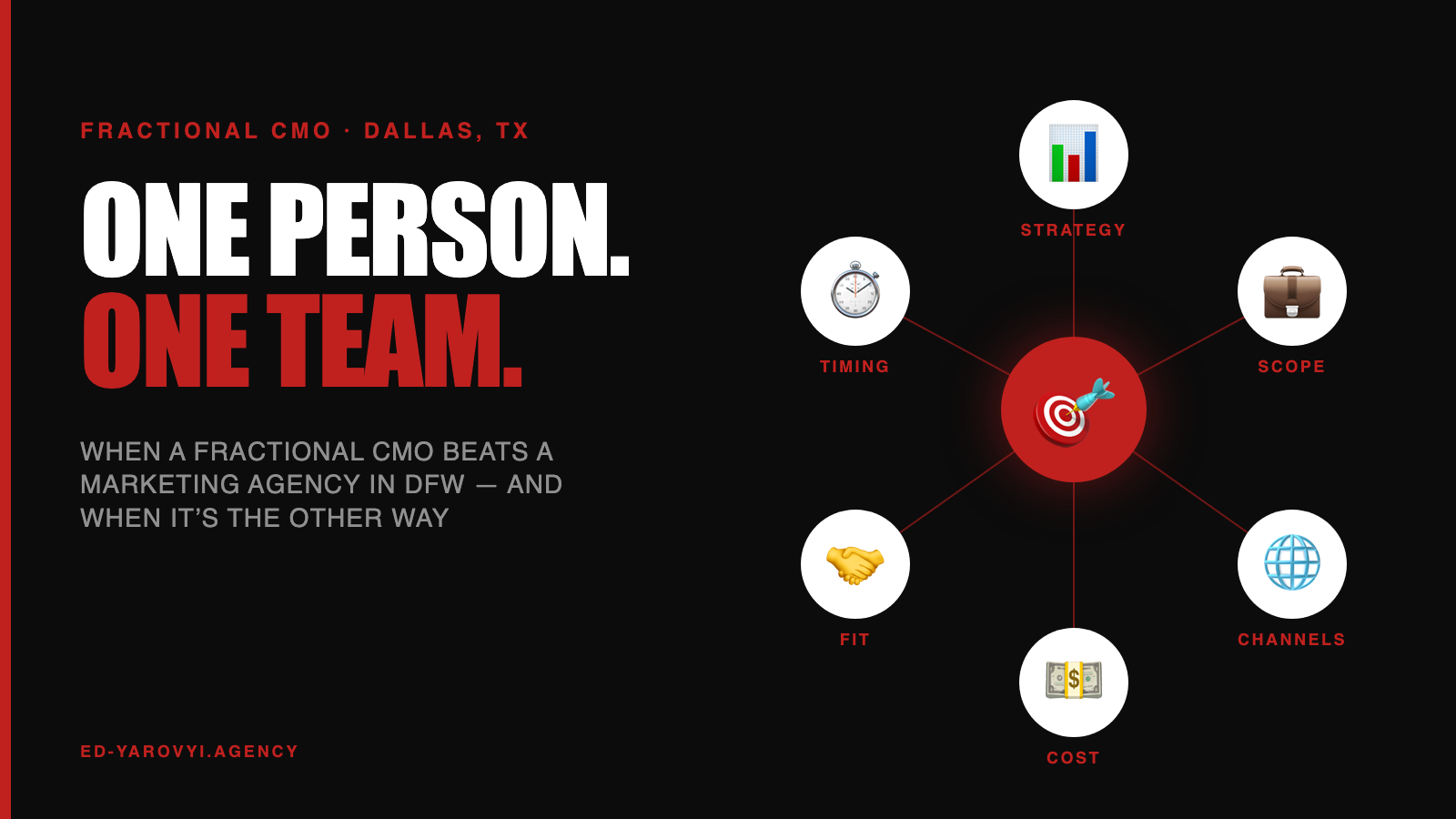
The fractional CMO vs agency choice is rarely about which one is “better” — it is about which layer of the work needs the help.
Marketing agencies are better at: high-volume content production, paid media at scale, designed campaigns, ongoing channel execution, weekly performance reporting. If you need 80 blog posts a quarter, an agency outproduces a fractional CMO by an order of magnitude. They have the team. The CMO does not.
Fractional CMOs are better at: deciding which channels to invest in, defining what “winning” means in numbers, hiring and firing vendors, building an internal team, presenting marketing strategy to investors or a board, integrating marketing with sales and operations. These are strategic decisions, not execution tasks.
The mistake I see most: a $1.8M Plano business hires a $12,000/month agency hoping the agency will provide strategy. Three months in, the operator realizes the agency is executing tactics but not actually directing the business toward a clearer market position. The strategy gap was an executive gap, not an execution gap. A $6,000 fractional CMO arrangement would have closed it; a $12,000 agency cannot, because that is not what agencies do. The La Bare Dallas content engine work is a useful counterpoint — there, the strategic direction was clear from day one and execution capacity was the real bottleneck, so agency-style throughput was the right tool.
The reverse mistake is also common. A $4M Frisco business hires a $9,000/month fractional CMO and expects the CMO to write the email sequences and run the Google Ads. The CMO sets strategy and delegates — but if there is no agency or staff to delegate TO, nothing gets executed. The CMO is not the bottleneck; the missing execution layer is.
When a Fractional CMO Makes Sense
Five signs you need a fractional CMO, not an agency.
Revenue between $1.5M and $25M. Below $1.5M you usually cannot afford a fractional CMO and the strategic complexity is low enough that the operator can decide channels themselves. Above $25M you should hire full-time. The fractional band is real but narrow.
Marketing is your bottleneck, not execution capacity. If you have a website, a CRM, some ads running, content getting published — and you still cannot tell whether marketing is working or which channel to invest in next — you have a strategy gap. Fractional CMO solves it. Adding another agency does not.
You have one or more agencies or freelancers and they need direction. A fractional CMO can manage three vendors who each handle one channel, ensuring they roll up to a coherent strategy. Without that direction, vendors optimize their own metrics and your overall growth stalls.
You are about to raise capital, sell the business, or expand to a new market. These transitions need executive-level marketing thinking that agencies cannot provide because they do not sit at the executive table. Fractional CMO is the right hire here.
Your team needs to grow but you do not know what to hire. A fractional CMO will spend the first 60 days mapping which marketing roles you actually need, then either hire them as employees or contract them as fractional specialists. This is hiring strategy, not execution.
When a Marketing Agency Makes Sense
Equally five clear signs an agency beats a fractional CMO.
Revenue under $1.5M and you need execution, not strategy. A solo / boutique agency executing two or three channels is the right fit. The strategic complexity at this scale is manageable by the operator with light advisory help — see the marketing consultant in Plano piece for the consultant version of this.
You have a clear strategy and need throughput. “We need 60 blog posts targeting these 12 long-tail keywords over the next two quarters” is an agency job. A fractional CMO would direct an agency to do this; they would not do it themselves.
You need creative production volume. Photo shoots, video, polished design assets, full campaign rollouts. Agencies have production teams. Fractional CMOs do not.
You need paid media managed at scale. $20K+/month in ad spend across Google, Meta, and programmatic — that needs a media buyer and an optimization cycle that runs daily. Agencies run this; CMOs direct it.
The operator is already strategic and just needs hands. Some Dallas small business owners are exceptional marketers themselves. They do not need a CMO; they need execution. Agency wins.
When You Need Both — The Hybrid That Works
The most common honest answer to “fractional CMO vs agency” in DFW small business is: both, layered. The fractional CMO sets direction and chooses the agency. The agency executes. Total cost lands in the $8,000–$18,000 per month range depending on agency tier — comparable to a single mid-market agency engagement, but with a strategy layer the agency alone cannot provide.
I have watched this hybrid work in three different DFW contexts: a Plano medical group that needed three locations rolled out under one brand, a Frisco home services company growing past $3M and not knowing what to do next, and a Dallas legal practice splitting B2C and B2B marketing tracks. In each case, fractional CMO + focused agency outperformed agency-alone within six months.
The hybrid does not always work. If you cannot afford both, pick fractional CMO and use freelancers for execution — slower but cheaper. Or pick agency and accept that your strategy will be channel-level, not executive-level. The full filter for hiring outside help in either direction sits in how to choose a marketing agency in Dallas.
What is the main difference between a fractional CMO vs agency?
A fractional CMO is a senior marketing leader making executive-level decisions part-time — strategy, budget allocation, vendor selection, hiring. A marketing agency is a team that executes campaigns across channels. The CMO decides what gets done; the agency does it. Mixing the two roles is the most common cause of overpaying for the wrong shape of marketing help.
How much does a fractional CMO cost in Dallas in 2026?
$4,000–$14,000 per month for 30–100 hours of senior marketing leadership. Senior fractional CMOs with deep operational experience price toward the top of the range. Compared to a full-time Dallas CMO at $16,000–$28,000 per month plus benefits, the fractional arrangement is roughly 60–70% cheaper for similar strategic input.
Can a fractional CMO replace a marketing agency entirely?
No, because a fractional CMO does not execute. They will identify which campaigns to run but they will not run them. You still need execution capacity — agency, in-house team, or freelancers. The CMO is the strategy layer; the agency or staff is the execution layer.
What revenue range justifies a fractional CMO over an agency?
Roughly $1.5M–$25M annual revenue is the band where fractional CMO makes the most sense. Below $1.5M, strategic complexity is usually manageable by the operator with consultant or boutique agency support. Above $25M, full-time CMO becomes more cost-effective. In between is the fractional sweet spot.
How long should a fractional CMO engagement run?
Three months minimum to establish baseline metrics and strategy. Most working engagements run 6–18 months. Beyond 18 months either convert to full-time or transition to lighter advisory because the foundational work is done. Short engagements under 90 days rarely deliver lasting impact.
Should I hire a fractional CMO or a marketing consultant?
Marketing consultant for businesses under $1.5M revenue or for project-based engagements. Fractional CMO for businesses $1.5M+ needing ongoing senior leadership. The roles overlap but a fractional CMO carries more executive responsibility — vendor hiring, team building, board reporting — that a consultant typically does not.
Can I run a fractional CMO and a marketing agency at the same time?
Yes — this is the most common working setup for $2M–$15M Dallas businesses. The CMO sets direction and selects or manages the agency. The agency executes within that direction. Combined monthly cost lands in the $8,000–$18,000 range, comparable to a single mid-market agency engagement but with proper strategic oversight.