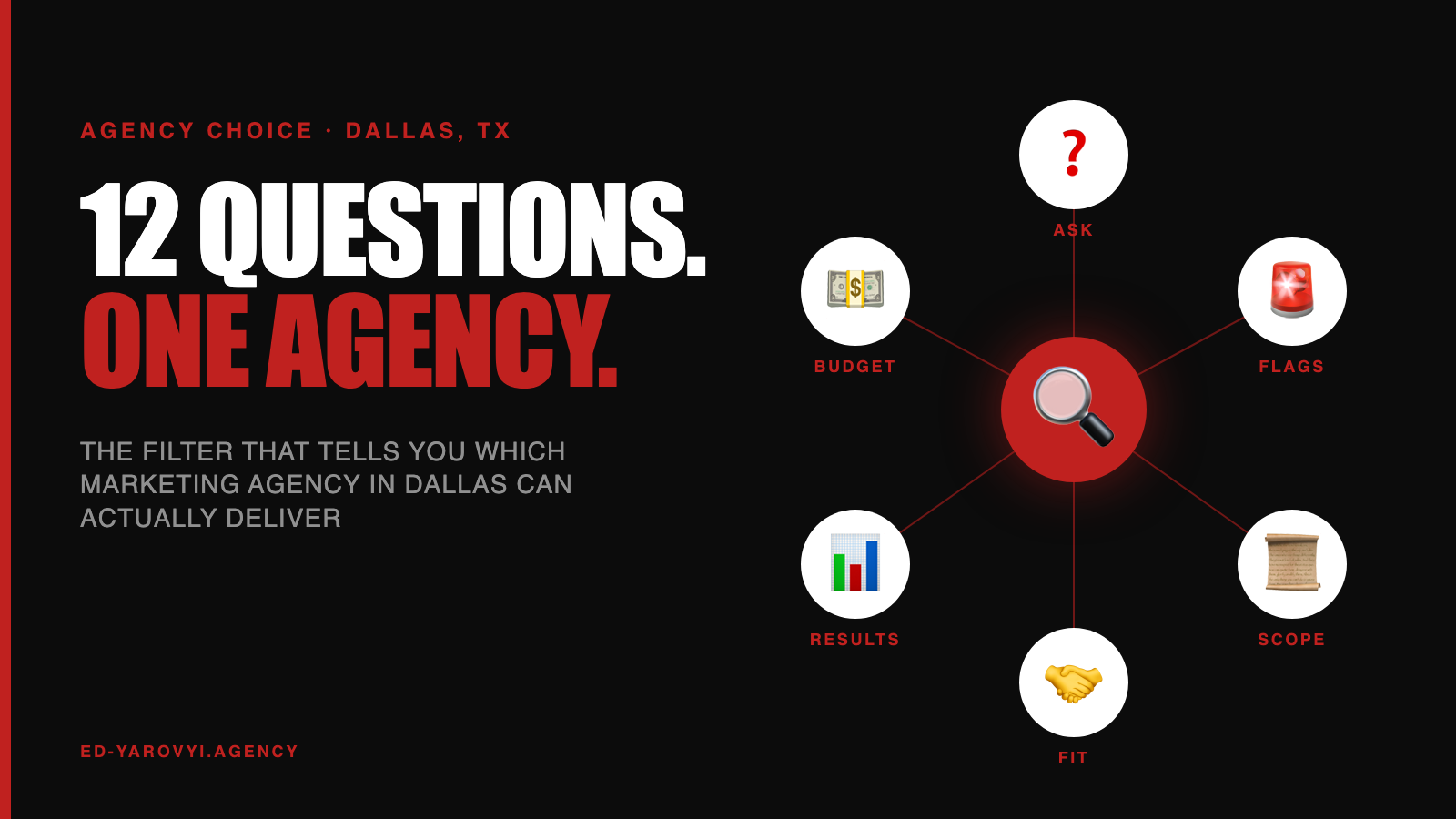
How to choose marketing agency Dallas businesses can actually trust is one of the most expensive decisions a small business owner makes. The wrong agency burns $30,000 to $80,000 of budget before you realize it. The right one becomes the operating partner that helps the business grow. Furthermore, the difference between them is not visible in the sales pitch. It is visible in the questions you ask before signing.
These are the 12 questions that surface the truth. Most agency sales reps have not been asked them. Therefore, the ones who have good answers are the ones worth hiring. According to the U.S. Bureau of Labor Statistics, marketing services employ over 600,000 people nationally — which means the choice you are making is from a vast and uneven pool of providers. As a result, learning how to choose marketing agency Dallas providers correctly saves more money than any tactical decision after.
The 12 questions in figuring out how to choose marketing agency Dallas owners regret missing
1. “What specifically will you do in the first 30 days?”
If the answer is “we will do discovery and develop a strategy,” walk away. Discovery should not be a paid month. By the time you are signing, the agency should know your industry, your competitors, and your immediate execution priorities. The 30-day plan should be a list of deliverables with dates — not a research phase.
2. “Show me three current clients of similar size to mine.”
Not testimonials. Not case studies on the website. Current clients you can call. If they do not have three at your revenue tier, you are either too small or too big for them. Both are bad fits when learning how to choose marketing agency Dallas providers worth keeping.
3. “Who specifically will be doing the work on my account?”
The most common pattern in Dallas agencies: senior people sell the contract, junior people execute. Ask for names, titles, and how long they have been with the agency. If the answer is vague — “our team” — assume the work goes to whoever has bandwidth, including contractors offshore.
4. “What does your reporting look like, and can I see a sample?”
Good reports are short, outcome-focused, and tell you what they changed and why. By contrast, bad reports are 30 pages of Google Analytics screenshots with no narrative. If they cannot show you a sample report, they do not have a reporting habit. They have a screenshot habit.
Related reading: the Rival Sign Company case shows what operator-led work looks like outside the agency model, red flags marketing agency walks through the contract and reporting patterns to watch for, and marketing agency pricing in Dallas covers the tier breakdown.
Before picking a specific agency, it is worth deciding which shape of help you need at all — marketing help Dallas compares agency, freelancer, and consultant side by side.
Once the contract is signed, what to expect from a marketing agency sets the month-by-month benchmarks for the first 90 days.
Before hiring anyone, it helps to understand why small business marketing fails — most problems are not the agency, they are the setup.
A monthly report should fit on one page and answer three questions: What did we do? What worked? What is next?
5. “What’s your contract term and exit clause?”
Any agency in Dallas asking for a 12-month upfront contract is hedging against their own work not being good enough to earn a renewal. Healthy options: month-to-month, 90-day initial term, or 6 months with a 30-day exit clause. Anything that locks you in for a year before they have shown results is the agency protecting itself at your expense.
6. “How do you handle a client who’s underperforming on their end?”
Marketing fails when the agency does great work but the client does not respond to leads, does not supply photos, does not approve content in time. A good agency has a process for this — accountability check-ins, content stockpiling, deadline enforcement. By contrast, a bad agency will just keep collecting the retainer while the work stops mattering.
7. “What do you not do, and why?”
An agency that does “everything” usually does nothing well. Ask what they actively turn down. Good answers: “We do not do paid ads under $3,000 per month because the ROI does not work” or “We do not do client work in industries we do not already understand.” Bad answer: a long list of capabilities they will happily bill you for.
8. “What’s your average client tenure?”
Industry average is roughly 12 to 18 months. If they say “most of our clients stay 5+ years,” they are probably doing minimal work for legacy retainers. If they say “6 months,” they are losing clients who did not see results. The healthy range is 18 to 36 months — long enough to mean the work compounds, short enough that real evaluations happen.
9. “How will I know if it’s working?”
The right answer is a specific list of metrics tied to your business goals. Not “engagement,” not “brand awareness.” Things like: “We will track form fills, attributed revenue, and email list growth, and we will know within 90 days if the engagement is producing pipeline.” If they cannot answer this in concrete terms, neither of you will know.
10. “What happens if we want to leave?”
Ask specifically: do you keep the content we paid for? Do we get access to our own analytics and ad accounts? Do we own our website code? A surprising number of Dallas agencies own the work product and keep clients locked in by ownership of assets. The right answer is “everything is yours, and we will do a clean handoff.”
Get clarity in writing on: website code, content library, ad accounts, social accounts, analytics, and email list. If any of these are not explicitly yours, walk away. This is the single most overlooked piece in how to choose marketing agency Dallas providers.
11. “What’s the worst engagement you’ve ended?”
An agency that says “we have never had a bad client” is either lying or has not worked with enough clients to learn. A good agency will tell you about a specific situation where things did not work, what they learned, and how they handle it now. This is the single best signal of operational maturity.
12. “If I were starting from zero today, what would you do first?”
This question reveals whether they actually understand priority. A weak agency answers with “we would start a content calendar.” A strong one answers with something specific to your business: “First, fix your Google Business Profile and reservation flow. Without those, nothing else works for you.” That kind of specificity is the giveaway in how to choose marketing agency Dallas providers worth a long-term contract.
Red flags during the sales process
Some patterns signal a bad agency before you even get to the contract. According to FTC advertising guidelines, transparency in marketing claims is required by law — yet many agencies still bend these rules in their own sales pitches. Watch for these specific patterns.
Six red flags to spot during agency sales calls
- The first call is 90 percent them pitching — should be 80 percent them asking about you
- They promise specific results — “We will get you 100 leads a month” — without seeing your business
- They show competitor screenshots as their work — “We did this for [name]” without proof
- The contract has auto-renewal clauses buried in section 14
- Pricing is opaque — “It depends” when you ask for ballpark
- Their own marketing is bad — slow website, dead social accounts, generic copy. If they cannot market themselves, they cannot market you.
What “fit” actually means and how to test it
“Fit” gets tossed around as a vague qualifier. In practice, fit comes down to three concrete things that determine how to choose marketing agency Dallas providers who match your actual business tempo.
The three concrete components of agency fit
- Communication cadence matches yours — if you want weekly check-ins and they default to monthly, that is a constant source of friction
- Response time is acceptable — most agencies promise 24 hours; the ones who actually deliver in 4 hours are noticeably different to work with
- Their decision speed matches your tempo — if your business moves fast and they need 7 days to approve a creative direction, they will slow you down
Test fit by sending one realistic email during the sales process — a question, an edit request, a hypothetical scenario. How long they take to respond, and the substance of the response, is a better predictor of the actual relationship than any pitch deck.
“How they handle the sales process is how they will handle the work.”
FAQ
What’s the most important question in how to choose a marketing agency in Dallas?
“What specifically will you do in the first 30 days?” If the answer is vague or labeled as a “discovery phase,” that is a sign the agency has not actually planned for your business. The right agency walks in with a 30-day execution plan as part of the sales process.
How long should a marketing agency contract in Dallas last?
Start with 90 days or month-to-month. Once results are visible (typically 60 to 120 days in), extend to 6 to 12 months if the work is producing returns. Twelve-month upfront contracts from a new agency relationship are the single most common cause of regret among small business owners in Dallas.
Should I get multiple quotes before choosing an agency?
Yes — three minimum, from different tiers (boutique, mid, enterprise if relevant). The price spread is informative even if you do not hire the cheapest. Cheap agencies often skip strategic work. Expensive agencies often charge for overhead you do not need. The middle option usually wins.
What red flags should I watch for in how to choose marketing agency Dallas providers?
The agency that aggressively pitches “ad spend management” before understanding whether you should run ads at all. Ad management fees compound, ad spend compounds, and an agency incentivized by both has no reason to tell you “you do not need ads yet.” For most small businesses in Dallas, organic and retention come first; paid ads later or never.
Do agencies in Dallas charge differently than elsewhere?
Dallas pricing sits in the middle of major US markets — higher than Memphis or Oklahoma City, lower than New York or San Francisco. Plano and the corporate-corridor suburbs run slightly above Dallas-proper. Expect $2,500 to $8,500 for a full SMB retainer in Dallas, and $3,000 to $10,000 in Plano or Frisco.
What if the agency’s portfolio looks great but the reviews are mixed?
Trust the reviews. Portfolios are curated highlights. Reviews are unfiltered current and former clients describing how it actually was to work with them. If reviews mention response delays, surprise charges, or hard-to-reach account managers — those will be your experience too.