Every few years marketing gets a new acronym and a new round of people selling it. Right now it’s GEO. Some will tell you SEO is dead and you need a GEO strategy by Monday. Others will tell you GEO is just SEO in a new jacket. Both camps are partly right, which is the most annoying kind of answer, so let me be specific.
I pulled 56 questions people type into Google, Bing and DuckDuckGo about generative engine optimization. The biggest cluster was some version of “GEO vs SEO,” followed by AEO, AIO and “what does it even mean.” Here are the ten questions that matter, answered for a business owner, not a conference panel.
- What’s the difference between GEO and SEO?
- What does generative engine optimization mean?
- GEO vs SEO vs AEO: what is AEO?
- What is AIO, and how is it different from GEO?
- Is GEO replacing SEO?
- How does generative engine optimization work?
- Does a small business need a GEO strategy separate from SEO?
- What is generative engine marketing?
- Why does GEO matter if AI search is still small?
- What does Reddit get right about GEO vs SEO?
What’s the difference between GEO and SEO?
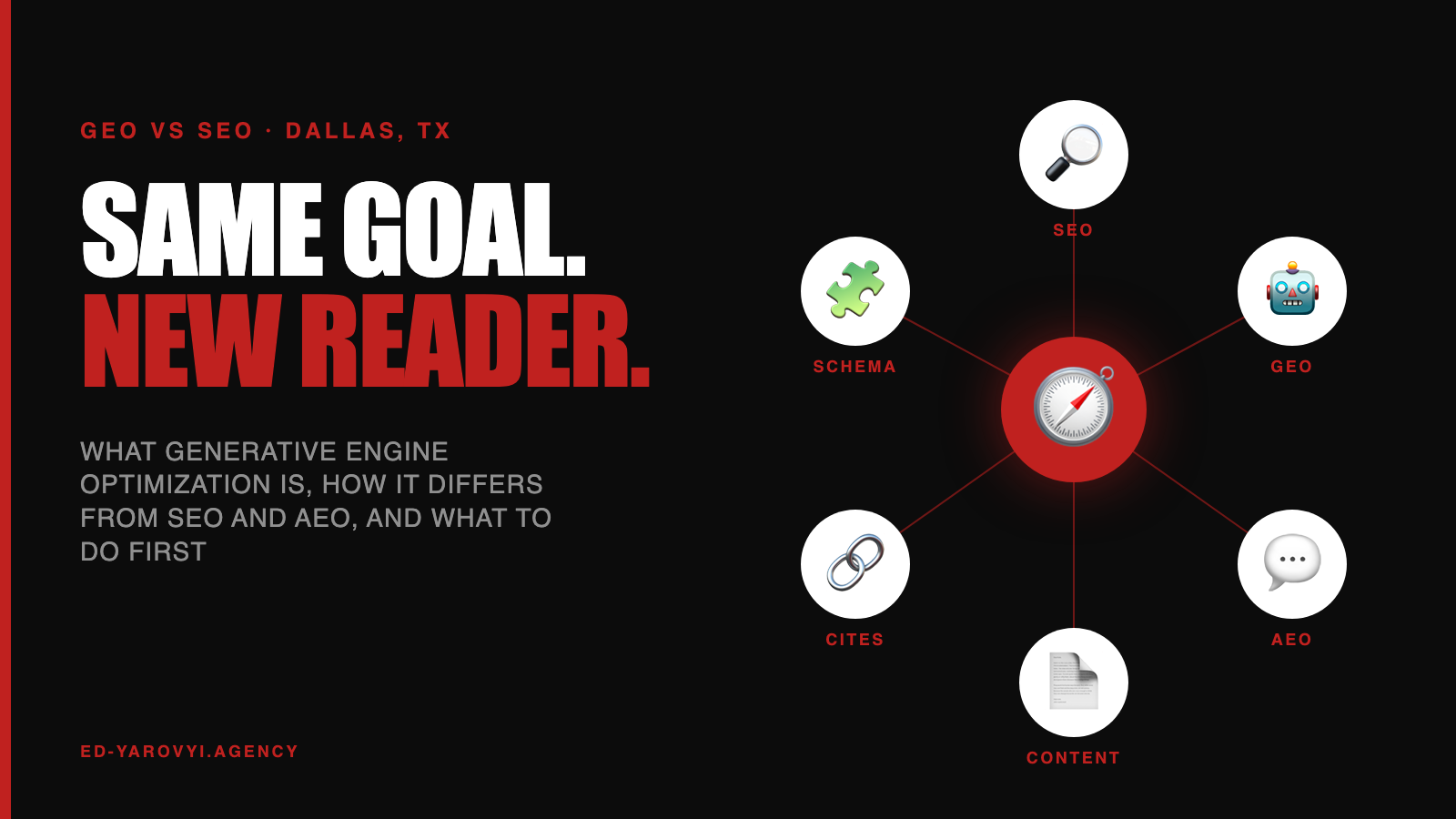
Short answer: SEO aims to get your page ranked as a link in search results. GEO aims to get your business quoted, cited or named inside an AI-written answer from tools like ChatGPT, Perplexity, Gemini or Google’s AI Overviews. Same goal, getting found by people with a question; different reader, a machine summarizing for them.
In practice most of the work overlaps. AI tools build answers by searching the web and reading pages, so a page that can’t be found by search engines rarely gets quoted by AI either.
The difference shows up in how you write. SEO-era pages often buried the answer under a long intro. Pages that get quoted by AI answer early, clearly and specifically, so the model can lift a sentence and trust it.
What does generative engine optimization mean?
Short answer: Generative engine optimization means shaping your content and online presence so that generative AI systems, the ones that write answers instead of listing links, understand your business correctly and include it when it’s relevant. “Generative engine” is just the name for an AI that generates an answer.
The term came out of academic research around 2023 and spread fast through marketing. The concept underneath is simple. When someone asks an AI “who should I hire for this in Dallas,” you want the answer to include you, describe you accurately, and ideally link to your site.
I explain how I approach it for local businesses on my generative engine optimization page.
GEO vs SEO vs AEO: what is AEO?
Short answer: AEO stands for answer engine optimization. It started with featured snippets and voice assistants, where one answer gets read out or shown above the results. AEO focuses on formatting content as direct answers to specific questions. GEO grew out of the same idea, applied to AI tools that write longer answers.
If AEO and GEO sound similar, that’s because they are. Both reward pages that state a clear answer to a clear question. AEO is the older term from the snippet and voice-search era. GEO is the newer term for the AI-answer era.
For a small business, the practical advice for both is the same, so don’t pay twice for two acronyms.
What is AIO, and how is it different from GEO?
Short answer: AIO is used loosely. Some people mean “AI optimization” in general, others mean optimizing for Google’s AI Overviews specifically. Either way it describes the same family of work as GEO: being visible and accurately represented when AI summarizes the web for someone.
When a vendor pitches AIO, GEO, AEO and SEO as four separate services, ask what actually changes in the work. Usually the answer is: better service pages, clearer answers, structured data, stronger reviews and more mentions on other sites. That’s one job with four names.
When someone sells you a new acronym, ask them to name three things they’ll do differently from good SEO. If the list is “write clear answers, add structured data, earn mentions,” that’s good SEO. You’re paying for the label.
Is GEO replacing SEO?
Short answer: Not replacing, extending. Traditional search still sends most website traffic for most small businesses, and AI tools rely on search indexes to find what they quote. What’s changing is that more questions get answered before anyone clicks, so being the cited source matters more than it used to.
My honest read is that clicks from simple informational questions will keep shrinking, because AI answers them directly. Clicks for things people actually hire, buy or book will stick around longer, because people still want to see the company before calling.
So protect your service pages, your reviews and your reputation first. That’s where the money is in both worlds.
How does generative engine optimization work?
Short answer: When someone asks an AI tool a question, it often searches the web, reads several sources, and writes a summary with citations. GEO works by making your pages easy to find, easy to understand and easy to quote, and by making sure other trustworthy sites say consistent things about your business.
There are three levers. First, findability: your pages are crawlable and indexed by the search engines AI tools rely on. Second, clarity: each page answers a specific question with specifics like prices, locations, timelines and names.
Third, corroboration: reviews, directories, local press and partner sites that back up what you claim. AI systems lean toward claims they can confirm in more than one place.
Does a small business need a GEO strategy separate from SEO?
Short answer: Usually no. A small business needs one strategy: be the clearest, most trustworthy answer to the questions your customers ask, in your area. Write it once on your website, back it up with reviews and mentions, and both search engines and AI tools benefit.
Where I’d add a GEO angle is in how pages are written and checked. I write service pages so each section starts with a direct answer, I add structured data that labels the business and its services, and I check monthly what AI tools say about a friend’s business compared to competitors.
That’s an extra hour a month, not a separate retainer.
What is generative engine marketing?
Short answer: It’s a looser term for marketing aimed at AI-driven discovery overall. It can mean GEO itself, paid placements inside AI products where they exist, or creating content designed to be picked up by AI tools. When someone uses it, ask which of those they mean, because the costs and tactics are very different.
Paid placements in AI tools are still young and vary by platform. Organic visibility in AI answers can’t be bought directly; it’s earned through the same clarity and reputation work described above.
If a proposal mixes the two without saying which is which, push back until it’s clear.
Why does GEO matter if AI search is still small?
Short answer: Because the people using AI search for buying decisions tend to be researching seriously, and the answer they get often names only a few businesses. Being one of them is worth more than a click from a casual search. And the work that earns AI mentions also strengthens your regular search visibility, so it pays off either way.
You don’t need to bet the business on AI search. You need to make sure that when a customer asks, the AI says something true and good about you. When friends ask me whether this is worth their time, I show them what ChatGPT currently says about their business. That usually settles it.
Right now many local businesses get described with old hours, wrong services or not at all. Fixing that costs little and protects you as usage grows.
What does Reddit get right about GEO vs SEO?
Short answer: The common Reddit take is that GEO is mostly SEO rebranded, and that’s largely fair. Where it falls short is ignoring how much the format of answers has changed: being quoted inside an answer rewards different writing habits than ranking a link, especially direct answers and verifiable specifics.
Here’s my hot take: the acronym doesn’t matter, the habit does. Write every important page as if someone will quote one paragraph of it to a customer who never visits your site. If that paragraph would still be accurate, specific and good for your business, you’re doing GEO and SEO at the same time.
If you only change one habit after reading this, change how your pages start. Put the answer first, make it specific to your business and your area, and back it up with proof. For the practical steps on showing up in ChatGPT specifically, read how to rank in ChatGPT, and for the content side, my content marketing system covers how to produce pages like this consistently.
Is GEO just a buzzword?
Partly. The label is new and overused, but the shift is real: more people get answers from AI tools before they click anything. The useful part of GEO is the habit of writing clear, quotable, verifiable pages, which is good practice anyway.
How do I know if AI tools mention my business?
Ask them the way your customers would, in a fresh chat, and keep a monthly log of which businesses get named and which pages get cited. Compare results across ChatGPT, Perplexity, Gemini and Google’s AI Mode.
Does structured data help with GEO?
It helps machines read your business correctly: type of business, location, services, hours, reviews. It isn’t a magic switch for AI mentions, but it removes ambiguity, and that matters when an AI is deciding what’s true about you.
Should I rewrite my whole website for GEO?
No. Start with your most important service pages. Make each one answer its main question in the first few sentences, add specifics and proof, and fix inconsistent details across your listings. Expand from there if it’s working.
Can GEO hurt my Google rankings?
Not if it’s done sensibly, because the core practices, clear answers, accurate details and helpful pages, are the same things Google rewards. What can hurt is mass-producing thin AI-written pages to chase AI visibility.