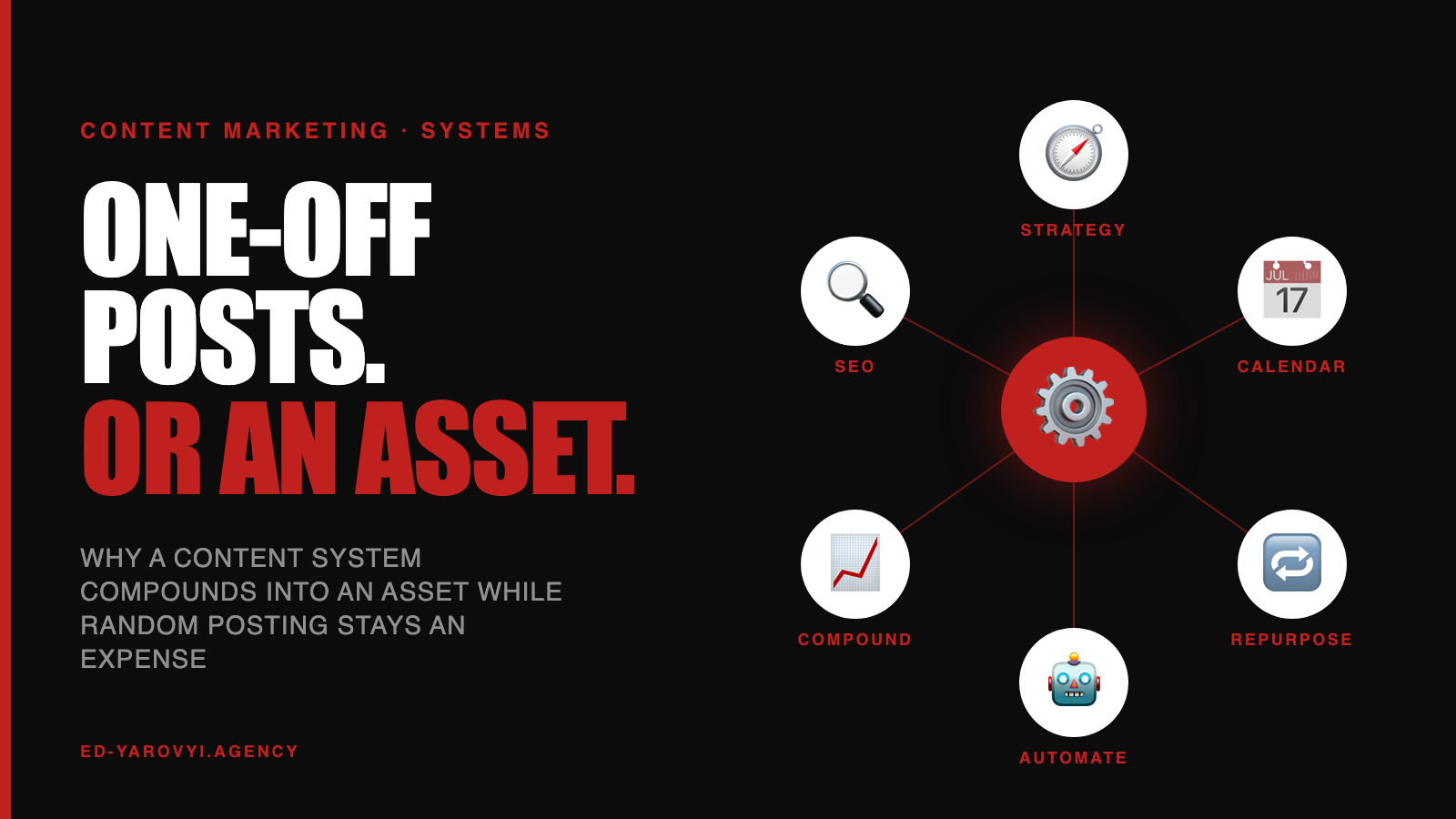
A real content system is the difference between publishing sometimes and building an asset that compounds. Most businesses treat content as a series of one-off efforts — a blog post here, a video there — and wonder why nothing accumulates. A real system turns content into a machine that produces, publishes, and improves on its own rhythm, so every month builds on the last instead of starting over. The U.S. Bureau of Labor Statistics reflects how much professional content production has become its own discipline, and for a growing business, the system behind it is what separates results from busywork.
I have built editorial systems and automated publishing pipelines for 20 years, and I build the machine, not just the posts. So this guide breaks down what a real content system actually is in 2026 — the parts that make it work, why it compounds, and how to build one that runs without eating all your time.
Why a content marketing system beats random posting
Random content produces random results. A system produces predictable, compounding ones, because each piece is planned, connected, and reused. The businesses that win with content are not the most creative — they are the most systematic. They ship reliably, they build a library, and that library keeps working long after it is published.
Five things a content marketing system does that random posting cannot
- It compounds — every article and video keeps attracting traffic for years, so the library grows into an asset
- It stays consistent — a calendar and pipeline mean content ships even in busy weeks, which is when most businesses go silent
- It connects — internal links and topic clusters build authority that a scattered post never earns
- It repurposes — one idea becomes an article, a video, an email, and social posts, multiplying the output
- It improves — data feeds the next round, so the system gets sharper instead of stale
This is the same logic behind the content marketing Dallas work: reach without a system produces nothing, while a modest amount of content on a real system quietly builds a moat.
How AI is changing content production in 2026
The biggest shift in content over the last few years is AI, and used well it makes a content system dramatically more efficient. Used badly, it floods the internet with thin, generic content that search engines increasingly punish. The difference is entirely in the approach.
AI shines at the mechanical parts of the workflow: outlining, first drafts, repurposing one piece into many formats, generating variations for testing, and handling formatting. These are the tasks that used to eat hours, and automating them lets a small team produce far more without sacrificing the calendar.
What AI cannot do is replace real expertise, genuine experience, and an authentic voice. The content that wins in 2026 pairs AI-assisted efficiency with a human who brings actual knowledge, real stories, and a point of view. A content system that leans on AI for speed but keeps a human in charge of quality and truth produces more and ranks better than one that dumps raw AI output onto a blog.
This is the balance I build into every system: automation and AI handle the repetitive, mechanical work, while strategy, expertise, and voice stay human. The result is production at scale without becoming the kind of thin, generic content that gets ignored or penalized.
The businesses that get this right in 2026 gain an enormous edge: the output of a large content team with the quality of a specialist, running on a system that mostly runs itself. The takeaway is simple — use AI to remove drudgery, never to remove judgment. A content system built on that principle scales your output and protects your quality at the same time, which is exactly what compounds into a lasting asset.
There is also a distribution shift worth planning for. Generative engine optimization is about structuring content so AI assistants can cite it, which is increasingly where discovery actually happens.
Content is the rare marketing channel that keeps working after you stop paying for it. An article that ranks brings customers for years. That is why a content marketing system is an asset, not an expense — it compounds while ads disappear the moment the budget stops.
The parts of a content marketing system
A working system has a handful of connected parts. Miss one and the whole thing sputters. Here is how I build them.
1. A strategy and topic map
It starts with knowing what your customers search for and what builds your authority. A topic map organizes content into clusters — related pieces that link together and tell search engines you own a subject. This is the foundation that makes everything else compound instead of scatter.
2. An editorial calendar
The calendar turns intention into output. It defines what gets produced, when, and by whom, so content ships on a rhythm instead of whenever someone remembers. Consistency is the whole game in content, and the calendar is what enforces it.
3. A production and repurposing workflow
This is where efficiency lives. One core piece — a long article or a video — gets repurposed into clips, social posts, an email, and graphics. A repeatable workflow means you create once and distribute many times, turning a modest production effort into a wide, consistent presence.
4. An automated publishing pipeline
Publishing should not depend on someone manually posting at the right time. An automated pipeline schedules and pushes content across platforms on the calendar’s rhythm, handles the mechanical steps, and frees your time for strategy and creation. Automation is what lets a small team, or one operator, run a big-company content operation.
How automation makes the system run itself
The biggest leap in content marketing over the last few years is automation. The parts of the system that used to eat hours — formatting, scheduling, cross-posting, tracking — can now run on pipelines that you build once and maintain lightly. This is what turns a content marketing system from a time sink into a genuine asset.
- Auto-publishing — content ships on schedule across platforms without manual posting
- Repurposing workflows — one input generates multiple formatted outputs
- Monitoring pipelines — automated tracking surfaces what is working so you can double down
- AI-assisted production — used carefully, it speeds the mechanical parts while a human keeps the quality and voice
Automation is not about replacing judgment — it is about removing the drudgery so the judgment scales. For more on that side, the AI automation Dallas case shows one input turned into seven systems.
What derails a content marketing system
Knowing the failure modes protects the investment. These are where content systems break down.
- Starting without a strategy — producing content with no topic map means effort that never compounds into authority
- Chasing volume over quality — thin, mass-produced content can be ignored or penalized; the system has to protect quality
- No repurposing — creating everything from scratch makes the system too heavy to sustain
- Abandoning it early — content compounds over months, and quitting at month three throws away the payoff
Here is my honest take: most businesses either never start a content system or quit it right before it would have paid off. The ones that build the machine and let it run for a year end up with an asset competitors cannot buy their way past.
Building a content system that fits your business
The right system matches your capacity. A founder with no time needs heavy automation and a lean cadence; a business with a marketing person can run a richer operation. The point is not maximum output — it is a sustainable machine that ships reliably and compounds.
This is what I build end-to-end: strategy, editorial calendar, production workflow, and automated publishing, handled by one operator with no handoffs. The marketing cost Dallas breakdown covers what it costs to build and run, and the marketing budget Dallas guide covers how to fund it alongside your other channels.
How to repurpose content answers the ten most common questions about turning one piece into many.
What is a content marketing system?
It is the connected machine — strategy, editorial calendar, production workflow, and automated publishing — that turns content from one-off posts into a compounding asset. It ships reliably, repurposes efficiently, and improves from data, so every month builds on the last.
Why is a system better than just writing blog posts?
Random posts produce random results and rarely accumulate. A system connects content into clusters, keeps it consistent, repurposes each idea across formats, and improves over time, so the library compounds into traffic and authority that a scattered blog never earns.
How does automation fit into content marketing?
Automation handles the mechanical work — scheduling, cross-posting, formatting, and tracking — so your time goes to strategy and creation. Auto-publishing pipelines and repurposing workflows are what let a small team or one operator run a big-company content operation.
How long until a content marketing system pays off?
Content compounds over months. Expect early traction in 3 to 6 months and meaningful, compounding returns over 6 to 12 as the library, authority, and automation build on each other. The businesses that quit at month three throw away the payoff.
Can a small business or founder run a content system alone?
Yes, with the right amount of automation and a lean cadence. The system should match your capacity — heavy automation and a modest output for a busy founder, a richer operation for a business with a marketing person. The point is a sustainable machine, not maximum volume.
How do you repurpose content?
Start with one substantial piece, like a long article or video, then cut it into smaller formats for each channel: short clips, quote graphics, social posts, an email, and a checklist. Adapt each to the platform rather than pasting the same thing everywhere. One focused piece can feed a week or more of content.
How do I build a content strategy?
Start with your customers’ real questions, the ones they ask on sales calls and type into search. Group them into a few topics you want to be known for, decide which formats you can sustain, and set a realistic publishing rhythm on a calendar. Review results monthly and adjust. Strategy is mostly choosing what not to make.
How often should a business publish new content?
As often as you can sustain with quality. For most small businesses that is one solid piece a week or every other week, repurposed across channels. Consistency matters more than volume: a steady rhythm builds a library that compounds, while bursts followed by silence rarely do.