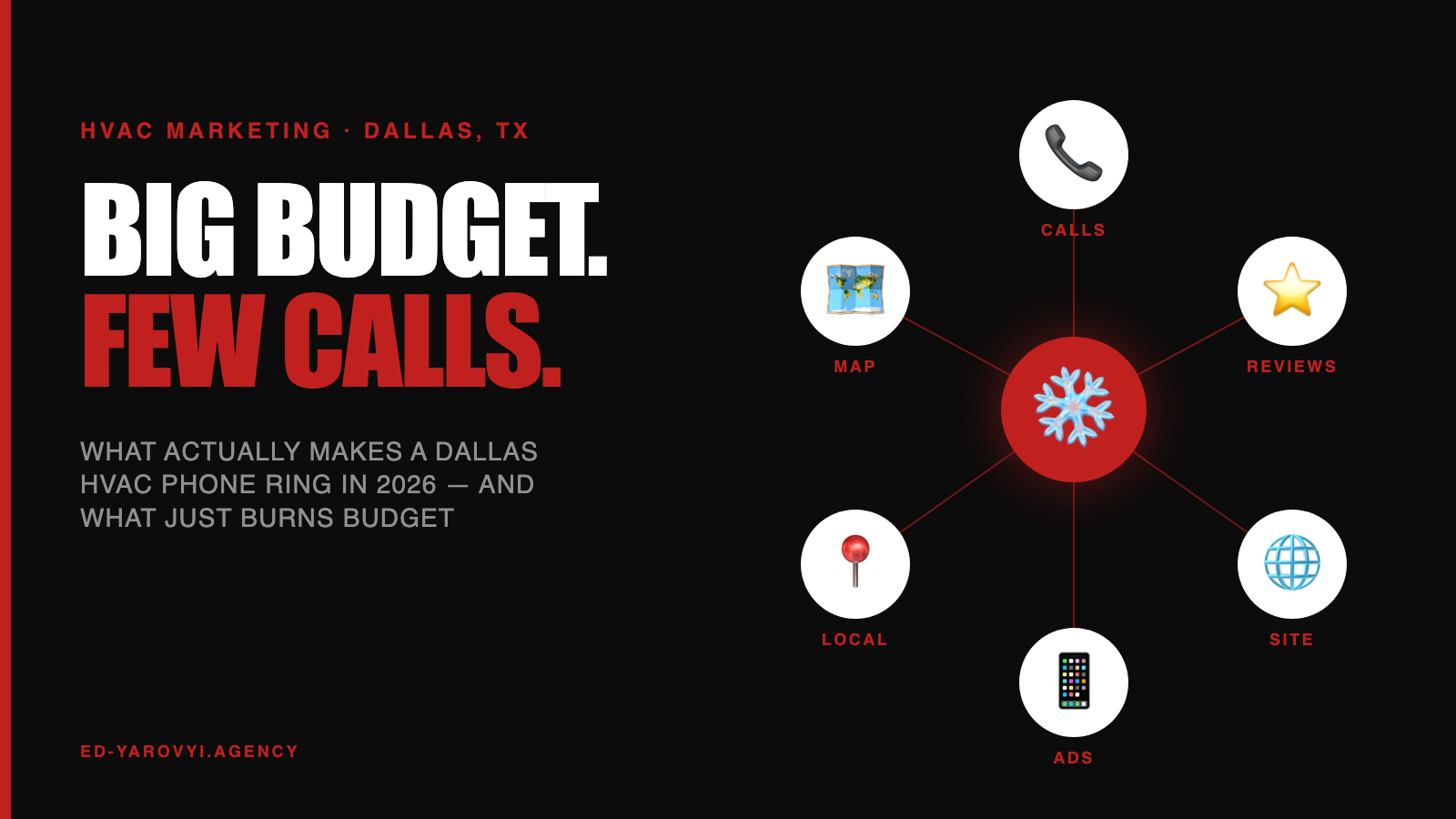
HVAC marketing in Dallas is brutal. The market is saturated, every contractor on every corner has a yard sign, and Google’s local 3-pack is dominated by the same five or six big shops that have been spending on SEO since 2014. Furthermore, the heating and cooling industry employs over 425,000 technicians nationwide, according to the U.S. Bureau of Labor Statistics, and Dallas-Fort Worth holds one of the densest contractor populations in the country. If you are running a small HVAC operation in Plano, Garland, Mesquite, Irving, or Fort Worth, the question is not “should I do marketing” — it is “what actually moves the needle when I can’t outspend the big players.”
This guide breaks down what works for HVAC marketing in Dallas in 2026, based on what is actually generating calls and what is just burning budget. As a result, by the end you will know which channels deserve your time, which to skip, and what realistic ROI looks like.
Why HVAC marketing in Dallas is different from other home services
HVAC is not like other home service categories. The trigger to call is usually urgent (the AC died in August, the heat is out in February), the search behavior is hyperlocal (“AC repair near me”), and the customer does not shop for weeks — they pick whoever shows up first and looks credible. Consequently, that single fact changes the entire marketing equation.
Five things that make HVAC marketing in Dallas unusual
- Search intent is emergency-driven — most calls come from “[service] near me” Google searches done in panic mode
- Decision time is minutes, not weeks — whoever picks up first usually wins
- Local 3-pack is everything — if you are not in the top three map results, you might as well not exist for new customers
- Trust signals matter more than aesthetics — reviews, years in business, and licensing are what customers screen for
- Seasonality is extreme — Texas summers create 4 to 6 weeks of nonstop calls; winters and shoulder seasons can be brutally slow
The BLS Occupational Outlook on HVAC mechanics and installers shows steady DFW employment growth — demand keeps rising, which means marketing has to compete for technician attention too.
Related work: the Rival Sign Company case is a useful DFW service-business example of marketing built on craft and reviews rather than ad spend, the marketing cost Dallas piece covers broader spend allocation, and dental marketing Dallas walks through a parallel local-service category.
HVAC Seasonal Demand and Marketing Rhythm in DFW
HVAC marketing in DFW is not steady year-round. Three seasonal peaks define the calendar — adjusting marketing spend to match seasonal demand is the single biggest leverage point most HVAC operators miss.
Spring tune-up season (March–April). Customers schedule cooling system inspections before summer heat arrives. Marketing focus: scheduled maintenance offers, tune-up packages, GBP photo refresh. Paid search budget can stay moderate because customer intent is anticipatory rather than emergency.
Summer emergency season (June–September). Peak HVAC marketing window in DFW. Customer searches like “emergency AC repair Dallas” spike. Paid search costs climb sharply. Budget allocation: 40–55% of annual marketing spend often goes into this 4-month window. Response time within 2 hours is non-negotiable; competitors who respond faster win the booking even at higher quoted price.
Fall heating preparation (October–November). Heating system inspections before first freeze. Less aggressive than summer but steady. GBP and content marketing carry more weight than paid; customer intent shifts back to anticipatory.
Winter freeze events (December–February). Unpredictable but high-stakes. A single hard freeze produces weeks of emergency calls. Marketing during winter focuses on review velocity and brand-recall content rather than aggressive paid; operators who built reputation during summer cash in during winter freeze events.
HVAC Review Velocity — Why It Matters More Than Most Categories
HVAC customers face decision urgency (broken AC in 100-degree summer means buying NOW) combined with high ticket size (00–5,000+ per call). The combination makes trust signals decisive. A DFW HVAC operator with 250 reviews at 4.7 stars consistently outranks competitors with 60 reviews at 4.9 in local pack.
The mechanism: customers reading reviews during a heat emergency read the most recent 5–10 reviews more carefully than they read the headline number. Recent review depth and quality matter more than total count. Practices that systematically request reviews after every successful call accumulate the depth that decides the close.
Practical cadence: ask for reviews at job close, send follow-up SMS 24 hours later with direct Google review link, respond to every review within 12 hours. HVAC review velocity of 8–20 new reviews per month sustained over 12 months produces compounding ranking improvements that paid ads alone cannot match. The combination — reviews plus paid for emergency keywords — is what separates the operators dominating their service areas from the ones running flat year over year.
How DFW HVAC Operators Build Repeat-Customer Retention
The cheapest revenue per dollar in HVAC marketing is the customer who already trusts you. Three retention systems that compound over years.
Annual maintenance contracts. 50–50 per year covering two scheduled inspections plus priority emergency dispatch. Predictable monthly revenue, repeat customer relationship, and emergency-call advantage when a current contract holder calls during peak season.
Email reminders aligned to seasons. Pre-summer cooling inspection reminders in March, pre-winter heating reminders in October. Open rates exceed 25% because the timing is genuinely useful to the customer. Conversion to scheduled service runs 15–25% per send.
Post-service follow-up. 30-day check-in after every major repair. Catches issues early, generates referrals when satisfaction is fresh, and produces review requests at the moment trust is highest. Practices that systematize this consistently outperform those who do not by measurable margins on lifetime value.
If your business comes from one channel, you are one algorithm update away from a bad quarter. HVAC contractors who survive long term run three channels minimum.
The three channels of HVAC marketing in Dallas that actually generate calls
Most HVAC contractors try six to eight marketing channels and do none of them well. However, the ones who actually grow run three channels deeply. Below are the three that earn their place in any HVAC marketing strategy.
Channel 1: Google Business Profile and the local 3-pack
This is the single biggest lever in Dallas HVAC marketing. The 3-pack at the top of Google maps drives 50 to 70 percent of new customer calls for service trades. According to Google’s own data on local search, “near me” intent searches have grown over 500 percent on mobile in the last decade. Getting into the 3-pack requires several specific things.
What actually moves the needle on GBP for HVAC contractors
- Categories set correctly — “Air Conditioning Contractor” primary, plus 2 to 3 secondary categories (HVAC Contractor, Furnace Repair Service, Heating Contractor)
- Service area defined precisely — do not claim all of DFW; claim the cities you actually serve. Google’s algorithm penalizes overclaiming.
- 50+ reviews with 4.5+ average — below 4.5 stars and you drop out of the 3-pack for high-intent searches
- NAP consistency — name, address, and phone identical across every directory listing (Yelp, Yellow Pages, BBB, HomeAdvisor, etc.)
- Weekly posts — Google rewards active profiles with higher rankings
- Photos uploaded monthly — interior, exterior, vans, completed jobs, team
Most HVAC contractors set up GBP once in 2018 and never touched it again. By contrast, the contractors moving up the rankings actively maintain it as part of their HVAC marketing system. That is the entire difference between rank 7 and rank 2.
Channel 2: Review velocity and recency
Google’s local algorithm cares about review count, average rating, AND review velocity (how often new reviews come in). For example, an HVAC contractor with 200 reviews but none in the last 6 months ranks below one with 80 reviews and a steady 3 to 4 per month. Velocity matters more than total volume.
How to build review velocity into HVAC marketing operations
- Ask at job completion — the only window when satisfaction is at peak
- Use a one-tap review link — most customers will not search “Company X Google Reviews” themselves
- SMS the review link 2 to 3 hours post-service — open rates are 5 to 10 times higher than email
- Do not incentivize reviews — against Google’s terms, can get your profile suspended
- Reply to every review within 48 hours — both 5-star and 1-star
No new ad spending, no agency. Just an SMS automation that hits at the right moment and a technician who actually asks. That is the difference between contractors who grow their HVAC marketing results and contractors who plateau.
Channel 3: Retention and repeat customers
Most HVAC contractors in DFW chase new customers and ignore the gold sitting in their existing customer database. The math is simple: a maintenance customer is worth 5 to 10 times a one-time repair customer over their lifecycle. As a result, building a retention layer is the single most undervalued growth lever in Dallas HVAC marketing.
The retention pieces that actually work in HVAC
- Seasonal reminders — automated SMS or email when it is time to schedule spring AC tune-up or fall furnace check
- Maintenance plans — recurring revenue, automatic touchpoints, and customers who do not shop other contractors
- Birthday and anniversary touches — surprisingly effective in trades
- Referral SMS after positive resolution — “Thanks for the 5-star review! If you know anyone needing service, here is a link to share…”
What doesn’t work in Dallas HVAC marketing (and what owners keep doing anyway)
If a marketing channel has not produced calls for HVAC in five years, why do owners still spend money on it? Inertia, mostly. Additionally, the salespeople for these channels still cold-call every month.
The dead channels Dallas HVAC contractors should drop
- Boosted Facebook posts — they reach people who were not going to call anyway
- Direct mail postcards — open rates under 5 percent, costs add up fast
- SEO-only strategies that ignore GBP — your website ranking #1 organically matters less than GBP being in the 3-pack
- Yard signs for marketing — fine for brand visibility, generate almost zero attributable revenue
- Vehicle wraps — same as yard signs; great for trust, low for direct generation
- Yellow Pages — should be obvious in 2026, but the rep still calls
- Pay-per-call lead services without negotiation — paying $40 to $80 per lead with no exclusivity is a margin killer
What’s a realistic marketing budget for HVAC marketing in Dallas?
HVAC budgets scale with revenue. The contractors who get the most from their marketing spend follow predictable allocation patterns. Below is what is typical for HVAC marketing operations by revenue tier.
| Annual revenue | Marketing budget | Primary focus |
|---|---|---|
| $500K to $1M | $2,500 to $5,000 per month | GBP, reviews, basic retention SMS |
| $1M to $2.5M | $5,000 to $12,000 per month | + light paid search, maintenance plan program |
| $2.5M to $5M | $12,000 to $25,000 per month | + paid search at scale, content marketing |
| $5M+ | $25,000 to $50,000 per month | + broader content, awareness campaigns |
The fastest way to lose money in Dallas HVAC marketing is to skip Channel 1 and Channel 2 (which are nearly free) and dump $5,000 per month into Google Ads. By contrast, the contractors winning in DFW build foundation first, then add paid layers on top.
“If your GBP is at rank 7, no amount of ad spend fixes that. Fix the ranking first.”
The 90-day plan for HVAC marketing in Dallas starting from zero
If you are an HVAC contractor walking into this with nothing systematized — no review process, no GBP optimization, no retention layer — here is the order that actually works.
Step-by-step: from zero to a working HVAC marketing stack in Dallas
- Days 1-14: Audit and fix Google Business Profile completely. Categories, photos, NAP, posts, Q&A. As a result, this alone moves the needle within 30 days.
- Days 15-30: Build the review automation. SMS link sent 2 to 3 hours post-service. Train techs to mention reviews on every job.
- Days 31-60: Set up the retention layer. Seasonal SMS reminders, maintenance plan touchpoints, birthday and anniversary triggers.
- Days 61-90: Audit the website. Page speed under 2 seconds, schema markup, click-to-call button. Only after this — consider paid ads.
Notice that paid ads do not appear until after day 90. Many contractors get this order wrong and burn budget on Google Ads before the foundation can convert the traffic. Therefore, fix the foundation first, then accelerate with paid layers.
FAQ
What’s the best HVAC marketing strategy on a small budget?
Google Business Profile optimization plus a systematic review collection process. These two together drive the majority of new customer calls in Dallas HVAC marketing. Everything else (ads, SEO, social) is secondary and only worth investing in once GBP is at rank 3 or better in your service area.
How much should an HVAC contractor spend on marketing per month?
Between 3 percent and 6 percent of revenue. For example, a contractor doing $1.5M annually should budget $3,750 to $7,500 per month. Spending less is fine if your reputation and word-of-mouth are doing the heavy lifting. Spending more is not proportionally better unless you are scaling territory.
Do HVAC contractors need a website if they have a Google Business Profile?
Yes. The GBP drives initial discovery, but customers research before calling. A website that loads in under 2 seconds on mobile, shows trust signals (license, insurance, years in business, reviews), and has a working phone-call button converts visitors at 3 to 5 times the rate of bad websites. The site is the trust step between GBP click and phone call.
Are Google Ads worth it for HVAC marketing in Dallas?
Yes, but only after GBP is dialed in. Local Service Ads (the “Google Guaranteed” badge) specifically work well for HVAC because they are trust-coded and pay-per-lead. Standard Google Ads work too but require active management to keep CPC under control — DFW HVAC CPC can run $25 to $60 in peak season.
What about Angi, HomeAdvisor, and Thumbtack for HVAC?
Useful in the early years of an HVAC business when you are building review velocity and case volume. However, lead costs are high ($30 to $100), exclusivity is rare, and the leads are typically lower-quality than organic. Use them as a supplement, not a foundation, for HVAC marketing in Dallas.
How long until HVAC marketing starts producing calls?
GBP optimization shows noticeable rank movement in 14 to 30 days. Review velocity improves visibly in 30 to 60 days. Paid ads (if used) work immediately but with high learning costs in the first 60 days. Full organic and retention compound returns take 6 to 12 months to see real lift in revenue.