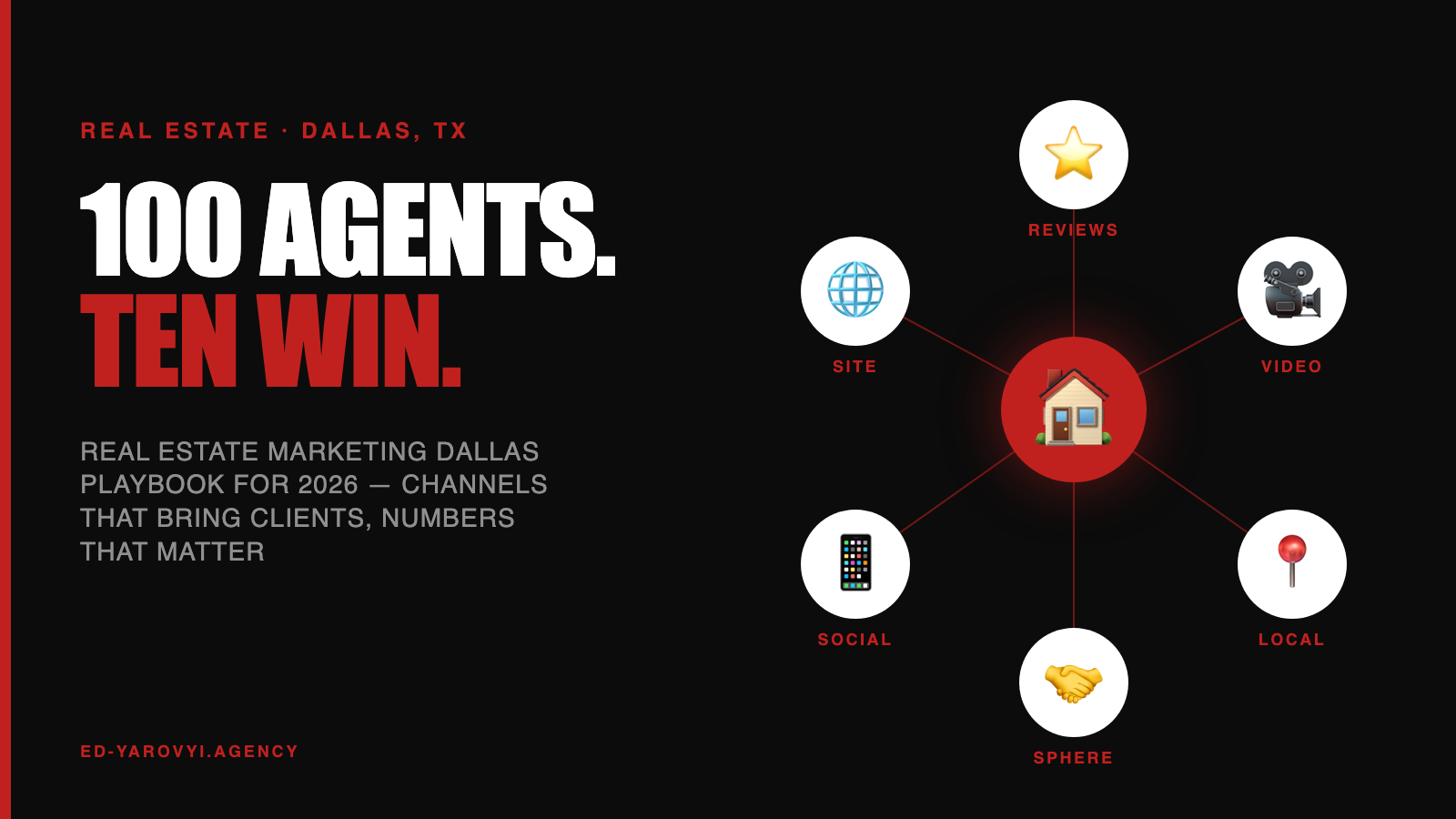
There are roughly 30,000 licensed real estate agents in the Dallas-Fort Worth metro in 2026 and the population keeps growing fast enough to add new agents almost every month. The math is brutal. The top 10% of DFW agents close more than 70% of the transactions. The bottom half close fewer than two deals a year. The difference between the two groups is rarely talent. It is real estate marketing in Dallas — who knows how to be visible, trusted, and remembered in a market this dense.
This piece is what real estate marketing in Dallas actually requires in 2026 to build a sustainable agent business. Channels that bring clients, real numbers on what each costs, what works in Plano versus what works in Bishop Arts, and the mistake almost every new DFW agent makes in their first 18 months. I have advised friends in residential and commercial real estate across DFW; the patterns are consistent.
What “Real Estate Marketing in Dallas” Actually Means in 2026
Real estate marketing in Dallas in 2026 is not “post listings on Instagram.” It is a system of repeat exposure to a defined sphere of people who will either buy, sell, or refer someone who will buy or sell, within the geographic markets you serve. The output is one number: closed transactions per year, divided by the cost to produce them.
Five channels carry the load for working DFW agents:
- Sphere of influence and referral systems. The highest-converting channel in real estate, period. Most agents underbuild it because it feels like maintenance, not marketing.
- Google Business Profile + reviews. Free, high-leverage, and most agents either skip it or treat it as a one-time setup.
- Local content and SEO. Pages targeting specific neighborhoods, school zones, and price points. Long-tail traffic that compounds.
- Video and social presence. The shift since 2020 — video now does what flyers did in 2005. Agents who skip video lose ground every year.
- Paid search and social. Useful but expensive in DFW. Always the last channel built, never the first.
Notice what is not on the list. Postcards, door-knocking, billboards, bench ads, and pay-to-play “exclusive lead” platforms. Those channels still produce occasional results but they are not where leverage lives in 2026. Real estate marketing in Dallas is digital-led with relationship-driven follow-through. Skipping either half breaks the system.
Channels That Bring Clients in DFW Real Estate
Channel by channel, what actually produces transactions in DFW in 2026.
Sphere of influence. Past clients, current clients, friends, family, neighbors, kids’ soccer parents, contractor relationships, gym people. The agents I have watched scale past 30 transactions a year all built sphere systems — quarterly check-ins, value-add content, holiday touches, the occasional in-person event. Cost: $500–$2,500 per year. Return: 30–60% of total transactions for established agents.
Google Business Profile and reviews. A DFW agent with 80+ Google reviews at 4.9 stars and complete service area listings outranks competitors with thinner profiles in almost every “real estate agent near me” query. Cost: free if managed in-house, $300–$700 per month if outsourced. Return: 8–15 leads per month for an established Plano or Frisco agent profile.
Local content and neighborhood SEO. Pages on your site covering “homes for sale Bishop Arts,” “Plano West school district homes,” “luxury homes Highland Park,” “first-time buyer Frisco.” Slow channel — meaningful traffic in 3–6 months — but compounds for years. Cost: $1,500–$4,500 per month if produced consistently. Return: 5–12 leads per month after 9 months of compounding.
Video. Listing walkthroughs, neighborhood tours, market updates, agent introduction content. Distributed on Instagram Reels, TikTok, YouTube Shorts, and the agent’s own website. The leverage is twofold — video humanizes the agent and feeds the algorithm for organic reach. Cost: $1,000–$5,000 per month including production. Return: harder to attribute but compounds reputation; agents who built video presence in 2022–2024 are now closing 15–35% of leads who say “I followed you for months before reaching out.”
Paid search and social. Google Ads for “real estate agent Dallas,” “homes for sale Plano,” and similar queries. Meta ads for sphere retargeting and brand awareness. Cost in DFW: $1,500–$10,000 per month in ad spend depending on price tier and geo. Return: 4–15 leads per month at $80–$400 cost per lead. Expensive in 2026 because every DFW agent runs paid ads, so cost per click is elevated.
According to the Bureau of Labor Statistics data on real estate sales agents, the median annual wage in the Dallas-Plano-Irving metropolitan area runs above the national median, reflecting both market activity and agent density. That density is the entire reason marketing matters more here than in less-saturated markets.
How Much Real Estate Marketing in Dallas Costs in 2026
Real numbers from working DFW agents in the last twelve months.
- New agent (year 1–2): $400–$1,800/month focused on sphere + GBP
- Established agent (10–25 transactions/year): $1,500–$5,000/month
- Top-producer (30+ transactions/year): $4,500–$15,000/month
- Team lead (5+ agents): $10,000–$40,000/month team marketing budget
- Cost per closed transaction (target): $400–$1,500 for general residential, higher for luxury and commercial
The spread is wide because what you are buying differs. A $1,800/month new-agent budget covers basic CRM, sphere automation, and GBP management. A $5,000 mid-career budget adds local content, video production, and modest paid search. A top-producer’s $12,000 budget includes a full content engine, video team, paid ads at scale, and CRM with assistant support.
The general rule from the marketing cost Dallas piece — 4–8% of revenue — applies to real estate agents too. An agent grossing $180,000 in commission can support $7,200–$14,400 per year in marketing investment, scaled up as gross income grows. Spending more than 8% of gross commission on marketing in the first three years rarely pays back; spending less than 3% almost guarantees stalling.
Sphere of Influence Is Still the Highest Leverage Channel
The thing every successful DFW agent does and most new agents skip: systematic sphere maintenance. The top producers I watch in Plano, Frisco, and Dallas proper all run some version of the same playbook.
Monthly: one piece of value-add content sent to the entire sphere. Could be a market update with specific Plano or Frisco numbers, a neighborhood spotlight, a local business recommendation, or a piece of helpful homeowner advice. Goal is staying visible without selling. The same logic drives the email retention work in the Animal-ID USA case — recurring, low-pressure contact that compounds trust over months instead of demanding a transaction in the first message.
Quarterly: a personal touch. Phone call, handwritten card, small gift, or in-person coffee. Not transactional. Maintenance of relationship.
Annually: a meaningful gift or experience for past clients. Pumpkin patch invitations, Mavericks game tickets, custom housewarming gifts. Cost: $30–$150 per past client per year. Return: 60–80% of past clients become repeat clients or referral sources within 5 years.
The math is brutal in the agents’ favor. A sphere of 200 people maintained well produces 8–20 transactions per year. Same 200 people ignored produces 0–2 transactions per year. The difference is process, not talent. The agents who scale to 50+ transactions per year almost always built sphere systems before they built anything else.
Video, Social, and the Death of Cold Calling
Cold calling was the dominant lead generation channel for DFW real estate from 1990 to 2015. It still works occasionally. It does not scale and it does not compound. Video has replaced it for agents under 50 building a business in 2026.
What works in DFW real estate video right now: 60–90 second neighborhood tours, listing walkthroughs at the agent’s narrated pace, market updates with specific zip codes and price points, agent intro content showing personality. What does not work: generic real estate advice content that any agent could produce, listing photo slideshows with stock music, anything that looks scripted.
Distribution: Instagram Reels and TikTok for organic reach, YouTube Shorts for SEO reach, the agent’s own website and email list for sphere reinforcement. Cross-posting is fine. Native production for each platform produces better results but takes 3–5× the time.
Production budget: a working agent can self-shoot listing walkthroughs with an iPhone 15+ and a $200 gimbal. Quality is acceptable. Hiring a video editor at $400–$1,200 per month turns raw clips into polished content for distribution. Above that, full production runs $3,000–$8,000 per month and is usually team-budget territory, not solo-agent budget. The La Bare Dallas social media work is a useful Dallas example of what disciplined video distribution looks like — different niche, same compounding logic.
Listing-Centric vs Agent-Centric Real Estate Marketing in Dallas
Two strategic approaches that produce different results.
Listing-centric marketing. Every piece of content showcases a current listing. Listing flyers, listing video, listing social posts, listing Google Ads, listing email blasts. Works for high-volume teams with constant inventory. Fails for solo agents because listings come and go but the agent stays.
Agent-centric marketing. Content focuses on the agent’s expertise, market commentary, neighborhood knowledge, and personality. Listings appear inside the agent’s broader content stream but are not the focus. Works for solo agents because it builds a personal brand that survives listing droughts. Slower to start but compounds for years.
Most working DFW agents do agent-centric marketing 70% of the time and listing-centric 30%. The split shifts when the agent has a particularly compelling listing, but the default is agent-first. New agents who go listing-first usually flame out within 24 months because they cannot maintain enough fresh inventory to sustain the content engine.
The Plano-Frisco-McKinney Real Estate Marketing Difference
Suburb-level segmentation matters in DFW real estate more than in most US markets. Three differences worth knowing.
Plano: high-income, dense competition, mature market. Buyers research extensively. Reviews and website depth matter. Sphere referrals close at high rates because the social network is tight.
Frisco: growth corridor, family-driven, school-zone-obsessed. School district content and family-amenity coverage drive massive traffic. New construction expertise opens doors that resale-only agents cannot. Per Census Bureau Frisco profile, the city has been one of the fastest-growing in the country, which means a steady stream of relocating buyers actively searching for agents online.
McKinney and Allen: middle-market growth, mix of new construction and historic, value-conscious. Honest content about neighborhoods, schools, and commutes outperforms luxury-positioning content. Sphere networks here are tighter than Plano-Frisco; referrals carry more weight.
Dallas proper: neighborhood-specific. Highland Park is its own market. Bishop Arts is its own market. Lakewood, Oak Cliff, Uptown — each has different demographic, price tier, and buyer behavior. Generic “Dallas real estate” marketing underperforms hyper-local positioning by a wide margin. The same operator-grade focus I covered in the marketing consultant in Plano piece applies to DFW agents — channel discipline beats channel breadth.
Metrics That Actually Matter for DFW Agents
Five numbers tell you whether your real estate marketing in Dallas is working. Track these monthly.
- Cost per closed transaction. Total annual marketing spend divided by closed transactions. Healthy target: $400–$1,500 for general residential, $1,500–$5,000 for luxury, $3,000–$10,000 for commercial.
- Sphere transactions vs lead-gen transactions. What percent come from people who already knew you versus people you found through marketing. Healthy: 50–70% sphere for established agents, 30–50% for new agents building.
- New leads per month per channel. Where leads originate so you know which channels to feed. Headline number per channel, not aggregate.
- Lead-to-close conversion rate. How many leads turn into transactions. Healthy: 4–10% for organic leads, 1–3% for paid leads. Below 1% means lead quality is broken; above 15% means you have low volume making the percent unreliable.
- Repeat client rate. What percent of transactions come from past clients buying or selling again. Mature business target: 25–45%. Below 15% suggests sphere maintenance is failing.
Agents who track these monthly outperform agents who do not by a factor of 2–3× in transactions per year, based on the data I see across DFW. Tracking is not optional; it is the difference between marketing as expense and marketing as investment.
How much should a Dallas real estate agent spend on marketing in 2026?
4–8% of gross commission is the reasonable band. A new agent (year 1–2) typically spends $400–$1,800 per month focused on sphere and Google Business Profile. Established agents at 10–25 transactions per year spend $1,500–$5,000. Top producers at 30+ transactions per year spend $4,500–$15,000. Team leads run $10,000+ monthly team budgets.
What is the most effective real estate marketing in Dallas channel for new agents?
Sphere of influence systems and Google Business Profile reviews. Both are low-cost and produce immediate compounding returns. Most new DFW agents skip sphere systems because they feel like maintenance, then wonder why they have no repeat business in year three. The agents who build sphere systems in year one routinely scale to 25+ transactions by year five.
Do Dallas real estate agents need video content in 2026?
Yes if they want to grow. Video has replaced cold calling and direct mail as the dominant trust-building channel for DFW real estate. Working agents under 50 produce 4–12 video pieces per month — neighborhood tours, listing walkthroughs, market updates. Production can be self-shot with an iPhone or outsourced to an editor at $400–$1,200 per month.
Should I focus on luxury or volume in Dallas real estate marketing?
Depends on the agent. Luxury Highland Park, Preston Hollow, Southlake requires different content and budget than volume Frisco, McKinney, Allen. Trying to market both simultaneously usually means failing at both. Most successful DFW agents specialize in either a price tier or a geographic submarket and double down on it.
Is paid lead generation worth it for Dallas real estate agents?
Sometimes. Paid lead platforms (Zillow Premier Agent, Realtor.com leads) deliver volume at 1–3% conversion. Google Ads on high-intent queries can convert at 4–8% but require active management. Most successful DFW agents use paid leads as a supplement to sphere and organic, not as the primary channel. Building a business solely on paid leads typically stalls when ad costs rise.
How does Plano real estate marketing differ from Dallas proper?
Plano buyers research more extensively before contacting agents — reviews, website, social presence all matter more. Dallas proper is neighborhood-specific, where Highland Park, Bishop Arts, and Lakewood require different positioning. Frisco favors school-district and family content. McKinney and Allen reward value-conscious honest content over luxury positioning. Suburb specificity outperforms generic DFW positioning everywhere.
What metrics should a Dallas real estate agent track monthly?
Five: cost per closed transaction, sphere-versus-lead-gen split, new leads per channel, lead-to-close conversion rate, and repeat client rate. Agents who track these monthly outperform agents who do not by 2–3× in annual transactions. Tracking is the difference between marketing as expense and marketing as investment.