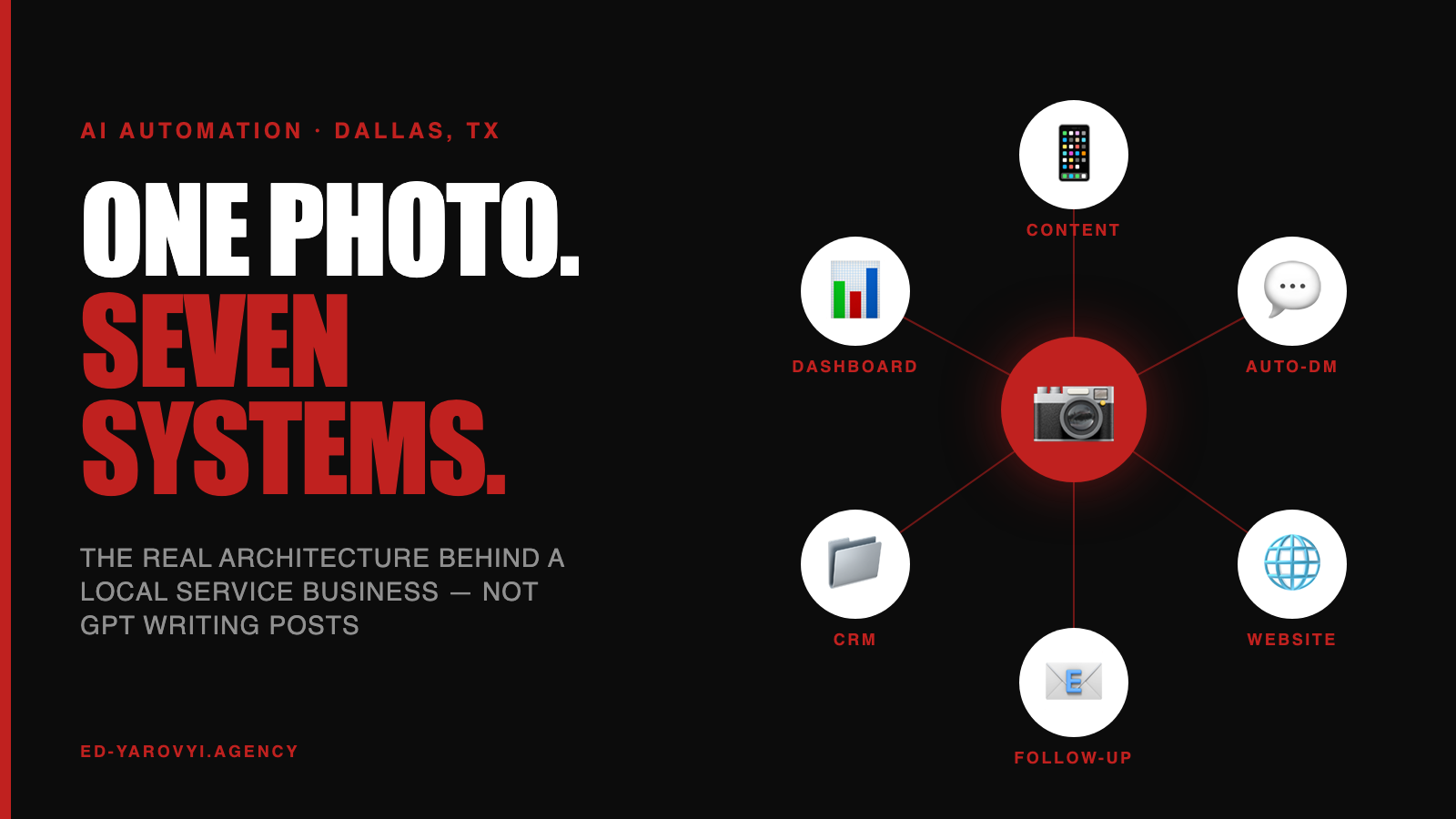
Content marketing Dallas, your Friday evening. 8 PM. A nail salon in Dallas. The master finishes her last client, takes one photo of the finished work, and sends it to a bot. That is it. She does nothing else. In that single moment, seven systems run in parallel on her behalf — and that is what real content marketing Dallas looks like when the system is actually built, not bolted on.
Not GPT writing posts. An architecture. It connects the tools the salon already uses, wires in publishing and follow-up, and hands the owner a dashboard that forces decisions instead of just showing numbers.
I spent four months running exactly this kind of system for entertainment brands, pet-tech, and news media — 15M+ views, 1,100+ videos, 150K emails, 700 AI-written articles in thirty days. The architecture scales down from content marketing DFW operations at that volume to a five-master salon without losing a single moving part.
The One-Trigger Architecture
The whole system sits on one idea. In short, a single input from real work triggers parallel outputs. For example, one photo. Or a closed POS ticket. A calendar event. A QR receipt from the front desk. Whichever one is cleanest in the shop — that becomes the trigger. As a result, the outputs fan out in seven directions at once.
Trigger discipline — one clean input, not three
A content marketing agency dallas that delivers at volume learns one lesson fast: the single biggest mistake in local automation is trying to wire up three triggers at once. For instance, photo from the master, appointment from the calendar, receipt from the POS — each one firing a different chain. As a result, three chains means three failure modes, three debugging sessions, three chances for duplicate posts. Instead, I pick one trigger per shop — the one the master already does without thinking — and everything else pulls from it. For example, if the photo is the trigger, the appointment gets looked up from the CRM using master + time. Then the POS gets looked up from the appointment. Clean. One source of truth per event.
Event-driven, not scheduled — why cron kills automation
A lot of cheap automation runs on cron: every hour check the calendar, every day send a digest, every week post a summary. However, that works until it does not — for example, a cancelled appointment still gets a thank-you SMS, a no-show gets a review request, a dead client gets a birthday promo at 3 AM. By contrast, event-driven means nothing fires unless the real thing happened. For instance, photo arrives → post goes out. Then appointment closes → SMS fires. In other words, nothing happens on a schedule. Everything happens on a trigger.
Branch independence — the real reason you can start small
In addition, every branch reads from the CRM and writes to its own channel. Moreover, no branch depends on another branch running first. For instance, content does not wait for follow-up. Similarly, follow-up does not wait for the dashboard. As a result, that is what makes the architecture usable for a small salon: you install one branch this month, another in three months, another in six. For example, if content is running and follow-up is broken, content still runs. Likewise, if CRM integration is slow, the dashboard loads from a cached snapshot instead of blocking. In short, nothing breaks because something is missing. This is the difference between a pipeline and a platform.
Seven Systems From One Trigger
Here is the full seven-system stack — what fires the moment that photo hits the bot. Each one is its own branch, built separately, wired together.
Retention & reporting — branches 5–7
Branch #1 — Content as Your Content Marketing Dallas Engine
First of all, this is the branch I push hardest. Not paid ads. Not SEO promotion. Instead, content that ships every day, tuned per platform, connected to a real conversion point. In short, this is where organic leads actually come from — the core of any real content marketing Dallas operation, and the first module I always deploy for content marketing services dallas clients.
How the content pipeline fires — per photo
- The photo is resized, color-corrected, watermarked, and formatted per channel — 9:16 for TikTok and Reels, square for feed, 2:3 for Pinterest.
- AI drafts the caption from the salon’s editorial template — tone, length, banned phrases set once by a human, reused forever. AI fills variables (service, master, duration, price range). Not the voice.
- Hashtags and geo tags per platform. Instagram is not TikTok. TikTok is not Pinterest. Copy-pasting the same caption across all three is a rookie mistake. Real Multi-Platform Distribution treats each channel as its own animal.
- Publishing on a schedule, so the queue does not dump twenty posts on a Monday morning.
- For variable assets — AI avatars, mockups, motion graphics — a library of templates sits behind the pipeline. AI picks a template, injects the master’s real photo, renders the clip. Looks real because the important pixels are real.
Above all, this is a deep topic on its own. First, the visual asset itself gets segmented for feed, stories, and reels — a still or a short video. Then AI automation produces the exact asset the salon needs under strict brand rules, built from a photo of the master’s real work. As a result, you do not hire a videographer. Instead, you animate the actual job your master just delivered. For example, pick from a roster of AI models. Or build AI avatars. Alternatively, set up a system of a thousand mockups where AI itself decides which one to insert. In the end, the output looks real, because the hands, the nail shape, and the polish color are real.
Same engine at 15M+ views — La Bare Dallas reference
This is the same Multi-Platform Distribution engine I ran for La Bare Dallas — social media marketing Dallas at scale. 1,100+ videos. 15M+ organic views in four months. Zero ad spend. The salon version is smaller. The architecture is identical.
What AI decides here — and what it never touches
What AI does not decide here: the brand. Tone, aesthetic, banned phrases, what the salon will never say — human decision, made once on day one, written into the editorial rulebook. In short, the rulebook is the product. AI is a very fast assembler that follows the rulebook. Nothing more. This is the distinction between a dallas content marketing system and a spam machine.
Branch #2 — Auto-DM, Chat Bots & Multi-Platform Distribution
Content works. In fact, that is the problem. The moment Multi-Platform Distribution fires and a post lands, DMs start filling up with the same five questions. For example, how much. Where. When are you open. Can I book for Saturday. Do you do pedicure too. However, if the master answers, she stops doing nails. On the other hand, if she does not answer, the lead dies in an hour.
- Auto-DM: every new follower gets a short welcome within seconds, with a link to book. One message. Measurable conversion lift.
- Chat bots on Instagram, WhatsApp, Telegram: price, address, availability, service scope. Complex or emotional messages get routed to a human.
- First comment on fresh posts gets templated replies — not spam, not fake praise, just “yes, Saturday 3 PM is open” or “starting at $45”. Keeps the comment section alive, signals the algorithm the post is active.
However, the bot does not close the sale. It does not push, upsell, or flirt. In practice, mechanical 80% — bot. Emotional 20% — human. As a result, that is where the conversion actually happens. In other words, this is content marketing Dallas applied to the conversation layer, not a chatbot pretending to be a person.
What the bot actually says — three real message templates
First, short, specific, no emoji-spam. Moreover, the voice comes from the editorial rulebook. So, here are three patterns that work in a salon:
Platform limits that kill bad bot setups
However, every platform has a different rulebook. For instance, if the bot ignores them, the account gets throttled, shadow-banned, or killed. So, here are the ones that matter most for a salon:
- Instagram 24-hour window: the bot can reply freely for 24 hours after a user messages first. After that, only template messages approved by Meta. Cheap bots ignore this and get account restrictions.
- WhatsApp Business API template approval: any message sent outside a 24h reply window needs a pre-approved template. Review takes 24-72 hours. Plan templates before launch.
- Telegram 30-messages-per-second limit: not a problem for a single salon, but if you run 5 locations through one bot, you batch.
- Meta handover protocol: when the bot passes a conversation to a human, the handoff has to be clean — otherwise Instagram keeps trying to auto-reply on top.
Metrics the bot branch reports weekly
- Auto-DM open rate — typically 60-85% within the first hour on Instagram.
- Auto-DM click-to-book rate — baseline ~4-6% for a warm follow; with a real photo of the master’s work and a direct booking link, I have seen it climb to 12-15%.
- Bot-to-human handoff ratio — healthy range is 15-25%. If it drops below 10%, the bot is doing too much. If it pushes above 40%, the bot is not answering enough.
- Unanswered DM count by end of shift — target zero. Anything above it is a leak.
The same conversation layer ran through Multi-Platform Distribution for La Bare Dallas. When 15M views hit in four months, DMs went with them. Without a bot answering price and schedule questions, the master team would have drowned in the first week.
Branch #3 — Website Development Dallas as a Self-Updating SEO Asset
In addition, every asset that fires through Multi-Platform Distribution also lands on the salon’s own website. However, this is the branch most local businesses leave on the table. Moreover, it is also the one that compounds the longest.
For instance, when a photo comes in, the pipeline does not just make a post. Instead, it creates a short web entry — a gallery item, a before/after, a service page update — with schema markup, canonical URL, Open Graph tags, alt text, and meta description, all generated automatically against a template. Additionally, internal links get inserted based on service category. Meanwhile, sitemap updates itself. Finally, image is served as WebP at the right resolution per device.
This is website development Dallas where the website is not a static five-page brochure from GoDaddy Website Builder. It is a living asset that grows every shift. The same principle — custom code, schema.org markup on every entity, image optimization, clean URLs — is what I delivered for Rival Sign Company — website development Dallas for a veteran-owned sign shop. The technical foundation adapts to any service business.
SEO scope — the technical layer only
One line on SEO scope: I cover the technical layer — schema, meta, structure, performance. I do not sell SEO promotion, ranking guarantees, or ongoing link-building. Different service, one I do not run.
Why it matters: first, Instagram can shadow-ban an account overnight. Second, TikTok can pull an audio track. By contrast, a website cannot be taken away. In short, every piece of content that ships to social should also live on a domain you own, structured so search engines can read it — and every service category needs its own landing page Dallas clients can actually convert on. In other words, the difference between renting attention and owning it.
Branch #4 — Customer Follow-Up and Reviews
Above all, attention without follow-up is a vanity metric. In fact, I wrote about that at length in the first article on content marketing Dallas and the virality trap. So, here is how follow-up runs for a salon.
- +20 minutes after the visit — a thank-you with a review link. Not a form. A direct tap-and-rate link that lands on the right platform based on the client’s history: Yelp, Trustpilot, Google Business, Booksy. Review aggregation is an automation skill on its own, and it is part of my 100-skill stack.
- +3–5 weeks (depending on service) — a rebook reminder pre-filled with her usual master and slot.
- Birthday & anniversary of first visit — promo or a simple warm note. These outperform any cold sequence because they are actually personal.
- After visit #3 — short survey. By visit three the client is loyal, her feedback matters.
- Reactivation — clients who missed two or three usual cycles get a targeted offer, not a blast. Segmentation is what makes this work.
Retention scales from 150K sends down to a 500-client salon
This is email marketing Dallas the way I built it for Animal-ID USA — email marketing Dallas retention at scale. Three campaigns, ~50K recipients each, segmentation across new buyers, returning visitors, dormant contacts. In practice, it scales down to a salon with 500 clients — the same retention engine pairs with dallas social media marketing and a single landing page Dallas clients convert on. Same logic: trigger points, not blast lists.
In short, none of this works without the CRM branch. Follow-up without data is just spam.
Branch #5 — CRM Integration (Not CRM Building)
I do not build CRMs. I integrate with the one you already have. Booksy, Square Appointments, Fresha, Mindbody, Airtable, HubSpot — the list is long. Every piece of the system above reads from and writes to that source of truth. This is where AI automation in Dallas meets your existing stack.
Specifically, plumbing handles: pulling appointment data (master, service, duration, price, client), pushing follow-up events (SMS sent, review submitted, rebook suggested), syncing the client back (birthday, visit count, last service, lifetime value).
In practice, what’s possible depends on what your CRM lets me touch. Clean APIs — trivial. Closed systems — webhooks, scheduled exports, middleware. This is the part of the project where I ask the most questions upfront. As a result, a wrong integration guess wastes weeks.
Branch #6 — Owner Dashboard, Not a Custom CRM Build
The dashboard pulls from your CRM and reporting tools. In other words, I wire the view, not the database. Every week, the owner sees one screen: first, master utilization; then service mix; also repeat-visit conversion; finally, new versus returning ratio and effectiveness of the last promo. In short, not numbers for decoration — numbers that force a decision.
The dashboard suggests, in plain English: “Thursdays dropped three weeks in a row — test a Thursday promo,” or “Nail art with design is trending; top masters are Anna and Dasha — give them more slots.” If the suggestion does not end in an action, the dashboard is useless.
What the owner actually sees on Monday morning
First, a single screen. Then four quadrants. Also seven numbers. Moreover, written in plain English, not dashboard jargon.
From metric to decision — the routing logic
Every number on the dashboard has a paired question and, where it makes sense, a suggested action. Four examples the owner sees every Monday:
- Utilization below 60% → *“Two masters underused this week. Move them into the Thursday promo slot or shift their hours.”*
- Rebook rate drops 10% week-over-week → *“Follow-up sequence underperforming — check if the SMS provider is throttling, or rewrite the 3-week reminder.”*
- One service trending up 3 weeks running → *“Create a landing-page entry for this service. Let the website branch pick it up.”*
- Top post drives zero bookings → *“Content is pulling the wrong audience. Tighten the editorial rulebook or shift platform weight.”*
Content marketing Dallas — the Iron Man console
On one hand, five masters in one salon is one dashboard. On the other hand, five locations across DFW — or across the US — is a different beast. In practice, no human can control dozens of social accounts, dozens of WhatsApp threads, dozens of calendars manually. As a result, that is where the owner’s console becomes Iron-Man-level: every city, every location, live, on one screen. Additionally, push corrections by text, voice, or a single tap. In short, AI automation in Dallas at scale means one owner seeing every location at once, not a team of managers on phone calls.
Additionally, the dashboard runs on whatever reporting stack the owner already has — Google Looker Studio, Metabase, a custom view inside Notion. I do not rebuild your BI. Instead, I wire the data pipes into it.
The Real Numbers Behind The Architecture
To be clear, I have not run this exact six-branch stack on a nail salon yet — the first content marketing dallas texas pilot is scoped for Q3 2026 in the DFW area. However, every branch is live in production on adjacent projects. Here are the real numbers behind each building block, and what they project for a five-master salon.
For reference, here is what the same architecture projects for a typical DFW salon with 5 masters, 25 clients per master per week:
- 6,500 client visits per year. Every one of them fires the seven-system loop.
- 6,500 pieces of source content in 12 months. That is feed, story, reel, and pin variants — roughly 26,000 native assets across platforms via Multi-Platform Distribution.
- +20% improvement in rebook rate is the industry benchmark when structured follow-up replaces ad-hoc reminders. On 6,500 visits × $60 average ticket, that is roughly $78,000 of additional annual revenue from retention alone.
- Master time saved: 3-4 hours per master per week previously spent on social and DM reply, returned to paid service time. 5 masters × 3.5 hours × 52 weeks ≈ 910 hours/year.
Small print: projections are modeled on industry benchmarks and the performance of the adjacent systems I have already built. Exact numbers for any salon depend on pricing, location, and current baseline. The Q3 pilot will replace projections with measured results — the case study lands on this site when it closes.
What You Need to Launch AI Automation in Dallas
- A single clean trigger — one obvious input (a photo, a calendar event, a POS ticket).
- A brand rulebook — how your business sounds in text, what it will never say.
- A CRM, even a basic one — clients, services, masters, scheduling.
- A primary channel — Instagram, WhatsApp, email, SMS. Wherever your audience actually lives.
- One north-star metric — the one number that tells you whether the system is working.
In short, without these five, automation on top of chaos just accelerates the chaos. However, with them, the first branch usually ships in 7-14 days.
Ultimately, I build these systems module by module for local service businesses across the DFW metroplex. This is the working model behind Ed Yarovyi — a small digital marketing agency Dallas that runs closer to an operator than to traditional marketing consultants dallas quote for retainer packages. So, if you read this far and see two branches that would save your operation — that is the right starting point. Let’s talk.
The Hard Lines — What AI Automation in Dallas Does Not Touch
Before you wire anything up, the limits. In short, automation removes grind — not humans. So, here are six things I refuse to automate in a service business, regardless of the brief:
In a service business, relationships are the product. In short, everything else is grind — and grind is what gets automated.
For the broader questions owners ask about AI, including which tools to start with, read how AI can help a small business.
FAQ — AI Automation in Dallas
Where should a small salon start if the budget is limited?
First, start with content and social. These are the two branches that generate leads organically. A content marketing Dallas setup wired to Multi-Platform Distribution plus a chat bot moves the needle before any CRM is in place. After that, follow-up and analytics come in. Any serious content marketing agency dallas running this kind of stack prices it per module, not as an all-or-nothing contract.
How long does implementation take?
For one branch: one to two weeks. For the full six-branch stack: one to two months. In fact, about 70% of the time is spent on editorial rules, integration scoping, and brand calibration — not on code. A serious dallas content marketing operation is always written on paper before it is written in software.
Can one photo really become a full post?
Yes, if the shooting standard and the editorial template are defined. However, without that framework, the output is random. On the other hand, with it, one photo turns into a caption, a vertical clip, a Pinterest pin, a website gallery entry, and a review request — in seconds. In other words, full Multi-Platform Distribution from a single input. Ultimately, that is the content marketing Dallas delivery model I build for every local service business.
What if the master forgets to take the photo?
In practice, it depends on how the shop operates. If photos of finished work are already part of the CRM record, automation pulls from there. If they are not, that shift simply does not post. As a result, the system does not break — it just skips a beat. Over time the habit forms because the master sees the result on her own account within minutes.
How do I know it is working before the ROI lands?
In practice, every branch has its own weekly metric from day one. First, content branch — reach and save rate. Second, DMs branch — bot-to-human handoff ratio. Third, website — indexed pages and GSC clicks. Finally, follow-up — rebook conversion. The dashboard surfaces all four in the first Sunday digest. However, if a number does not move in six weeks, that branch gets rewritten — not abandoned.
Does this replace a marketing agency?
Mostly, it replaces the repetitive 80% of what most marketing companies in dallas charge retainer for. Content production, Multi-Platform Distribution, follow-up, review collection, reporting — all automated. However, you still need a human operator who owns the editorial voice, reviews analytics, and makes the real decisions. That is the role I take — closer to a marketing consultant Dallas than to an agency account manager. In other words, the marketing agencies in dallas that keep winning clients are the ones running this kind of stack in-house. One person, full ownership, no handoffs.