Marketing for startups Dallas founders attempt usually falls into one of two traps: spending nothing and hoping the product speaks for itself, or burning a seed round on ads before there is anything worth scaling. Neither works. Startup marketing has its own logic — tight budgets, unproven messaging, and the need to find product-market fit before pouring fuel on the fire. The U.S. Small Business Administration stresses that early marketing is about learning what resonates, not just spending, and Dallas-Fort Worth’s growing startup scene is full of founders learning that the hard way.
I have helped founders and startups build marketing from scratch for 20 years, and I have started over from zero myself. So this guide breaks down marketing for startups Dallas founders should actually run in 2026 — what to do before you have budget, what to spend on when you do, and how to avoid the expensive mistakes that sink early companies.
Why marketing for startups Dallas founders run is different
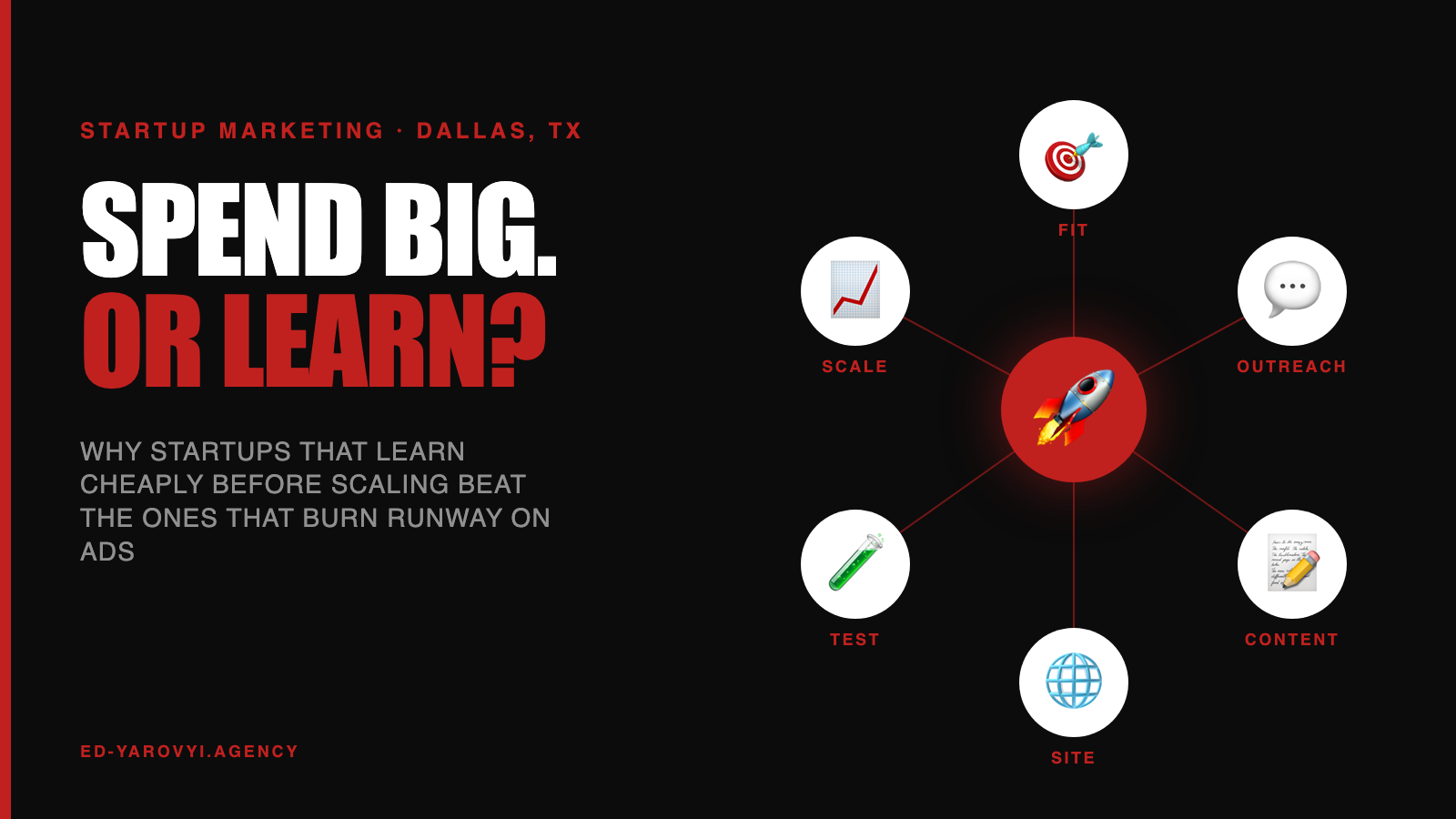
A startup is not a small version of a big company — it is a search for a repeatable, scalable business model. That changes marketing entirely. Before you have proven who your customer is and what makes them buy, spending big on ads is just burning money faster. Early marketing is about learning; later marketing is about scaling what you learned.
Five things that make startup marketing unusual
- Finding fit comes before scaling — you cannot scale marketing that has not proven it converts, so early spend is for learning
- Budgets are tight and precious — every dollar has to teach you something or earn something
- Messaging is unproven — you are still discovering the words that make your customer care
- Speed and iteration matter — startups win by learning faster, so quick tests beat big campaigns
- Founder involvement is an asset — the founder’s story and direct outreach often outperform any polished ad early on
Get the sequence right — learn, then scale — and a startup makes its limited budget go far. Get it wrong and even a well-funded company burns out chasing growth it never validated.
Building a marketing foundation before the raise
Founders often assume serious marketing waits until there is funding. The opposite is true: the foundation built before the money is what makes the money work later. The U.S. Bureau of Labor Statistics reflects how strategic marketing has become its own discipline, and the startups that treat it that way early move faster once capital arrives.
A pre-raise foundation is cheap but powerful: a clear message you have tested on real customers, a converting website, the beginnings of a content presence, and a handful of case studies or testimonials from early users. With that in place, marketing for startups Dallas founders scale becomes amplification of something proven, not a gamble. Without it, a raise just funds faster guessing.
Metrics a startup should actually track
Vanity metrics kill startups by making failure feel like progress. Followers and impressions are not the point. The numbers that matter tie directly to the business model and to whether marketing is working.
Track cost per acquisition so you know what a customer costs to win, conversion rate at each step so you see where the funnel leaks, customer lifetime value so you know what a customer is worth, and the ratio between the two, which tells you whether growth is sustainable. Watch retention closely, because a leaky bucket cannot be filled by more spending. These are the numbers that tell a founder whether to scale, fix, or pivot, and they are the honest scoreboard behind every good marketing decision.
The founder’s role in early marketing
In the earliest stage, the founder is the marketing, and that is a strength, not a weakness. No one understands the problem, the customer, and the vision better, and no hired hand can fake the authenticity a founder brings. Marketing for startups Dallas founders lead personally almost always outperforms polished but generic outsourced work in the beginning.
That means the founder should be visible: sharing the story, talking to customers directly, posting what they learn, and putting a real human face on the company. This builds trust, sharpens the message through real conversations, and often creates the first genuine audience the startup has. It does not scale forever, and that is fine, because its job is to find what works while the stakes are low.
The transition comes later. Once the message is proven and the founder’s time becomes the bottleneck, the systems and the help step in to scale what the founder discovered. But skipping the founder-led stage to outsource early is how startups end up with marketing that sounds like everyone else and resonates with no one. Lead it yourself first, then build the system to carry it.
Do not scale marketing until it converts on a small scale first. Pouring budget into unproven messaging is the fastest way a startup wastes a runway. Find what works cheaply, then amplify it.
Marketing for startups Dallas founders can do with little budget
Before there is real budget, the best startup marketing is cheap, direct, and built for learning. Here is where a founder should focus first.
1. Direct outreach and conversations
Nothing teaches you more than talking directly to potential customers. Founder-led outreach — messages, calls, coffees — validates your messaging, surfaces objections, and lands the first customers. It does not scale, and that is fine; early on, learning matters more than reach.
2. Content that builds authority
Content is the highest-leverage cheap channel for a startup. Sharing what you know builds trust, attracts your ideal customer, and compounds over time. A founder who writes and posts consistently becomes a magnet for the exact people they want to reach. The content marketing system guide covers how to make that sustainable.
3. A website that converts the traffic you earn
Every early visitor is precious, so the site has to convert. A fast, clear, conversion-focused site turns hard-won attention into signups and sales. The conversion focused web design guide covers what that takes.
4. Organic social and community
Showing up where your customers already gather — communities, social platforms, local events — builds awareness without ad spend. For a Dallas startup, local networks and founder communities are a genuine early channel.
When and how to start spending
Once you have proof that your messaging converts and you know your customer, spending makes sense — to amplify what already works, not to discover it. This is the moment paid channels earn their place.
- Amplify proven messaging — put budget behind the message and offer that already converted organically
- Start small and measure — test paid channels with modest spend and clear metrics before scaling
- Build systems as you grow — automation and content systems let a small team scale without proportional headcount
- Protect the runway — scale spend against proven return, not hope
Here is my honest take: the startups that win at marketing are not the ones that spend the most — they are the ones that learn the fastest and scale only what works. The marketing budget Dallas guide covers how to think about that spend.
Startup marketing mistakes that burn runway
Knowing the traps protects the runway. These are where Dallas startups waste money and time.
- Scaling before fit — spending big on ads before the messaging converts burns cash with nothing to show
- Doing everything at once — spreading a tiny budget across every channel means none of them get a real test
- Ignoring what the data says — falling in love with a channel that is not working wastes precious runway
- Outsourcing too early — handing marketing to an agency before you understand your own customer produces generic results
For a founder, the right early partner is not a big agency but someone who builds the systems with you and moves fast. This is the model I run: strategy, content, web, and automation handled end-to-end by one operator, built to learn quickly and scale what works, with no handoffs and no bloated retainer. The marketing agency vs in-house guide covers that decision for a growing company.
How should a startup approach marketing on a small budget?
Focus on cheap, direct, learning-oriented channels first: founder outreach, content that builds authority, a converting website, and organic community presence. Marketing for startups Dallas founders run early is about finding what resonates, not spending big before you know your customer.
When should a startup start spending on ads?
Once you have proof that your messaging converts organically and you know your customer. Then paid spend amplifies what already works rather than trying to discover it. Start small, measure clearly, and scale against proven return to protect your runway.
What is the biggest marketing mistake startups make?
Scaling before finding fit — pouring budget into unproven messaging. It burns cash with nothing to show. The startups that win learn fastest on a small scale, then amplify only what has already proven it converts.
Should a startup hire a marketing agency?
Rarely a big one early on. Before you understand your own customer, a generic agency produces generic results. A better early partner is someone who builds the systems with you, moves fast, and helps you learn — not a bloated retainer with layers of account managers.
What marketing channels work best for a Dallas startup?
Early on, founder-led outreach, authority-building content, a conversion-focused website, and organic social and local community presence. These are cheap, teach you what resonates, and compound — the right foundation before any paid scaling.
How much should a startup spend on marketing?
Early on, spend to learn, not to scale. Keep budgets small and tied to clear experiments until you know which message and channel bring customers at a sustainable cost. Once something proves it works, increase spend on that channel. Pouring money into marketing before you know what converts is the fastest way to burn runway.
How do I get my first customers as a startup?
Go direct. Talk to potential customers yourself through your network, communities, and direct outreach, and offer to solve their problem closely in exchange for feedback. In Dallas, founder communities and meetups such as The DEC Network are good places to start. Early customers usually come from conversations, not ads.
When should a startup start marketing?
Before launch, but in a learning mode. Start building an audience, a waitlist, and conversations with potential customers while the product is still taking shape, so you launch to people who already care. Save heavy ad spending for after you know what converts.