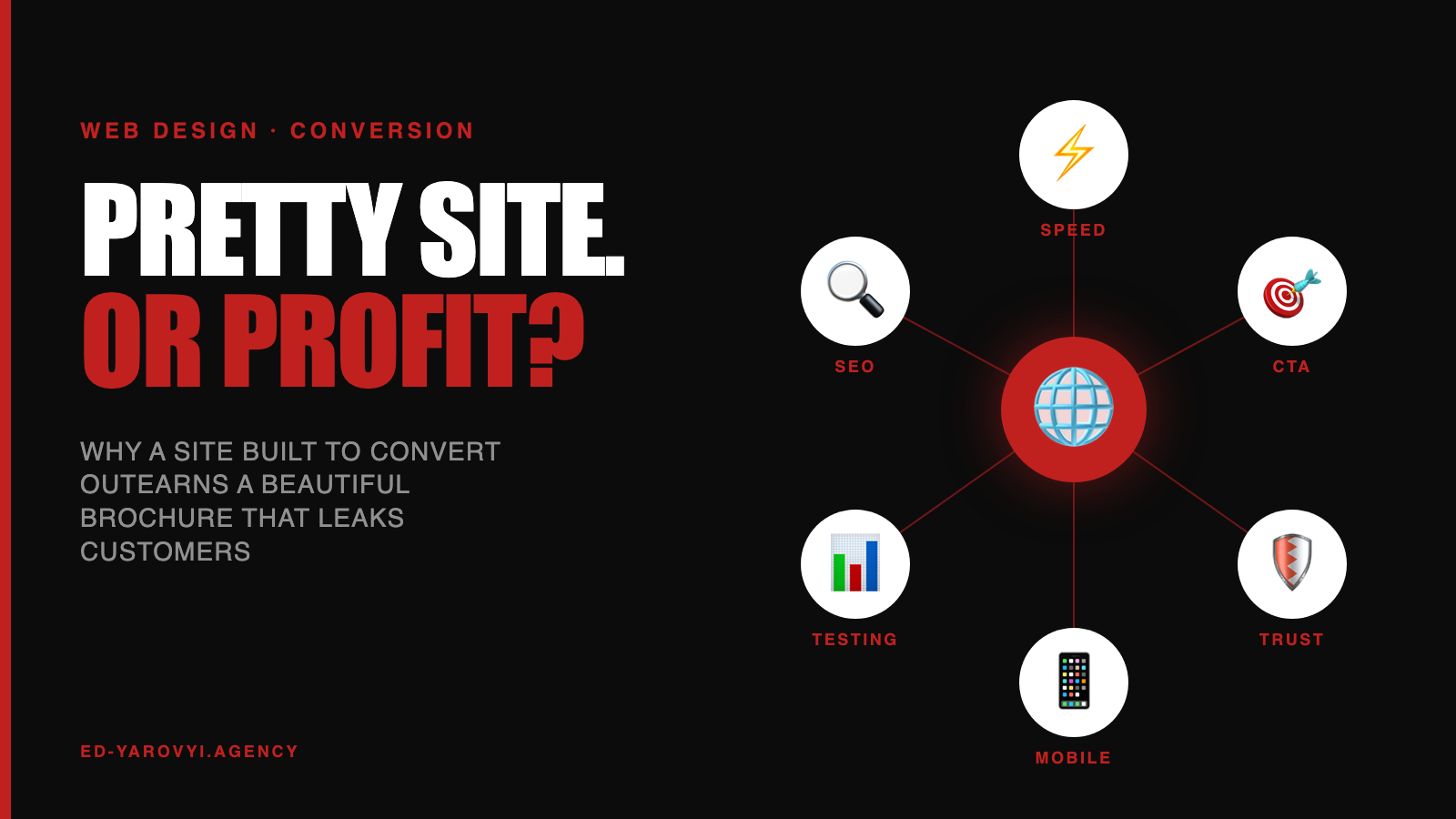
Conversion focused web design is the difference between a website that looks nice and one that makes money. Most business websites are digital brochures — pretty, static, and quietly losing the majority of the visitors they worked so hard to attract. A conversion-focused site is built with one job in mind: turn visitors into calls, bookings, and sales. The U.S. Bureau of Labor Statistics tracks strong demand for web development precisely because a website is now a business’s hardest-working salesperson, and most businesses have it working part-time at best.
I build websites end-to-end — design, development, on-page SEO, tracking, and A/B testing, all aimed at conversion. So this guide breaks down conversion focused web design in 2026: what makes a site actually convert, the mistakes that leak customers, and how to think about a website as a revenue tool instead of an online business card.
Why most business websites fail to convert
The typical business website is designed to look good in a portfolio, not to convert a real visitor. It leads with a vague headline, buries the phone number, loads slowly on mobile, and never tells the visitor exactly what to do next. Beauty without conversion is expensive decoration.
Five reasons websites leak customers
- Slow load times — visitors leave before the page even appears, especially on mobile
- No clear next step — a page with no obvious call to action leaves visitors to figure it out, so they leave
- Vague messaging — if a visitor cannot tell what you do and why to choose you in seconds, they bounce
- Friction to contact — a hidden phone number or a long form kills the visitors who were ready to act
- No trust signals — no reviews, credentials, or proof means no reason to believe you over a competitor
Fix these and the same traffic produces far more business. Conversion focused web design is often the highest-return marketing investment there is, because it multiplies the value of every other channel that sends people to the site.
The pages that matter most for conversion
Not every page carries the same weight. A conversion focused web design concentrates effort where decisions actually happen, rather than polishing pages nobody uses to convert.
The homepage has seconds to make a visitor understand what you do and why to choose you, then point them to the next step. Service or product pages are where interest becomes intent, so they need clear benefits, proof, and an obvious call to action. The contact or booking page is where the money is made, and every ounce of friction removed there directly lifts revenue. And landing pages for specific campaigns should match the ad that sent the visitor, with one focused goal and nothing to distract from it.
Get these few pages right and the rest of the site can be simple. Most businesses spread design effort evenly and under-invest in exactly the pages where conversion is won or lost.
Common conversion killers to fix first
Before adding anything, remove what is leaking customers. A conversion focused web design starts by fixing the obvious drains that quietly cost a business every day.
Slow mobile load times top the list, followed by unclear or buried calls to action, walls of text with no scannable structure, forms that ask for too much, and missing trust signals at the moment of decision. Auto-playing media, intrusive popups, and confusing navigation all push visitors away too. None of these are hard to fix, and each one recovered is revenue that was already within reach. The fastest conversion gains almost always come from removing friction, not adding features.
Conversion is a process, not a one-time project
The biggest misconception is that a website is finished at launch. In reality, the launch is the starting line. The best-performing sites are the ones that get measured and improved continuously, because visitor behavior, competitors, and markets all shift over time.
A simple ongoing rhythm keeps a site sharp: review the data monthly, form a hypothesis about what is holding conversion back, test a change, and keep what works. Small, evidence-based improvements to headlines, calls to action, page layout, and load speed compound into a meaningfully higher conversion rate over a year. The businesses that treat their site as a living asset pull steadily ahead of those that build once and forget it.
This is why I build tracking and testing in from the start rather than bolting them on later. A site that cannot be measured cannot be improved, and a site that is never improved slowly falls behind. Treating conversion as an ongoing process, not a one-time project, is what keeps a website earning more from the same traffic year after year.
Clean, structured markup pays off beyond the search results page. It is also the groundwork for generative engine optimization, where AI systems need to parse your pages without guessing.
Doubling your conversion rate is the same as doubling your traffic — but far cheaper. Before spending more to attract visitors, make sure the site actually converts the ones you already have. That is the leverage in conversion focused web design.
What makes a website actually convert
Conversion is not magic — it is a set of deliberate choices. Here is what I build into a site to turn visitors into customers.
1. Speed and mobile-first performance
Most visitors arrive on a phone, and every second of load time costs conversions. A conversion-focused site loads fast on mobile first, because a slow site loses the customer before the message ever lands. Performance is the foundation everything else sits on.
2. A clear message and one obvious action
Within seconds, a visitor should know what you do, why you are the right choice, and exactly what to do next. One primary call to action, repeated clearly, beats a page cluttered with competing options. Clarity converts; confusion bounces.
3. Trust signals in the right places
Reviews, credentials, real photos, and results reassure a visitor at the moment of decision. Placing trust signals where hesitation happens — near the call to action, on the pricing page — turns doubt into action. This is the same credibility logic behind the Rival Sign Company case.
4. Frictionless contact and conversion paths
Every extra step between interest and action costs customers. A visible tap-to-call button, short forms, and easy booking remove friction exactly where visitors are ready to convert. The easier you make it to act, the more people do.
Tracking and testing: how conversion improves over time
A conversion-focused site is never finished — it improves with data. Without tracking, you are guessing; with it, every change is informed. This is where a real web build separates from a template.
- Proper tracking — knowing where visitors come from and where they drop off is the starting point for any improvement
- A/B testing — testing headlines, layouts, and calls to action turns opinions into evidence
- Heatmaps and behavior — seeing how visitors actually use the page reveals what to fix
- Ongoing refinement — small, tested improvements compound into a meaningfully better conversion rate over time
On-page SEO belongs here too: a site built to convert should also be built to be found. The website development Dallas guide covers the build side, and the marketing cost Dallas breakdown covers where a site fits in the budget.
Redesign or rebuild: what your business actually needs
Not every underperforming site needs a full rebuild. Sometimes targeted conversion fixes on a solid foundation deliver most of the gain; sometimes the foundation itself is the problem. Knowing which saves money.
- Conversion tune-up — if the site is technically sound but converts poorly, targeted fixes to messaging, speed, and calls to action can transform results
- Full rebuild — if the site is slow, outdated, or built on a shaky platform, a conversion-focused rebuild is the better investment
- Start with the data — tracking reveals whether you have a traffic problem or a conversion problem before you spend a dollar
This is what I build end-to-end: design, development, on-page SEO, tracking, and A/B testing, all aimed at turning traffic into revenue, handled by one operator with no handoffs. If it needs a website, I code it myself. The how to choose marketing agency Dallas guide covers picking the right partner for it.
For benchmarks and quick fixes, read what a good website conversion rate is.
What is conversion focused web design?
It is designing and building a website with one goal: turning visitors into calls, bookings, and sales. Conversion focused web design prioritizes speed, clear messaging, trust signals, and frictionless action over decoration, so the site works as a salesperson rather than a brochure.
Why isn’t my current website getting me customers?
Usually because it is built to look good, not to convert. Slow load times, vague messaging, no clear call to action, hidden contact options, and missing trust signals all leak customers. Fixing these often produces more business from the same traffic.
Is improving conversion better than getting more traffic?
Often, yes. Doubling your conversion rate is like doubling your traffic but far cheaper, and it multiplies the value of every other channel. Before spending more to attract visitors, make sure the site converts the ones you already have.
Do I need a full rebuild or just fixes?
It depends on the foundation. A technically sound site that converts poorly may just need targeted fixes to messaging, speed, and calls to action. A slow, outdated, or shaky site is better rebuilt. Start with tracking data to know which problem you actually have.
How is conversion measured and improved?
Through proper tracking, A/B testing, and behavior tools like heatmaps. Tracking shows where visitors drop off, testing turns opinions into evidence, and ongoing small improvements compound into a meaningfully higher conversion rate over time.
What is a good conversion rate for a website?
It depends heavily on the industry and on what counts as a conversion, so there is no single right number. Many sites land in the low single digits for form submissions or purchases. The most useful benchmark is your own: measure where you are today, then improve it step by step through tracking and testing.
What is a website conversion rate?
It is the share of visitors who take the action you want, such as calling, booking, filling out a form, or buying. If 1,000 people visit and 20 contact you, your conversion rate is 2 percent. It tells you how well your site turns attention into business, which makes it one of the most important numbers to track.
How do I improve my website’s conversion rate?
Start by removing friction. Speed up mobile loading, make your message clear in the first few seconds, put one obvious call to action on every page, show reviews and credentials near that action, and shorten your forms. Then test one change at a time so you know what actually helped.