The DFW med spa market in 2026 has been on a tear since 2022. New locations opening every month. Owners crossing over from nursing, dentistry, plastic surgery, and corporate careers. Most of them are betting that demand will keep growing — which it will. Most of them will also lose money for 18 months because med spa marketing in Dallas is a specialized discipline and the playbook is different from what works for restaurants, dentists, or home services.
This piece is what actually moves the needle for a Dallas, Plano, Frisco, or Highland Park med spa in 2026. Channels that produce bookings, real pricing, what visual content actually has to look like, and where most owners get sideways in their first year. I have advised friends running med spas across DFW; the patterns are consistent enough to write down honestly.
What “Med Spa Marketing in Dallas” Actually Means in 2026
Med spa marketing in Dallas in 2026 is not just paid ads or pretty Instagram posts. It is a system designed around three structural realities of the category: high upfront cost per service (so margin matters), strong visual demand (clients buy with their eyes), and intense local competition (DFW added more med spas per capita in 2024 than any other Texas metro outside Houston).
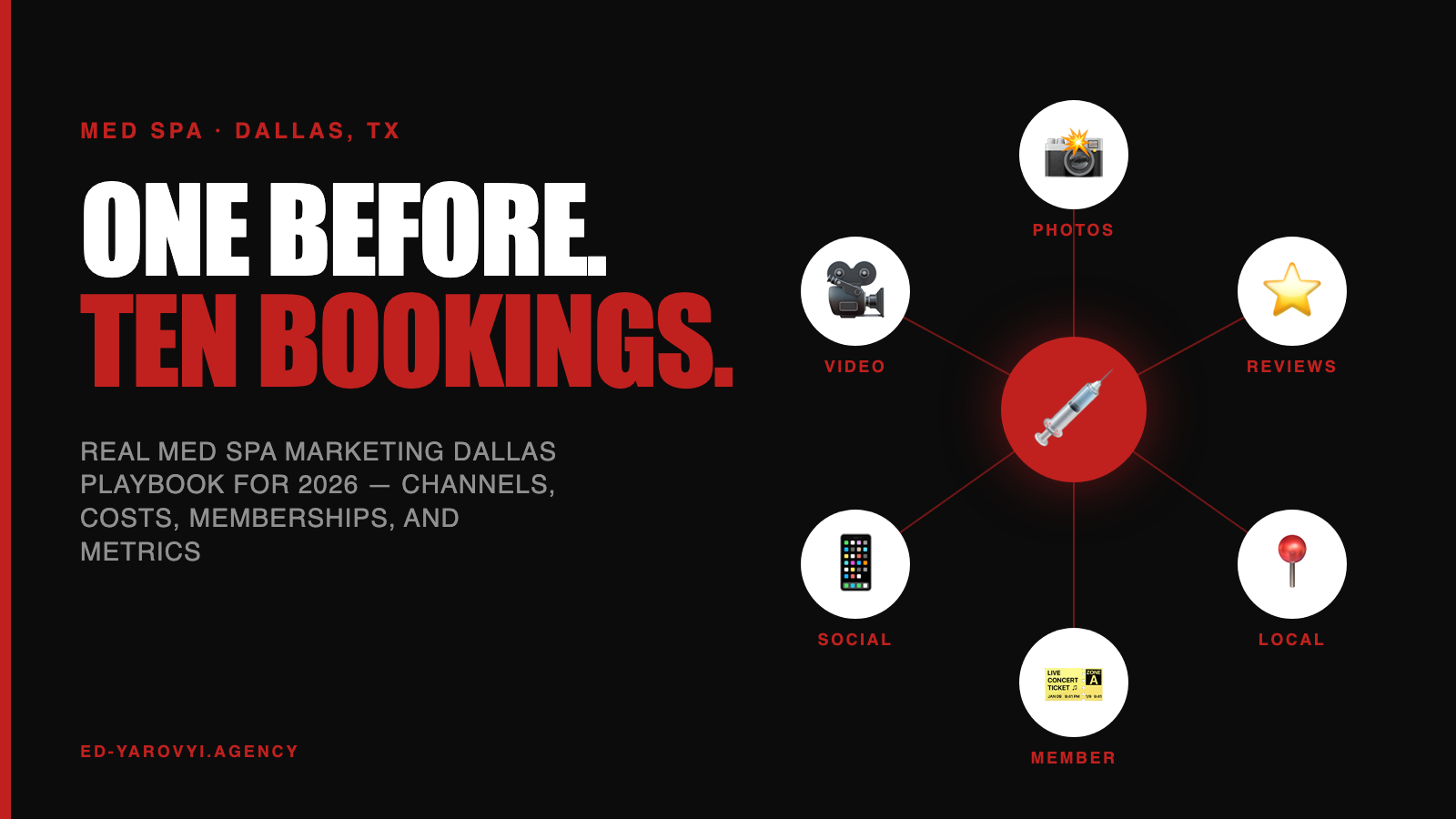
Six channels carry most med spas in DFW:
- Visual content — photos and videos. Before/after content, treatment demonstrations, staff intros. The single highest-leverage asset for any med spa marketing effort. Nothing else converts as efficiently.
- Google Business Profile + reviews. The local pack rules “med spa near me” searches. Profiles with 200+ reviews and weekly photo uploads dominate suburb-level queries.
- Local SEO and content. Pages targeting “lip filler Plano,” “Botox Highland Park,” “laser hair removal Frisco.” Specific service + neighborhood combinations.
- Email and SMS retention. Med spa lifetime value is high because clients return monthly for ongoing treatments. Retention drives 50–70% of revenue in mature practices.
- Paid social — Meta and Instagram. Higher leverage for med spa than for most categories because of strong visual fit. Lower cost per booking than Google Ads for awareness-stage clients.
- Membership and loyalty programs. The financial backbone of established med spas. Predictable monthly revenue smooths cash flow and compounds lifetime value.
What is not on the list: billboards, print ads, generic “med spa Dallas” Google Ads at the head term level, and TV. These channels still produce occasional results but they do not compound and they do not match category economics in 2026.
Channels That Bring New Clients in DFW Med Spas
Channel by channel, what actually produces bookings.
Visual content. Most successful DFW med spas produce 8–20 pieces of visual content per month — before/after photos, treatment process videos, staff introductions, satisfied-client testimonials with explicit permission. Distributed on Instagram Reels, TikTok, and the practice’s own website. Cost: $1,200–$5,000 per month including production. Return: typically 25–40% of new client volume in mature practices.
Google Business Profile. Critical and most med spas underbuild it. Complete profile, every service listed with pricing or “starting at” pricing, weekly photo posts of the office and recent before/afters (with permission), hours accurate, phone matched to website. Cost: free if managed in-house, $400–$900 per month if outsourced. Return: 10–25 new client inquiries per month for an established Plano or Frisco profile.
Local SEO. Service-and-neighborhood landing pages. “Botox Bishop Arts,” “lip filler Frisco,” “morpheus8 Highland Park.” Three categories of content compound here: service explainer pages, neighborhood-targeted pages, and treatment comparison pages. Cost: $1,500–$4,500 per month. Return: 5–15 new bookings per month after 9 months of compounding traffic.
Paid social. Meta and Instagram are where most med spa paid budget should sit in 2026. Cost per lead averages $30–$120 in DFW depending on service tier. Cost per booking: $80–$280. Significantly more efficient than Google Ads for awareness-stage clients. According to the American Med Spa Association’s State of the Industry Report, visual social channels have been the dominant new-client acquisition path for medical aesthetics practices since 2023, and DFW reflects that pattern strongly.
Email and SMS retention. Cost: $200–$1,200 per month including platform and management. Return: 50–70% of mature practice revenue. Members and existing clients drive predictable monthly revenue; ignoring them is the most common mistake new med spas make.
Membership programs. $99–$249 per month tiered memberships covering one or two services and discounting others. Build to 80–250 active members in year two. At 150 members paying $149/month, that is $22,350/month in predictable revenue before walk-ins. Most DFW med spa owners overlook this as a marketing lever because it feels like operations.
How Much Med Spa Marketing in Dallas Costs in 2026
Real numbers from active engagements in the last twelve months across DFW.
- New med spa (year 1): $4,500–$9,500/month — heavy on visual content + launch ads
- Established single location: $6,000–$13,000/month
- Multi-location group (2–4 locations): $12,000–$28,000/month
- Visual content production alone: $1,200–$5,000/month
- Cost per new client (target): $80–$280 in DFW
- Average client lifetime value: $2,400–$8,500 (depending on service mix and retention)
The 4–8% of revenue rule from marketing cost Dallas applies but typically skews higher for med spas — usually 7–11% in year 1, 5–8% in established phase. Higher than most categories because visual content production is expensive and competitive Meta ads costs are elevated.
A Plano med spa doing $1.2M in revenue should expect to spend $84K–$132K per year on marketing, which lines up to $7,000–$11,000 per month. Anything below $5,000 per month in a competitive DFW suburb in 2026 usually means undermarketing relative to competitors who are spending the upper range. This is a high-investment category by structural necessity.
Why Visual Content Carries the Med Spa Load
Med spa is one of the few categories where visual content is not optional — it is the primary marketing asset. Three reasons.
First, the service is intrinsically visual. Patients evaluating Botox, lip filler, body contouring, or laser treatments want to see before/after evidence. They will scroll your Instagram, search “your-spa-name reviews,” and look at your website gallery before booking. Practices with thin visual portfolios lose to practices with deep ones, regardless of clinical skill.
Second, social platforms reward visual content with reach. Instagram Reels, TikTok, and YouTube Shorts surface med spa content to people not following you. Organic reach for med spa content runs 3–10× higher than equivalent text-based content. The trade-off is production cost; it is real.
Third, trust transfer. Clients evaluating med spas read reviews but also need to feel confident in the clinical environment. Video tours of the practice, staff introductions, treatment process videos — these build the trust that converts a comparing visitor into a booking.
Production: most successful DFW med spas budget $1,500–$4,000 per month for content production. Smaller spas can self-produce with iPhone 15+ and a $400 lighting kit. Quality is acceptable but distribution discipline matters more than production polish. Three posts per week is the floor; daily is the ceiling. Consistency wins over occasional high-polish drops.
Reviews, Before/Afters, and the Trust Layer
The trust layer is where most DFW med spas underbuild. Three components.
Google reviews. Target: 5–15 new reviews per month for an active practice. Method: ask in-person right after a successful treatment, hand patient a QR code with the Google review link. Roughly 30–40% of patients asked at that moment leave a review within 48 hours. Practices with 200+ reviews at 4.7+ stars dominate local pack rankings in their service area.
Before/after content. Requires explicit written consent from each patient. Use the platform’s photo or video disclosure forms. Practices with 50+ before/after sets visible on their website and Instagram routinely outperform comparable practices with sparse portfolios.
Testimonials with permission. A 30-second video testimonial from a happy patient converts at 3–5× the rate of written reviews for prospective med spa clients. Pull these regularly. Most owners feel awkward asking; doing it anyway is what separates growing practices from stalled ones.
The trust layer compounds. A practice that builds review velocity and before/after depth in year one accelerates in year two because new prospects increasingly find them through search and trust them at first contact. The La Bare Dallas content engine is a useful analog — different niche but same compounding principle: consistent visual output produces compounding reach over months and years.
Plano, Frisco, Highland Park, and DFW Med Spa Submarkets
Suburb-level differences matter in DFW med spa more than most categories. Four distinct submarkets. The same hyper-local logic that drives dental marketing Dallas applies here — DFW patients rarely drive more than 15 minutes for routine aesthetic treatments, so generic citywide marketing underperforms tightly geo-fenced suburb-level campaigns by a significant margin.
Plano and Frisco. High household income, family-oriented, dense competition. Buyers research extensively. Membership programs convert better here than in lower-income suburbs. Census Bureau Plano profile shows median household income above $105K — that audience expects polished marketing and pays for it.
Highland Park and Park Cities. Very high household income, brand-conscious, premium positioning required. Pricing skews higher; volume is lower. Marketing emphasizes exclusivity and discretion. Generic “deal” promotions backfire here.
Bishop Arts, Deep Ellum, Uptown. Younger demographic, social-media-driven discovery, faster decision cycles. Instagram and TikTok carry disproportionate weight. Smaller average ticket but higher transaction frequency.
McKinney, Allen, Richardson. Middle-market growth corridor. Value-conscious clients who still want quality. Honest pricing and clear membership benefits outperform luxury positioning. Word-of-mouth and referrals matter more than paid acquisition.
One generic “DFW med spa marketing” playbook applied across all four submarkets underperforms a targeted submarket-specific approach by a significant margin. The marketing consultant in Frisco piece walks through how submarket awareness shapes channel choice.
Common Med Spa Marketing Mistakes
Five patterns that derail new and growing med spas.
Running Google Ads before reviews are healthy. A prospective client clicks your Google Ad, lands on a profile with 14 reviews at 4.2 stars, and bounces. Money lost. Fix the trust layer before paying for clicks. Reviews and before/afters first; paid ads after.
Treating membership programs as an afterthought. Memberships are not a loyalty perk; they are the financial backbone of mature med spas. New practices should design the membership program before opening and start enrolling clients in week one.
Generic before/after content. Stock before/after photos pulled from product manufacturer websites violate Instagram and TikTok policies and look obviously fake to prospective clients. Always your own clients, with written permission, with the practice’s name visible somewhere in the production.
Overpaying for influencer collaborations. The med spa influencer market in DFW has matured; rates have not all matched value delivered. Micro-influencers in specific neighborhoods (50K–200K followers, geo-concentrated) typically outperform mega-influencers (1M+ followers) for med spa client acquisition. Test small; scale only what proves out.
Ignoring email and SMS retention. Most DFW med spas focus 80% of marketing budget on new client acquisition and 20% on retention. Mature practices flip that ratio — retention is where margin lives. Build retention systems early; do not wait until growth stalls.
Metrics That Tell You Med Spa Marketing in Dallas Is Working
Five numbers tell you whether your med spa marketing is producing returns. Track these monthly.
- New clients per month. Headline metric. Healthy growth practice: 30–80 per month.
- Cost per new client. Marketing spend divided by new client count. Target: $80–$280 in DFW.
- Client lifetime value. Average revenue per client over their relationship with the practice. Healthy DFW range: $2,400–$8,500.
- Membership conversion rate. What percent of new clients become members. Healthy: 18–35%. Below 10% means the membership offer is broken.
- Reactivation rate. What percent of lapsed clients return within 12 months. Healthy: 25–40%. Driven by email and SMS retention systems.
Track these monthly. Practices that track them outperform practices that do not by 2–3× in revenue per location, based on data I see across DFW med spa engagements. The math is repeatable. The discipline of tracking is what most owners skip.
Per the BLS data on skincare specialists, DFW employment in aesthetic services has grown steadily — the talent pool exists, but the marketing density rises with it.
At the opposite end of the margin scale, marketing for restaurants Dallas shows what a 3–5% marketing budget has to prioritise.
How much does med spa marketing in Dallas cost in 2026?
New DFW med spas in year 1 typically spend $4,500–$9,500 per month, weighted toward visual content and launch ads. Established single locations spend $6,000–$13,000 per month. Multi-location groups: $12,000–$28,000 per month. Med spa marketing typically runs 7–11% of revenue in year 1, dropping to 5–8% once retention systems mature.
What is the most effective channel for med spa marketing in Dallas?
Visual content distributed on Instagram and TikTok, supported by Google Business Profile and reviews. Before/after content, treatment process videos, and staff intros convert at significantly higher rates than text-based marketing. Paid social on Meta typically outperforms Google Ads at the awareness stage because of strong visual fit.
Do I need a membership program for my Dallas med spa?
Yes for any med spa planning to scale beyond walk-in revenue. Memberships build predictable monthly revenue, smooth cash flow, and dramatically increase client lifetime value. Most successful DFW med spas have 80–250 active members by year two, typically at $99–$249 per month tiered pricing.
What is a good cost per new client for med spa marketing in Dallas?
$80–$280 in DFW depending on service tier and competitive density. Higher-ticket services (body contouring, laser packages) can sustain costs at the upper range; standard injectable practices target the lower range. Costs above $300 per new client for 3+ months indicate broken funnel — usually thin reviews, website conversion friction, or wrong channel mix.
Should my Dallas med spa run Google Ads or Meta ads?
Meta and Instagram for awareness and brand discovery — strong visual fit and lower cost per click in 2026. Google Ads for high-intent searches like “Botox near me” or specific treatment + neighborhood queries. Most DFW med spas allocate 60–70% of paid budget to Meta and 30–40% to Google Ads in 2026.
How long until med spa marketing in Dallas shows results?
Paid social: 2–4 weeks for initial signal. Google Business Profile optimization: 4–8 weeks for ranking lift. Local SEO content: 3–6 months. Visual content compounds over months but builds momentum once 30+ posts are published. Plan for 90 days before judging whether the marketing is working and require cost per new client reporting throughout.
How does med spa marketing differ in Plano vs Highland Park vs Bishop Arts?
Plano and Frisco favor membership programs and family-oriented marketing with high research-driven buyers. Highland Park and Park Cities require premium positioning and discretion; deal promotions backfire. Bishop Arts, Deep Ellum, and Uptown skew younger and social-media-driven with faster decision cycles. McKinney and Allen reward honest value-conscious messaging. Generic DFW positioning underperforms targeted submarket approaches significantly.