The Dallas dental market in 2026 has more competition than most operators realize. There are roughly 4,500 licensed dentists practicing in the DFW metro, and the population keeps growing — about 200 new residents per day. Plenty of demand. Also plenty of supply. Most dental practices I see in Dallas underperform their location because they pick the wrong two marketing channels and run them with no system underneath.
This piece is what dental marketing Dallas actually requires in 2026 to bring new patients in — not in theory, in real practice. I have helped friends in Plano, Frisco, and the M Streets run this play, and the math is repeatable. Channels, costs, what works for general practice versus pediatric versus implants, and the mistake almost every Dallas dental practice makes with its website. Numbers are real Dallas numbers from 2025–2026 engagements, not survey averages.
What “Dental Marketing Dallas” Actually Means in 2026
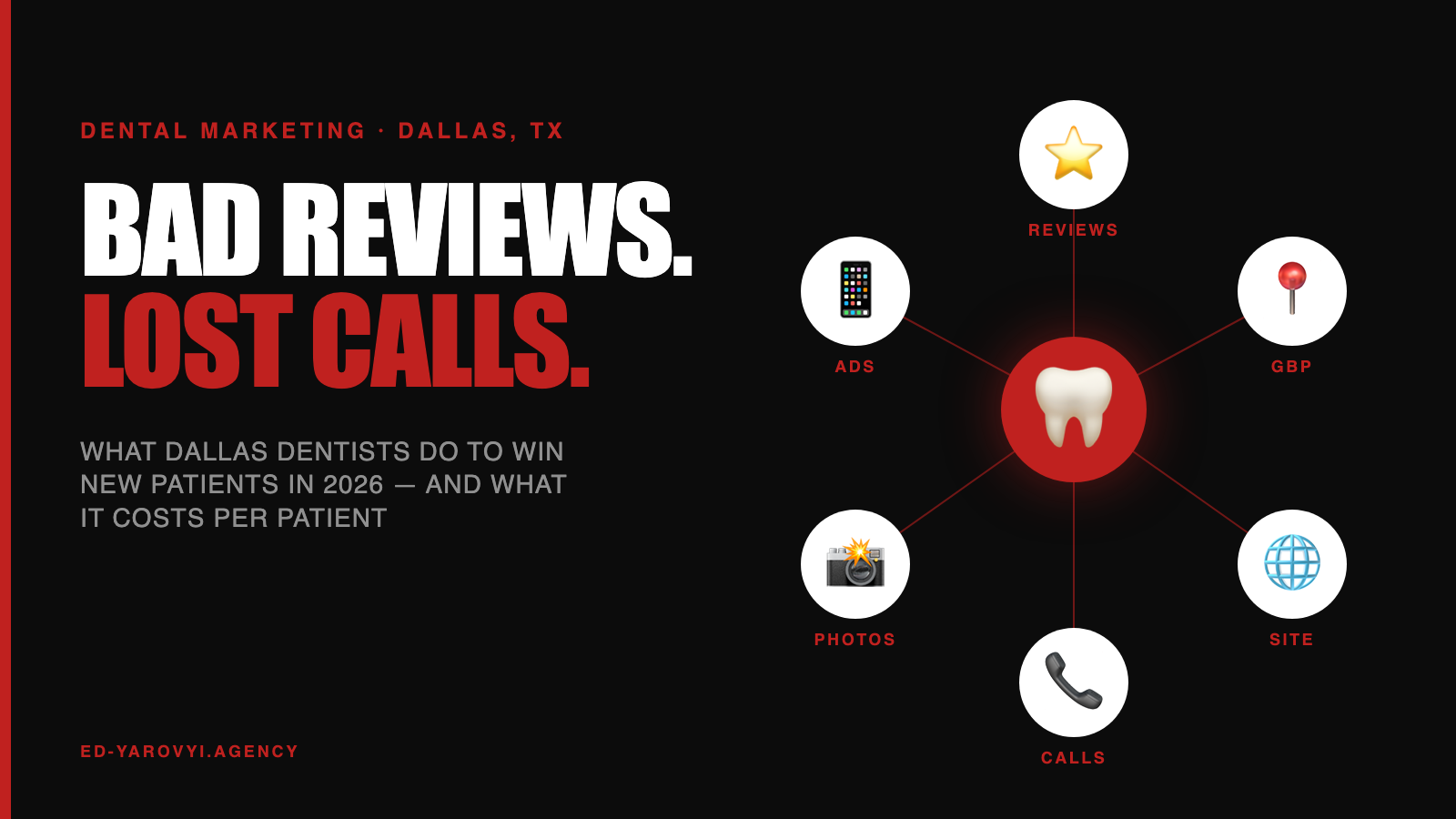
Dental marketing Dallas in 2026 is not “run some ads.” It is a connected system of five channels, each of which feeds the others, all measured against one number: cost per new patient (CPNP). Without CPNP, you cannot tell which channel works. Most Dallas dental practices track impressions and clicks, which tell you nothing about whether your chair is full.
The five channels that matter, in order of leverage for a Dallas general practice:
- Google Business Profile and reviews. The single most-clicked search result for “dentist near me” in any Dallas neighborhood is the local pack — three GBP listings with star ratings. If you are not in there, you are invisible.
- Local SEO and content. Pages on your site targeting Dallas-specific queries: “dental implants Bishop Arts,” “pediatric dentist Plano,” “emergency dentist Uptown.” Long-tail, low competition.
- Website conversion. Most dental sites in Dallas look fine and convert poorly. Booking friction, slow mobile load, no clear “new patient” path.
- Paid ads. Google Ads for high-intent searches, Meta for awareness in specific neighborhoods. Useful, but expensive if the previous three are broken.
- Email and SMS retention. The cheapest channel. The one Dallas dentists ignore most. Existing patients drive 60–70% of revenue in a healthy practice.
If the first three are not solid, paid ads will burn money. That is the order operators want to fix, not the order vendors will sell.
New-Patient Acquisition Channels That Actually Work in Dallas
Channel by channel, what I see produce real new patients for Dallas dental practices in 2026.
Google Business Profile. The highest-leverage free asset a Dallas dentist has. Optimization basics: complete profile, every service listed with descriptions, weekly photo posts of the office and staff, hours accurate, phone matched to website. Review volume is the multiplier. A Dallas dentist with 180 reviews at 4.8 stars outranks one with 45 reviews at 4.9 in almost every “near me” query I have tested.
Local SEO. A page per major service-and-neighborhood combination on your website. “Dental implants Uptown Dallas.” “Pediatric dentistry Lakewood.” “Emergency dentist Deep Ellum.” These pages are easy to write, easy to rank, and bring people who are 90% ready to book. The Google Search Central docs on structured data give the schema basics — most Dallas dental sites do not implement them and lose enhanced snippets to competitors who do.
Referrals from other dentists. Implant cases, oral surgery, orthodontics — referrals from general practitioners drive the highest-value patients. This is a relationship channel, not a marketing channel. But the marketing piece is making sure those referral patients can find your booking link in two clicks.
Paid search. Google Ads for emergency queries (“emergency dentist Dallas,” “tooth pain Dallas”) works because intent is maximum. Avoid broad terms like “best Dallas dentist” — high cost per click, low conversion, drained budget by week three.
Local community marketing. Sponsoring the Bishop Arts farmers’ market, the Plano youth soccer league, the Highland Park PTA. Old-school, slow, but creates the trust that converts in years two and three. Dallas is a relationship town in many neighborhoods. Marketing has to acknowledge that. If you want the full filter for hiring outside help on any of these channels, the 12 questions before signing a marketing agency piece walks through it.
How Much Dental Marketing in Dallas Costs in 2026
Real numbers from Dallas dental practices in the last twelve months. These are total monthly marketing spend, not retainer-only.
- Solo general practice, 1 location: $2,500–$6,000/month total
- Established 2-dentist practice: $4,500–$10,000/month
- Multi-location group (3–5 offices): $9,000–$25,000/month
- Specialty (implants, ortho, pediatric): $5,000–$15,000/month
- Cost per new patient (target): $80–$250 general / $300–$900 specialty
- Patient lifetime value (Dallas avg): $1,800–$4,500 general / $7,000+ specialty
A solo general dentist in Plano spending $4,000/month on dental marketing Dallas should target 25–50 new patients per month at $80–$160 cost per new patient. If you are spending $4,000 and adding 8 new patients, something in the system is broken. Diagnose before adding budget.
For full agency pricing context in DFW, I broke down the tiers in marketing agency pricing in Dallas. Dental practices typically sit in the solo / boutique tier with a tighter scope focused on the five channels above.
What I Tell Dentist Friends About Paid Ads
Three rules I give every Dallas dentist before they start paid ads. These overlap heavily with the channel logic from my La Bare Dallas social media work — different niche, same principle: intent and geo-fence beat reach every time.
First, do not run paid ads until Google Business Profile and review velocity are healthy. A patient who clicks your Google Ad then sees you have 12 reviews at 4.2 stars is gone. Fix the trust layer first.
Second, target intent, not interest. A Google Ad on “emergency dentist Dallas” converts at 8–14% in 2026. A Meta interest ad targeting “people interested in dental health 25–55” converts at 0.5–1.2%. Same dollar, 10× the patient flow. Always pick intent over interest for dental.
Third, geo-fence tight. A Plano dentist running ads to all of DFW is paying for clicks from Arlington and Mesquite that will never drive 35 minutes. Tighten the geo to a 15-minute radius around the practice. CPC goes up, but conversion goes up faster.
The mistake I watch most often: a Dallas dental practice runs broad ads, gets clicks, sees impressions climb, and thinks “marketing is working.” Three months later they realize the new-patient count is flat. By then $18,000 is gone. Paid ads only work if you are measuring cost per new patient, not vanity metrics.
Reviews — The Channel Most Dallas Dentists Underbuild
Reviews are the highest-leverage, lowest-cost piece of dental marketing Dallas in 2026. Most practices treat them as passive — hope patients leave them, reply when convenient. That is a 90s approach. In 2026, review volume and recency are ranking signals on Google and trust signals on every other channel.
A few patterns that work in Dallas dental:
Ask at the right moment. Right after a successful treatment, while the patient is still in the chair feeling good about the visit. Hand them a card with a QR code to your Google review link. 30–40% of patients asked at that moment leave a review within 48 hours. Ask three days later by email and you get 5%.
Reply to every review within 24 hours. Positive ones get a short “thanks” with a personal detail from their visit. Negative ones get a thoughtful reply that takes the conversation offline. Google rewards practices that engage; patients reading reviews read your responses too.
Aim for 4.7–4.8, not 5.0. A perfect 5.0 looks fake. 4.7–4.8 with 200+ reviews looks credible. According to Bureau of Labor Statistics data on dentists, Dallas-Plano-Irving has roughly 3,200 dental practitioners in the metro division alone — patients comparing five practices on their phone trust 4.7 with depth over 5.0 with thinness.
Review velocity matters. 200 reviews from 2018 with nothing new in 18 months ranks worse than 80 reviews where 30 are from the last 12 months. Steady flow signals an active, trusted practice.
The Mistake Dallas Dentists Make With Their Website
I have audited dozens of Dallas dental practice websites in the last two years. The pattern is consistent. Sites look modern and convert poorly because of four specific friction points.
The booking path is buried. “Schedule appointment” should be in the top right corner of every page and the largest button on mobile. Half the Dallas dental sites I see hide it three clicks deep behind a contact form.
Phone number is not click-to-call. Older patients in particular call rather than book online. If your phone is not a tap-to-dial link on mobile, you lose calls. Every page, top of the screen.
Page speed. Dental sites are heavy with stock photos and unused fonts. A Plano dental site I audited recently took 8.2 seconds to load on mobile 4G. Google penalizes that. So do patients — 40% bounce after 3 seconds.
No insurance information. The first question a new patient asks is “do you take my insurance.” A dedicated insurance page listing accepted plans, with the plan logos visible, removes a major objection. Most Dallas dental sites either hide this or list it in a footer.
Fixing these four costs less than two months of ads and lifts conversion by 30–60% in most cases I have measured.
Why Dallas Dental Practices Behave Differently Than National Averages Suggest
Most “dental marketing” advice on the internet is national average advice. It assumes a US-wide patient who behaves like the median. Dallas patients do not. Three specific patterns shape dental marketing Dallas differently in 2026.
First, Dallas patients shop harder than the national median. The Dallas-Fort Worth household income clears the national average and consumer-research time on healthcare decisions runs longer here than in lower-income metros. A Dallas patient evaluating a new dentist will look at your reviews, scroll your website, check insurance acceptance, and call the front desk — often before booking. That means every link in the chain matters. A great GBP cannot rescue a slow website. A fast website cannot rescue thin reviews.
Second, the suburb effect is real. A dentist in Plano competes mostly with other Plano and Frisco dentists, not with Oak Cliff or Pleasant Grove. Patients in DFW rarely drive more than 15 minutes for a general dentist. That means hyper-local optimization — “pediatric dentist Frisco,” “implants Plano,” “emergency dentist Allen” — outperforms broad citywide marketing. A friend running a practice in McKinney quadrupled new patients in 9 months purely on suburb-specific landing pages and GBP work, no paid ads at all.
Third, insurance plays a heavier role than in cash-pay markets. According to the ADA Health Policy Institute data on dental coverage, the majority of Texas adults under 65 carry some form of dental insurance, and Dallas-Plano patients in particular weight in-network status heavily. A clear “we accept these plans” page lifts new-patient inquiries by 20–35% in most audits I have run. Without it, a patient with a specific plan ID will close your tab and call someone else.
None of these patterns is unique to Dallas in isolation. The combination of them — high household income, dense suburban competition, plan-driven decisions — is what makes dental marketing Dallas a separate problem from “dental marketing” generally. Plug-and-play playbooks from Florida or Ohio will underperform here because the patient behavior is different. I have watched it happen on more than one engagement where the previous agency had a great track record in another state.
How to Tell If Your Dental Marketing in Dallas Is Working
Five numbers tell you whether your dental marketing Dallas is producing returns. Track these monthly. Skip everything else.
- New patients per month. The headline number. Healthy growth practice: 25–80 per month.
- Cost per new patient. Total monthly marketing spend divided by new patient count. Target $80–$250 general, $300–$900 specialty.
- Online booking ratio. What % of new patients book online versus call. Higher is better for cost efficiency. Healthy practice: 50–70%.
- Review velocity. New Google reviews per month. Target: 8–20 per practice location.
- Patient lifetime value. Average revenue per patient over their relationship with the practice. Dallas general average: $1,800–$4,500. Specialty: $7,000+.
If these five are tracked and trending up, dental marketing Dallas is working. If they are not tracked, you are guessing — and guessing in a 4,500-dentist market is how marketing budgets disappear. The principles overlap heavily with what I covered in the marketing consultant in Plano piece — channel choice over channel count, measurement tied to revenue, and a system that runs every week instead of a deck that runs once.
According to the Census Bureau Dallas city profile, the city itself sits at roughly 1.3 million residents inside a 7.6 million-person metro — the patient pool is large but so is the competitive density across DFW dental categories.
How much should a Dallas dental practice spend on marketing in 2026?
Most solo general dental practices in Dallas spend $2,500–$6,000 per month on marketing in 2026. Two-dentist established practices: $4,500–$10,000. Multi-location groups: $9,000–$25,000. Specialty practices (implants, ortho, pediatric): $5,000–$15,000. The right number is whatever produces a cost per new patient under $250 for general or under $900 for specialty.
What is the most important channel for dental marketing in Dallas?
Google Business Profile and review velocity together. The local pack — three GBP listings with stars — is the highest-clicked search result for any “dentist near me” search in Dallas. A practice with 180 reviews at 4.8 stars outranks one with 45 reviews at 4.9 in almost every neighborhood query I have tested.
Should a Dallas dental practice run Google Ads or Meta ads?
Google Ads for emergency and high-intent queries — they convert at 8–14% in Dallas in 2026. Meta ads work for awareness in specific neighborhoods (Bishop Arts, Plano, Highland Park) but convert at 0.5–1.2%, so allocate budget accordingly. Avoid broad Meta interest targeting; it burns budget on people who will not drive to your practice.
How long until dental marketing in Dallas shows results?
Paid search shows signal in 2–4 weeks. Google Business Profile optimization shows ranking lift in 4–8 weeks. Local SEO content takes 3–6 months. Reviews compound over 6–12 months. Plan for 90 days before judging whether dental marketing Dallas is working — and track cost per new patient throughout, not impressions.
What is a good cost per new dental patient in Dallas?
$80–$250 for a general practice, $300–$900 for specialty practices (implants, ortho, oral surgery). If your cost per new patient is above these ranges and stays there for three months, something in your funnel is broken — usually website conversion, review thinness, or paid ad targeting.
Do I need a dental marketing agency or can I do dental marketing Dallas myself?
You can run the basics yourself — Google Business Profile, review requests, simple local content. Most dentists do not have time to do it consistently, which is when an agency or solo marketing consultant helps. The question is not “agency or DIY” but “who keeps the system running every week.” If that is not you, hire it out.
How does dental marketing in Dallas differ from other markets?
Dallas has roughly 4,500 licensed dentists in DFW and adds about 200 new residents per day, so the market is dense but growing. Suburb-specific targeting matters more than in less-dense metros — a Plano dentist marketing to all of DFW wastes most of their budget. Local SEO with neighborhood-level pages outperforms broad citywide approaches.