Social media marketing for small business is where the most money gets wasted with the least to show for it. Owners post randomly, chase trends, buy followers, and burn out — because they are treating social as a chore instead of a system. The U.S. Bureau of Labor Statistics tracks steady demand for real marketing expertise precisely because doing this well is a discipline, not a side task. For a small business, startup, or founder, the difference between random posting and a real content system is the difference between noise and revenue.
I have run social media and content production for 20 years, and I build systems, not one-off posts. So this guide breaks down what social media marketing for small business actually looks like when it works in 2026 — the systems-first approach, what to produce, what to skip, and how to make it compound instead of drain your time and budget.
Why most social media marketing for small business fails
The failure is almost never the platform — it is the lack of a system. Small businesses post when they remember to, in whatever style feels right that day, with no plan for what the content is supposed to do. That randomness produces random results, and then owners conclude “social doesn’t work for us.” It works; the approach was broken.
Five reasons social media marketing for small business stalls
- No strategy behind the posts — content with no goal produces engagement that never turns into revenue
- Inconsistency — sporadic posting kills reach, because the algorithms reward steady, reliable output
- Wrong platform focus — spreading thin across every network instead of owning the two or three where customers actually are
- Vanity metrics over business metrics — chasing likes and followers instead of leads, bookings, and sales
- No repurposing system — creating each piece from scratch instead of turning one shoot into a month of content
Fix the system and the platform stops mattering. A small business with a real content operation beats a bigger competitor posting randomly, every time.
Which platforms actually matter for a small business
The instinct to be everywhere is the fastest way to be nowhere. Every platform demands its own content rhythm, and a small business spread across all of them produces thin, forgettable output on each. The winning move is to pick where your specific customers actually are and dominate there.
Instagram and TikTok reward short-form video and visual storytelling, and they drive the most new-customer discovery for most consumer-facing small businesses. If your product or service is visual at all, these earn attention first.
Facebook still holds enormous local reach, especially for community-oriented businesses, and its groups and events are underrated for local marketing.
YouTube is the long-game platform — videos that answer real questions keep bringing viewers for years, functioning more like searchable content than a feed.
LinkedIn is where B2B and professional-service businesses belong; the audience is smaller but the intent and value per contact are far higher.
Pinterest quietly drives real traffic for anything design, home, food, or planning related, and its content has a long shelf life.
For most small businesses, the answer is two platforms done well, not seven done poorly. Pick the one where discovery happens for your customers and the one where you can go deep, and pour your energy there. You can always expand once the system on your first two runs smoothly.
Whichever platforms you choose, judge them by business outcomes, not vanity numbers. A platform sending real leads and sales earns more effort; one generating only likes gets reconsidered. Let results, not habit, decide where your time goes.
Consistency beats brilliance. A small business that reliably ships good content on a system will out-grow one that posts a viral hit and then goes silent for a month. Social rewards the operation, not the accident.
The systems-first approach to social media marketing for small business
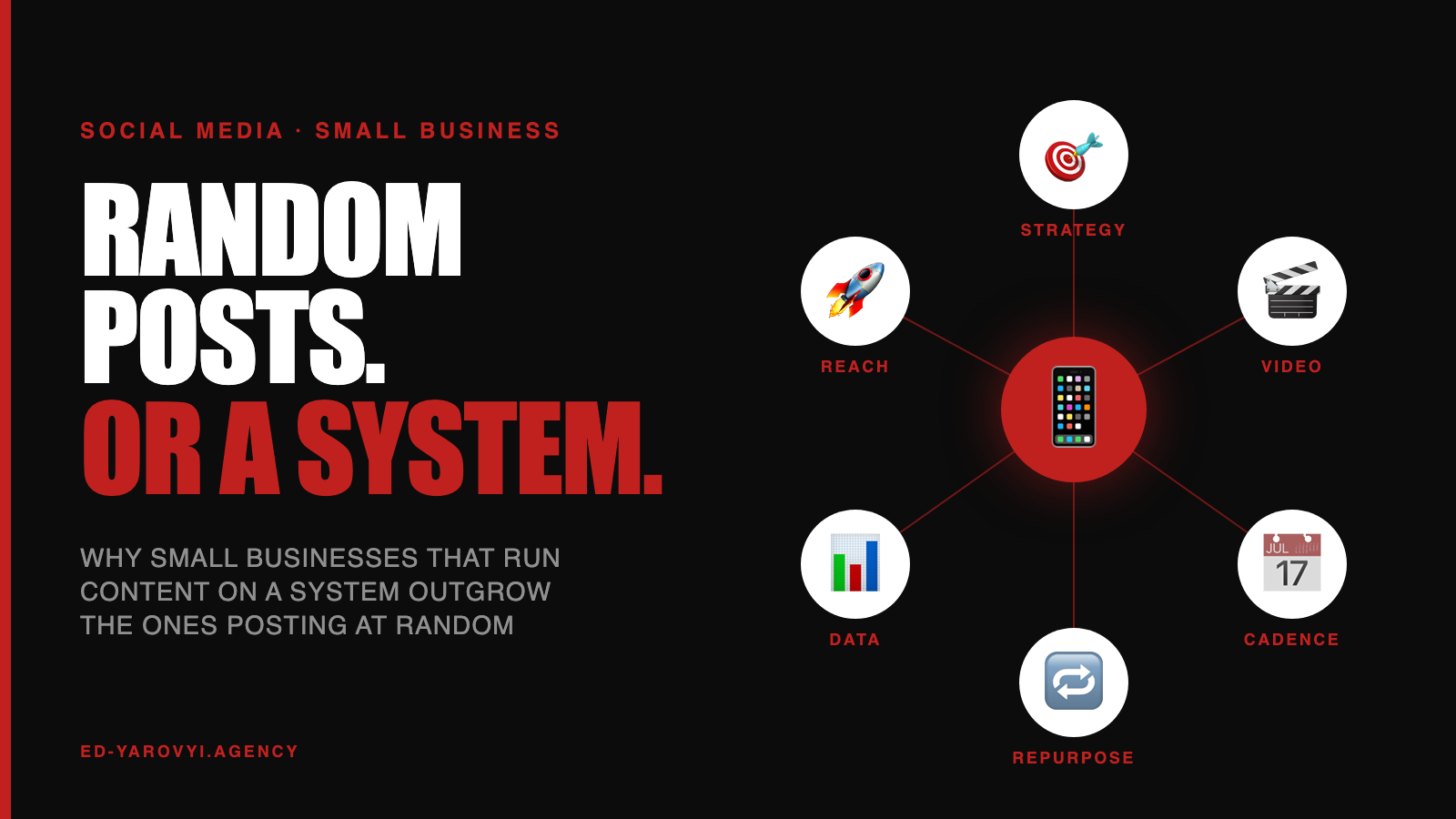
Here is how I approach it: strategy first, then a repeatable production system, then consistent distribution, then optimization from real data. No random posting, no guessing. This is the same content-systems logic behind the content marketing Dallas work — reach without a system produces nothing but a bill.
1. Strategy: decide what the content is for
Before a single post, decide the goal: leads, bookings, authority, or retention. Pick the two or three platforms where your customers actually spend time, define the content pillars that support the goal, and set a realistic cadence you can sustain. Strategy is what turns posting into marketing.
2. Production: build a repeatable system
The secret to consistency is not discipline — it is a system. One focused shoot can produce weeks of content: long-form video cut into clips, photos, quotes, and written posts. Batch the production, build a simple template library, and you turn a monthly effort into a steady daily presence without living inside your phone.
3. Distribution: multi-platform without multi-effort
The same core content, adapted for each platform, goes everywhere your customers are — TikTok, Instagram, Facebook, YouTube, X, Pinterest, and more. Native formatting for each matters, but the production effort stays centralized. This is how a small team, or one operator, maintains a presence that looks like a much bigger company.
4. Optimization: let the data drive the next month
Every month, look at what actually drove business results — not likes, but leads and sales — and do more of it. The system gets sharper over time, so your content works harder each quarter. Optimization is what makes social media marketing for small business compound instead of plateau.
Video is the engine of small business social in 2026
If there is one shift a small business cannot ignore, it is video. Short-form video drives the most reach across nearly every platform, and it is where new customers discover businesses now. The good news is that video does not require a studio — it requires a system.
- Batch-shoot in focused sessions — one afternoon can produce a month of short clips
- Lead with value or story — teach something, show behind the scenes, or tell a real customer story
- Cut long into short — one longer video becomes many clips across platforms
- Consistency over polish — a steady stream of authentic clips beats occasional cinematic perfection
A small business that builds a simple video production system captures the reach that random posters never touch, and it does it without hiring a whole content team.
What to skip in small business social media
Knowing what to skip protects your time and budget as much as knowing what to do. These are where small businesses waste both.
- Buying followers or engagement — fake numbers fool nobody, convert nobody, and can harm your reach
- Chasing every trend — jumping on unrelated trends confuses your audience about what you do
- Being on every platform — a strong presence on two beats a weak one on seven
- Outsourcing to a disconnected agency — generic posts from someone who does not know your business read as generic and perform like it
Here is my honest take: most small businesses would get more from one great video a week, consistently, than from a scattered presence across seven platforms. Do less, but do it on a system, and it compounds.
Doing it yourself vs bringing in help
Social media marketing for small business can be run in-house or handed off, and the right answer depends on time and skill. The trap is the middle: outsourcing to an agency that posts generic content with no connection to your business. If you bring in help, it should be someone who builds the system with you and executes it hands-on, not a layer of account managers.
This is the model I run: strategy, production, distribution, and optimization handled end-to-end by one operator, no handoffs and no middle layers. The marketing agency vs in-house guide covers that decision in depth, and the marketing cost Dallas breakdown covers what it costs.
The two questions owners ask first are answered in which social media is best for a small business and how much social media marketing costs.
What is the best social media platform for a small business?
The two or three where your customers actually spend time, not all of them. For most small businesses, a strong short-form video presence on one or two platforms beats a thin presence everywhere. Social media marketing for small business works when it is focused, not spread thin.
How often should a small business post?
Consistently enough that the algorithm and your audience can rely on you — several times a week is a common baseline. The key is a cadence you can sustain through a production system, because inconsistency kills reach faster than low volume.
Is video really necessary for small business social media?
In 2026, yes. Short-form video drives the most reach across nearly every platform and is where new customers discover businesses. It does not require a studio, just a simple batch-production system that turns one shoot into weeks of clips.
Should I do social media myself or hire someone?
Either can work; the trap is the middle — a disconnected agency posting generic content. If you hire help, choose someone who builds the system with you and executes hands-on, rather than a layer of account managers who do not know your business.
How long until social media marketing produces results?
A consistent system usually shows reach and engagement gains within 1 to 3 months, with leads and sales compounding over 6 to 12 months as your content library, audience, and optimization all build on each other.
How much does social media marketing cost for a small business?
It ranges from your own time to a monthly retainer, depending on how many platforms, how much video, and whether ads are included. The useful way to budget is by output: how many quality posts and videos per week you need to stay consistent. Paying for consistency on two platforms beats paying for a thin presence on seven.
How much should a small business pay a social media manager?
Pay for results and skill, not just posting. A part-time freelancer who only schedules posts costs less than someone who plans strategy, produces video, and reports on leads, and the difference usually shows in the numbers. Before hiring, decide what success looks like, such as inquiries or bookings, and pay for someone who can move that.
Is social media marketing worth it for a small business?
Yes, when it runs on a system and is measured by business results. Random posting rarely pays off. Consistent, useful content, especially short video on the one or two platforms your customers use, builds trust and brings inquiries over time. If you track only likes, it will feel like a waste; track leads instead.