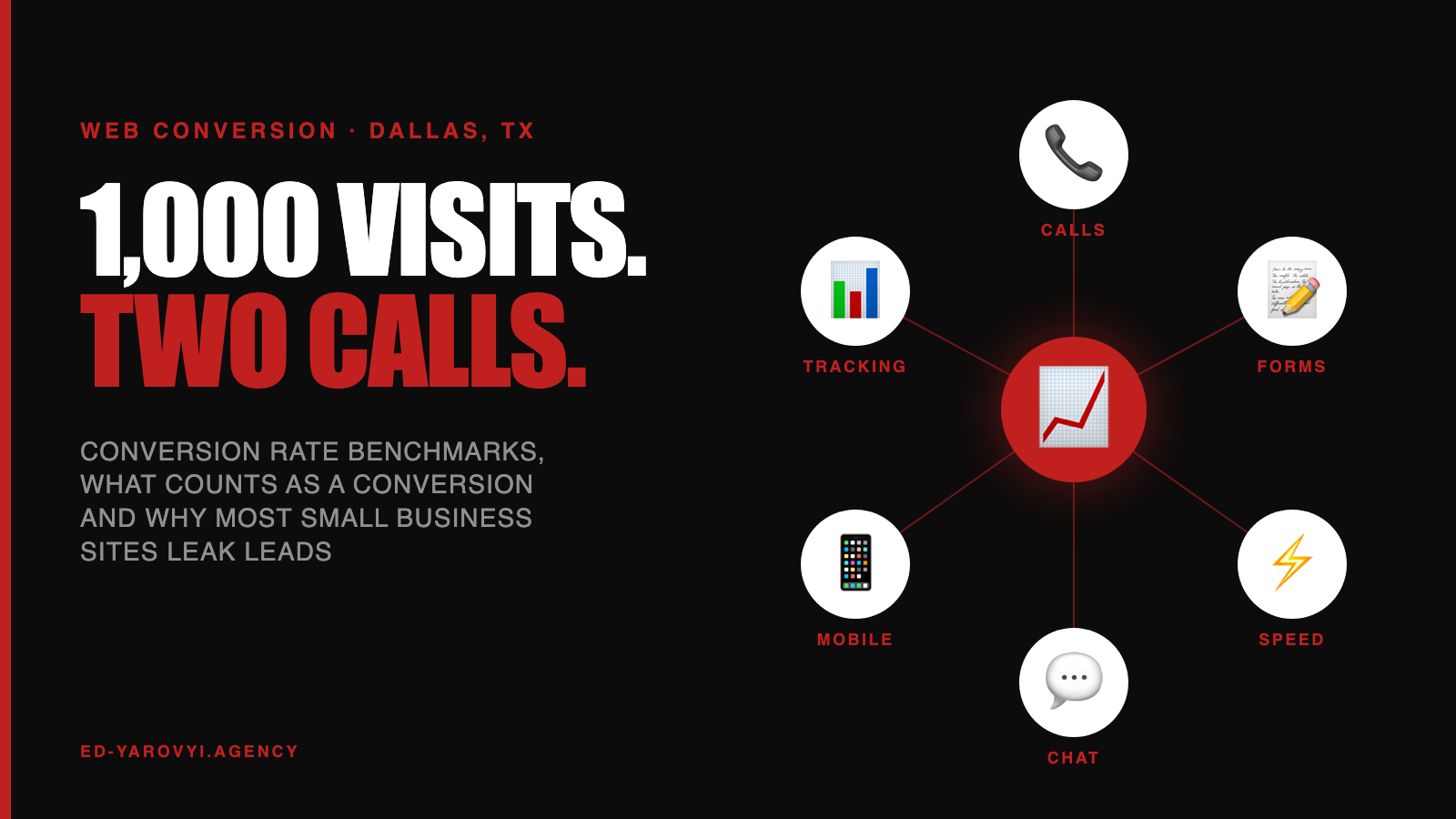
A thousand people visited your website last month. Two of them called. Is that good? Most owners have no idea, and the honest answer is that it depends on what those thousand people came for.
I pulled 51 questions about website conversion from Google, Bing and DuckDuckGo. Half came from people asking why their website won’t load at all, which is a different (and scarier) problem. The other half asked what a good conversion rate is and how to raise it. These are the ten that matter for a small business site.
- What is a good conversion rate for a website?
- What exactly counts as a website conversion?
- What is a good conversion rate for a service business website?
- What is a good ecommerce conversion rate?
- Why is my website not converting?
- How do you increase your website conversion rate?
- Does adding live chat improve conversion rate?
- How fast does a website need to load to convert?
- What’s a good click-through rate from Google?
- How do you measure conversions if you’ve never set it up?
What is a good conversion rate for a website?
Short answer: Most benchmark studies put typical websites somewhere around 2% to 5%, with ecommerce often near 2% to 3%. But averages hide a lot. A good rate for your site is one that beats your own last quarter, measured on the action that pays your bills: calls, bookings, quote requests or orders.
Benchmarks are a sanity check, not a goal. A landing page built for one offer can convert far higher than a homepage serving everyone. A site pulling lots of loosely related traffic from a popular blog post will look worse on paper while doing fine on leads.
Pick one main conversion, measure it honestly, and improve that number month over month.
What exactly counts as a website conversion?
Short answer: A conversion is any action that moves a visitor toward buying: a call from the site, a form submission, a booked appointment, a purchase, a quote request or an email signup. Decide which ones matter most to your business and track those instead of page views.
For a service business, the call button is often the most important conversion and the least tracked. If most of your leads tap to call from a phone and you only count form fills, you’re blind to most of your results. Track both.
What is a good conversion rate for a service business website?
Short answer: For local service businesses, a site that turns roughly 3% to 10% of visitors into calls or form requests is doing reasonably well, depending on how targeted the traffic is. People searching for an urgent service convert much higher than people reading a how-to article.
Intent is everything. “Emergency plumber near me” at 11 p.m. converts like crazy. “How much does it cost to repipe a house” converts slowly, because that reader is still researching.
Both visitors are valuable, but don’t judge the whole site by one blended number. Look at conversion by page, and start with your service pages.
What is a good ecommerce conversion rate?
Short answer: Many ecommerce benchmarks land around 2% to 3% of sessions turning into orders, with wide swings by industry, price point and device. Mobile usually converts lower than desktop. Email subscribers and repeat customers usually convert higher than first-time visitors from social media.
If you sell on Shopify or WooCommerce, segment before you panic. A 1% overall rate might be 4% from email and half a percent from social.
That tells you what to fix: probably product pages and checkout for new visitors, not your entire marketing plan.
Why is my website not converting?
Short answer: The usual culprits are slow loading on phones, an unclear offer, a hidden phone number, forms that ask for too much, no proof like reviews or real photos, traffic that doesn’t match what you sell, or a broken form nobody noticed. Check the boring things first.
When friends ask me to look at a site that “gets traffic but no calls,” the contact form is the first thing I test. A form that stopped sending emails is the most common silent leak I run into, and it can run for months.
Then open the site on your phone over mobile data, not office Wi-Fi, and try to reach yourself in under ten seconds. If you can’t, neither can your customers.
Today, on your phone, using mobile data: load your homepage, find your phone number, tap it, then submit your own contact form and wait for the email. If any step fails or takes longer than ten seconds, you’ve found your first fix.
How do you increase your website conversion rate?
Short answer: Make the next step obvious and easy. Use a headline that says what you do and where, put a tap-to-call button and a short form near the top, place real reviews and photos next to those buttons, and cut the number of choices on each page. Then speed the site up and change one thing at a time.
The fixes that usually move the number most:
- A headline that says what you do and where, not a slogan
- A tap-to-call button that stays visible on mobile
- A form with three to five fields instead of twelve
- Real reviews and project photos right next to the button
- One main action per page instead of five competing ones
Does adding live chat improve conversion rate?
Short answer: It can, if someone answers quickly or the chat captures contact details and routes them to you. A chat bubble nobody answers hurts trust. For many small businesses, a text-us option or an automated reply that books a callback works better than live chat.
The real question isn’t chat versus no chat. It’s response time. A visitor who asks a question and hears nothing for four hours has already called your competitor.
If you add chat, connect it to your phone, post honest hours, and use an after-hours reply that collects a number and promises a callback time you’ll actually keep.
How fast does a website need to load to convert?
Short answer: As fast as you can make it, especially on phones. Google treats a Largest Contentful Paint under 2.5 seconds as good, and visitors start leaving when pages feel slow. For most small business sites, fixing oversized images, heavy plugins and cheap hosting solves the bulk of the problem.
Speed is the conversion fix nobody sees. Most slow sites friends send me are slow for the same reasons: giant photos straight off a phone, a pile of plugins, image sliders and bargain hosting.
Converting images to modern formats and removing what you don’t need often cuts load time sharply without touching the design.
What’s a good click-through rate from Google?
Short answer: It depends heavily on your position and the search. Top organic results get far more clicks than lower ones, and AI Overviews and ads push organic results further down. Instead of chasing an average, open Search Console: a page with lots of impressions and few clicks needs a better title and description.
This is the conversion that happens before anyone reaches your site. A page on page one with a vague title like “Services | Smith Co” loses clicks to a competitor whose title says “Same-Day AC Repair in Garland, Upfront Pricing.”
Titles are cheap to change and easy to test. Rewrite one, wait a few weeks, compare.
How do you measure conversions if you’ve never set it up?
Short answer: Install Google Analytics 4 and mark your important actions as key events: form submissions, taps on your phone number, completed bookings and purchases. Add call tracking if phone calls matter, and connect Google Search Console. Within a month you’ll see which pages and channels produce leads.
Don’t overbuild it. Three to five tracked actions are plenty for a small business. What matters is that someone looks at the numbers monthly and makes one change based on them. Tracking nobody reads is decoration.
If you want an outside look at what’s leaking, my marketing performance audit guide walks through the process.
Your conversion rate isn’t a grade. It’s a dial. Find the one action that pays your bills, measure it honestly for a month, and turn the dial one change at a time. The build side of this is covered in conversion-focused web design, and if you’re weighing what a site should cost to run, read how much a website costs per month.
Is a 1% conversion rate bad?
Not automatically. For a broad online store or a page full of research traffic, 1% can be normal. For a local service page reached by people searching for that exact service, it’s low. Compare by page and by traffic source before deciding.
How many visitors do I need to judge my conversion rate?
Enough to see a pattern. Look at monthly numbers across a few months, and judge pages with hundreds of visits rather than twenty. Small samples swing wildly and will send you chasing noise.
Do pop-ups hurt conversion?
Aggressive pop-ups that cover the page on phones can hurt conversions and Google’s view of the page. A small, well-timed offer, like a slim banner or a signup shown as someone leaves, usually works better than a full-screen interruption.
Does website design affect conversion rate?
Yes, but clarity matters more than style. A plain page that loads fast and makes the next step obvious often beats a beautiful one that hides the phone number. Good design makes the action easier to see and easier to trust.
Should I A/B test a small business website?
Only on pages with real traffic. With low traffic, make clear, sensible improvements and watch the monthly trend. A/B testing works best on busy pages, ads and email subject lines where results show up quickly.