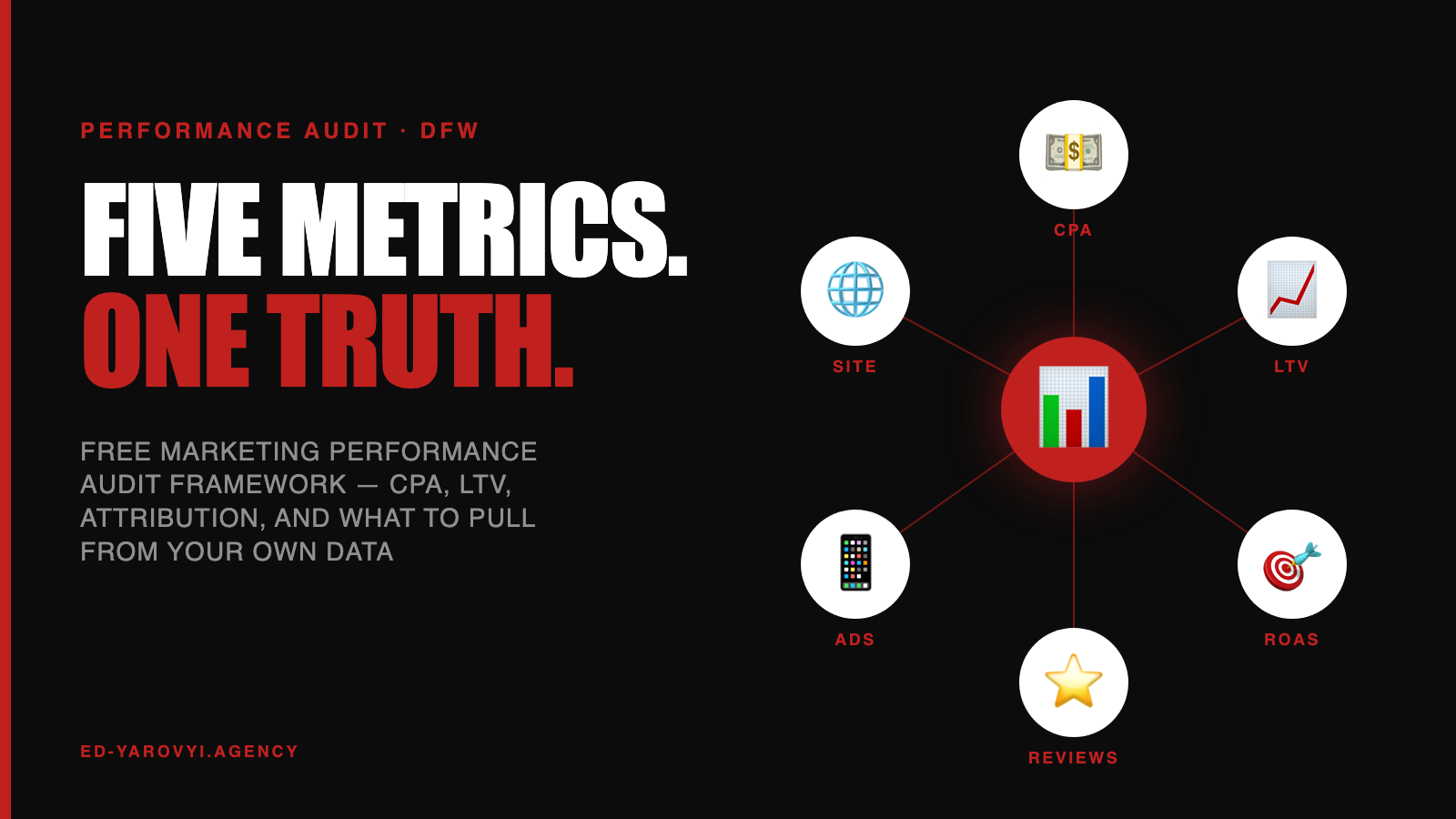
Most Dallas small business owners cannot answer a basic question about their marketing: is it working. Not “are we getting impressions” or “did the agency send a report” — is the marketing producing measurable revenue at acceptable cost. A real marketing performance audit answers that question in 5–10 hours of structured review. Most businesses skip it because it feels harder than it is. The cost of skipping it is six-figure mistakes that compound monthly.
This piece is the free marketing performance audit framework I use when friends ask me to second-opinion an agency engagement or an in-house effort. Five metrics, six channels, the patterns that reveal whether the marketing is actually producing returns. No tools required beyond Google Analytics, your CRM, and a spreadsheet. Numbers come from real audits across DFW small businesses in 2025–2026.
What “Marketing Performance Audit” Actually Measures
A marketing performance audit measures whether your marketing spend is producing revenue at a positive ROI within a defined time window. That is the whole job. Everything else — impressions, engagement rate, “brand awareness” — is input data, not output measurement.
Three things every real audit covers:
- Total marketing spend. All in: agency fees, ad spend, tools, content production, photography, premium plugins, scope-creep upcharges. The real number, not the retainer headline.
- Revenue attributable to marketing. New customers acquired, repeat customers reactivated, lifetime value of each cohort. Tracked by channel where possible.
- Cost per acquisition divided by lifetime value. The single ratio that tells you whether the marketing is creating value or destroying it.
A marketing performance audit that produces these three numbers, broken out by channel, is doing the work. Anything else is reporting theater.
The Five Metrics That Matter
Track these five. Ignore everything else until these are healthy.
1. Cost per acquisition (CPA). Total monthly marketing spend divided by new customer count. The headline number. Healthy ranges differ by category — $80–$280 for med spa, $400–$1,500 per closed transaction for real estate, $40–$200 per qualified lead for B2B services. If you do not know your CPA, you do not have a marketing performance audit. You have a marketing report.
2. Lifetime value (LTV). Average revenue per customer over the relationship. Calculate from your CRM by summing the revenue per customer over 12, 24, and 36 month windows. Healthy CPA-to-LTV ratio: CPA under 25% of LTV. Above 50% and you are bleeding money. According to Census Annual Business Survey data on US small businesses, businesses that track LTV systematically grow at significantly higher rates than those that do not — measurement discipline is itself a competitive advantage.
3. Channel attribution. What percent of new customers come from each channel. Most small businesses cannot answer this and end up overspending on channels that produce nothing. According to Google Analytics 4 documentation, the platform’s default attribution model handles multi-touch journeys reasonably well for most small business situations, but it has to be set up correctly with conversion events tied to revenue. Without that setup, channel attribution is guessing.
4. Time to first revenue. Days between marketing investment and first attributable revenue per channel. Paid search: 2–4 weeks. Local SEO: 90–180 days. Email retention: 30–60 days. Channels that have not produced first revenue by their normal window are broken and need diagnosis, not more budget.
5. Repeat customer rate. What percent of revenue comes from existing customers versus new. Healthy small business: 40–70% from existing customers within the first three years. Below 30% means retention is broken — and retention is the cheapest revenue per dollar in any marketing performance audit.
The Channel-by-Channel Marketing Performance Audit Framework
For each marketing channel, run this checklist.
Google Business Profile. Review count, average star rating, review velocity (new reviews per month), photo upload frequency, response rate to reviews. A profile producing fewer than 4 new reviews per month for a service business is underperforming. Response rate below 80% loses Google’s ranking benefit. Time to audit: 30 minutes.
Website. Page speed on mobile (under 2.5 seconds is target), bounce rate (under 60% healthy), conversion rate (2–7% depending on category), top-converting pages, top-bouncing pages. Most marketing performance audit findings here are simple: slow site, broken forms, unclear calls to action. Time to audit: 1–2 hours.
Paid search and social. Cost per click, click-through rate, conversion rate, cost per lead, cost per booking. Compare current 90 days to previous 90 days. Trend is the signal — flat or rising CPA across 90 days means something is breaking. Time to audit: 2–3 hours.
Email and SMS. Open rates (20%+ healthy), click rates (2–5% healthy), unsubscribe rates (under 0.3% per send), revenue per send. Email retention performance is the easiest to fix and the most often ignored. Time to audit: 1 hour.
SEO and content. Organic traffic over 6 and 12 months, keyword rankings for target queries, time-on-page for top content, internal linking density. The slowest audit because organic compounds over months. Time to audit: 2–3 hours.
Agency or in-house team performance. Cost per channel managed, throughput (output per week), response time (hours to answer operator), reporting cadence and quality. The most subjective but most important category. The red flags marketing agency piece walks through what to look for here in detail.
How to Tell If Your Marketing Agency Is Actually Working
Four questions a marketing performance audit answers about your agency relationship.
Is cost per acquisition trending down month over month? A healthy agency engagement drives CPA down over the first 6–12 months as channels optimize. Flat or rising CPA across 6 months is a red flag. Many agencies obscure this by reporting impressions and reach instead of CPA. The marketing performance audit should pull CPA directly from your CRM or analytics, not from the agency’s monthly deck.
Is revenue per channel growing or stagnant? Some channels naturally compound (SEO, content, retention); others have flat ceilings (paid search at constant spend). If multiple compounding channels have been flat for 6+ months, the agency is going through motions, not optimizing.
Are reports tied to revenue? Vanity metrics — impressions, reach, engagement rate — without revenue context indicate an agency that does not want to be measured on outcomes. The full marketing cost Dallas piece breaks down hidden costs and reporting patterns to watch.
Are recommendations tied to your business or to their service stack? If every recommendation maps to a service the agency happens to sell, the recommendations are sales pitches in audit clothing. Real agencies sometimes recommend you fix operations, change vendors, or hire in-house instead of expanding their own scope.
Common Marketing Performance Audit Mistakes
Five patterns that derail audits and produce wrong conclusions.
Comparing the wrong time periods. Year-over-year is the right frame for SEO and content; quarter-over-quarter for paid; month-over-month for retention. Mixing time frames produces noise. Always match the cycle to the channel.
Counting traffic instead of revenue. Traffic is an input, not an output. A 40% traffic increase that produces zero revenue lift means the marketing is targeting the wrong audience. Always tie the audit back to revenue.
Auditing too early. Local SEO and content do not produce meaningful signal in 60 days. Auditing organic channels before 6 months produces false negatives. Match the audit window to the channel timeline.
Skipping retention. Most marketing performance audit work focuses on acquisition because that is where the agency budget sits. But retention drives 40–70% of mature business revenue. Skipping it misses the biggest leverage point in the business.
Trusting the agency’s report at face value. Even honest agencies present their work favorably. The marketing performance audit pulls data from your CRM, your Google Analytics, your ad platforms directly — not from the agency’s reporting layer. The Animal-ID USA case is a useful reference for what direct measurement looks like in practice — revenue per cohort tracked at the data source, not at the agency’s dashboard layer.
When to Hire an Outside Marketing Performance Auditor
Three signals that suggest you need outside eyes on your marketing performance audit.
First, your agency has been running 9+ months and you cannot tell whether they have improved anything specific. Outside audit produces an honest read in 2–4 weeks at $1,500–$5,000 cost.
Second, you are about to renew a 12-month contract with an agency or vendor. Audit before renewal, not after. Renewing a bad engagement compounds the cost.
Third, marketing is a major budget line and you have never had it independently reviewed. Annual outside audit is reasonable hygiene above $50,000/year in total marketing spend. The cost of the audit is usually 5–10% of one month’s marketing budget; the value is preventing a year of wrong direction. The marketing consultant in Plano piece walks through how outside consultants approach this kind of audit work.
The Census SUSB data on US small business employment shows the vast majority of small businesses cannot absorb a six-figure marketing miss without operational consequences — measurement discipline is operator-protective at every revenue stage.
When the audit says the relationship is the problem, when to fire your marketing agency walks through the exit sequence and asset handover.
Vanity metrics have a long history — viral content versus actual sales is the clearest example of reach that never converted.
When the audit keeps surfacing the same gaps, why small business marketing fails explains the structural reasons behind them.
What does a marketing performance audit actually measure?
A real audit measures three things: total marketing spend (all in, not just retainer), revenue attributable to marketing by channel, and the ratio of cost per acquisition to lifetime value. Everything else — impressions, engagement, reach — is input data, not output measurement.
How often should I run a marketing performance audit?
Quarterly review for paid channels and retention. Semi-annual review for SEO and content. Annual comprehensive audit covering all channels and the agency or in-house team performance. Outside audit at minimum annually if total marketing spend exceeds $50,000 per year.
What is a healthy cost per acquisition?
It depends on category. Med spas: $80–$280. Real estate per closed transaction: $400–$1,500. B2B services per qualified lead: $40–$200. Dental practices: $80–$250. The right number is always CPA below 25% of customer lifetime value — that is the universal ratio.
Can I do a marketing performance audit myself?
Yes for most small businesses. You need access to your CRM, Google Analytics 4 set up with conversion events, your ad platform reports, and a spreadsheet. Expect 5–10 hours of structured work. Outside auditors run $1,500–$5,000 and produce findings in 2–4 weeks, useful when you cannot find the time or want independent verification.
What is the biggest marketing performance audit mistake?
Trusting the agency’s reporting at face value instead of pulling data directly from your own systems. Even honest agencies present their work favorably. Always pull CPA, conversion, and revenue numbers from your CRM and analytics platforms directly. Cross-check against agency reports rather than starting from them.
When does a marketing performance audit show the agency is failing?
Flat or rising cost per acquisition over 6+ months with no clear external cause. Multiple compounding channels (SEO, content, retention) flat over 6+ months. Reports that emphasize vanity metrics without revenue context. Recommendations that all map back to the agency’s service stack. Any one is a yellow flag; two or more is enough to plan an exit.
How long does a marketing performance audit take?
5–10 hours for an experienced operator running a structured audit of all channels. 2–4 weeks calendar time for an outside auditor producing a written report. Faster than this means corners were cut; slower means the auditor is padding the engagement.