AI automation for small business is where the hype and the reality finally diverge into something useful. Every founder has heard that AI will change everything, but most have no idea what to actually do with it on a Tuesday. The truth is less dramatic and far more valuable: AI is a tool for removing the repetitive work that eats a small team alive, freeing owners to do the things only humans can. The U.S. Bureau of Labor Statistics tracks how much of marketing has become operational and technical, and automation is what lets a small business run those operations without a big team.
I build automation pipelines myself — content workflows, auto-publishing, chatbots, monitoring systems. So this guide breaks down AI automation for small business in 2026 in plain terms: the real use cases that save time and money, the traps to avoid, and how to start without a technical team.
What AI automation for small business actually means
Strip away the buzzwords and it comes down to one idea: let software handle the repetitive, rules-based work so people can focus on judgment, relationships, and creativity. It is not about replacing your team — it is about removing the drudgery that keeps them from the work that matters.
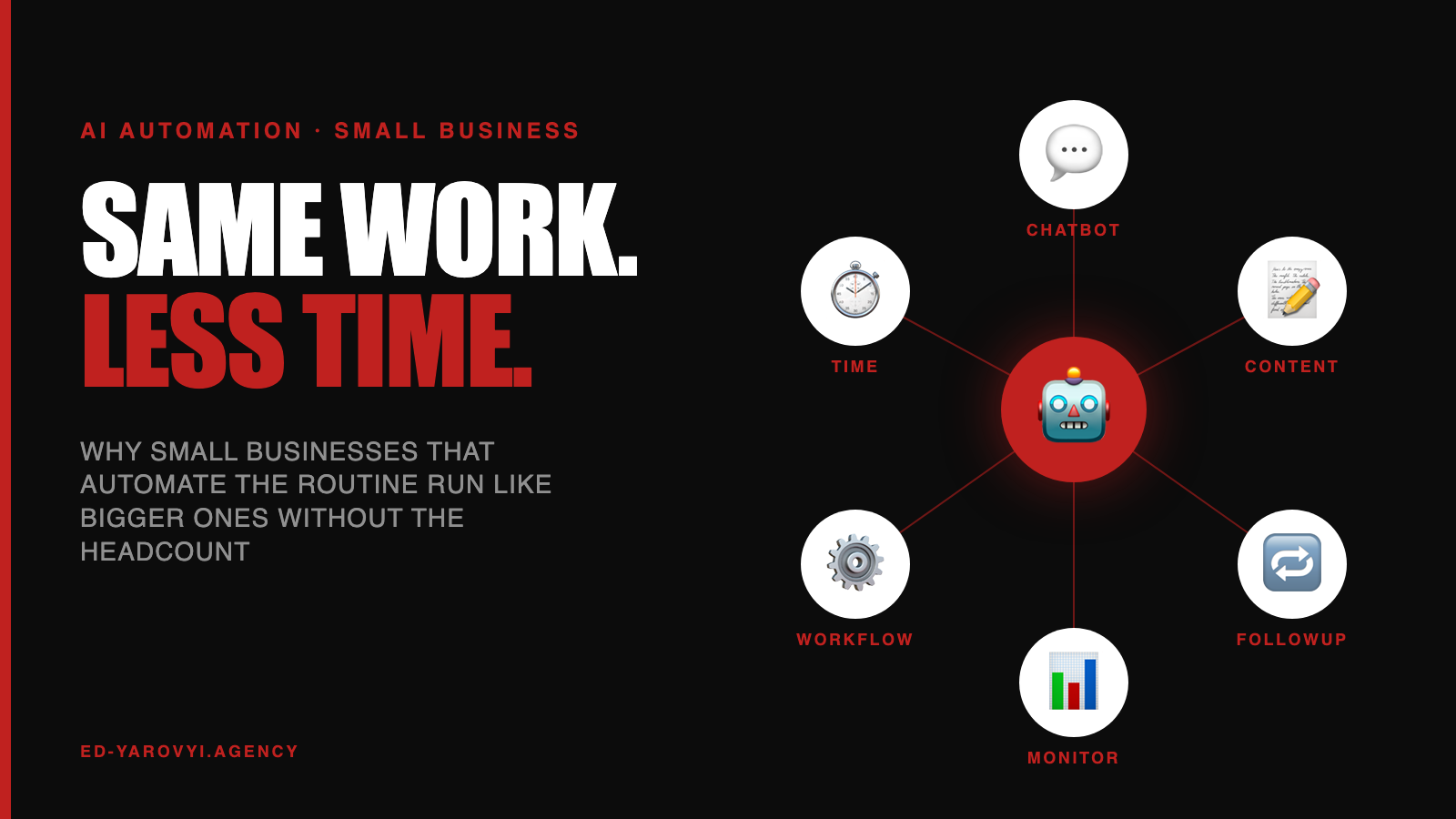
Five things AI automation does well for a small business
- Repetitive content tasks — drafting, formatting, repurposing, and scheduling that used to eat hours
- Customer questions — a chatbot that answers the same common questions instantly, day and night
- Follow-up and reminders — automated sequences that never forget a lead or a lapsed customer
- Data monitoring — pipelines that watch your metrics and surface what needs attention
- Routine operations — the small recurring tasks that quietly consume a founder’s week
The point is leverage. A small business that automates the routine runs like a bigger one without the headcount. This is the same one-input-many-outputs logic behind the AI automation Dallas case — one photo turned into seven systems.
The hidden cost of not automating
Most small businesses think of automation as a cost, but the real expense is doing nothing. Every hour a founder spends on repetitive tasks is an hour not spent on customers, strategy, or growth, and those hours add up to a ceiling the business cannot break through. The businesses that stay small often stay small because the owner is trapped in work a system could handle.
Consider what manual operations actually cost: leads that go cold because follow-up was inconsistent, customers lost because nobody answered at 9pm, content that never ships because there was no time, and decisions made late because the data was buried. None of these show up as a line item, but together they quietly cap the business. AI automation for small business is really about removing that ceiling.
The math is simple. If an automation saves ten hours a week, that is ten hours redirected to work that grows the business, plus the revenue recovered from leads and customers that would otherwise have slipped away. Against that, the cost of setting up a few well-chosen automations is small and pays back fast.
A realistic first automation roadmap
You do not automate everything at once. A sensible roadmap starts with the highest-pain, highest-return process and expands from there, proving value at each step before adding the next.
First, automate lead follow-up, because cold leads are pure lost revenue and the fix is straightforward. Second, add a chatbot for common questions and after-hours lead capture. Third, systematize content production and publishing so your marketing runs without constant manual effort. Fourth, layer in monitoring so you see what is working without pulling reports by hand.
Each step buys back time that funds the next. Done in sequence, AI automation for small business becomes less a one-off project and more a compounding advantage: a business that quietly runs better every quarter while competitors stay stuck doing everything by hand. Start with one process, measure the hours reclaimed, and let each win pay for the next.
Keeping the human in the loop
The businesses that get automation wrong usually make the same mistake: they remove the human from places where judgment matters. AI automation for small business works best as a partnership, where software handles the repetitive and predictable while people handle the nuanced, the emotional, and the exceptional.
A chatbot answering “what are your hours” is perfect automation. A chatbot fumbling an upset customer’s complaint is a disaster. An automated sequence nurturing a lead is smart. An automated message tone-deaf to a sensitive situation damages trust. The skill is drawing the line correctly: automate the routine, escalate the human moments, and design the handoff so a person steps in exactly when they should.
This is why I build automations with clear escalation paths and human checkpoints rather than trying to remove people entirely. The goal is a business that feels more personal to customers because the team has been freed from busywork to actually engage, not one that feels like a wall of bots. Done this way, automation amplifies your people instead of replacing the very thing that makes a small business worth choosing.
AI is changing how customers find you, not just how you work. Generative engine optimization covers the other side of that shift: becoming a source AI assistants cite when they answer questions in your category.
AI automation is not about doing more things — it is about doing the same things with far less of your time. For a small business, the scarcest resource is the owner’s attention, and automation buys it back.
Real AI automation use cases for small business in 2026
Forget the abstract promises. Here are the automations that actually pay for themselves for a small business, roughly in order of return.
1. Content production and publishing workflows
AI-assisted drafting plus an auto-publishing pipeline turns content from a weekly scramble into a system that mostly runs itself. One idea becomes an article, clips, social posts, and an email, formatted and scheduled automatically, with a human keeping quality and voice intact.
2. AI chatbots for instant customer response
A chatbot trained on your business answers common questions instantly, captures leads after hours, and books appointments while you sleep. For a small business, that is like having a receptionist who never clocks out — and it stops you losing customers who wanted an answer at 10pm.
3. Automated follow-up and nurture
Leads go cold when follow-up is manual and inconsistent. Automated sequences — email and text — nurture every lead and re-engage lapsed customers on a reliable schedule, recovering revenue that would otherwise slip away. This is where automation quietly pays for itself fastest.
4. Monitoring and reporting pipelines
Instead of manually pulling numbers, automated pipelines watch your marketing and business metrics and flag what needs attention. You get the signal without the busywork, so decisions happen faster and nothing important slips through unnoticed.
Where AI automation goes wrong for small business
Automation done badly creates more problems than it solves. Knowing the traps protects your time and your reputation.
- Automating a broken process — automating chaos just produces chaos faster; fix the process first
- Removing the human where it matters — a chatbot handling simple questions is great; one fumbling a sensitive complaint is a disaster
- Publishing raw AI content — thin, generic AI output hurts your brand and your rankings; keep a human on quality
- Over-engineering — building a complex system for a problem you do not have wastes the very time automation is meant to save
Here is my honest take: most small businesses do not need a sprawling AI system. They need two or three well-chosen automations that remove their biggest time drains. Start narrow, prove the value, then expand.
How to start with AI automation without a tech team
You do not need to be technical to benefit, but you do need the right approach. The best starting point is your biggest, most repetitive time drain — the task you dread doing every week.
- Find the drudgery — list the repetitive tasks that eat your week; those are your automation candidates
- Start with one — automate a single high-value process well before adding another
- Keep a human in the loop — automation handles the routine, people handle judgment and exceptions
- Measure the time saved — track the hours reclaimed so you know it is working
This is what I build for clients: practical automation pipelines wired to their real workflows, one operator handling the whole thing end-to-end, no handoffs. The marketing cost Dallas breakdown covers what it costs, and the content marketing system guide shows how automation fits into a full content operation.
For the questions owners ask before they start, read how AI can help a small business.
What is AI automation for small business?
It is using software to handle repetitive, rules-based work — content production, customer questions, follow-up, and monitoring — so people can focus on judgment and relationships. AI automation for small business is about leverage: running like a bigger company without the headcount.
What should a small business automate first?
Your biggest, most repetitive time drain. For many businesses that is content production and publishing, or lead follow-up. Start with one high-value automation, prove it saves real hours, then expand — do not build a sprawling system you do not need.
Will AI automation replace my employees?
No — the point is removing drudgery, not people. Automation handles the routine so your team focuses on judgment, creativity, and relationships, which is exactly the work that grows a small business. Keep a human in the loop where judgment matters.
Do I need to be technical to use AI automation?
No. You need the right approach and, often, someone to build the pipelines. Identify your biggest time drain, automate that one process well with a human kept in the loop, and measure the hours reclaimed. Start narrow rather than over-engineering.
Is publishing AI-generated content a good idea?
Only with a human keeping quality and voice. Raw, generic AI output hurts your brand and can be penalized by search engines. Use AI to speed the mechanical parts of production, but keep real expertise and an authentic voice in charge of what actually gets published.
How can AI help a small business?
Mostly by removing repetitive work. AI can draft and repurpose content, answer common customer questions through a chatbot, follow up with leads automatically, summarize data, and handle routine admin. The goal is to free the owner and team for work that needs judgment and relationships, not to replace them.
How are small businesses actually using AI right now?
The most common practical uses are content drafting, customer service chatbots, email follow-up, scheduling, and pulling insights from sales or marketing data. The businesses getting real value start with one painful, repetitive task and automate it well, rather than trying to add AI everywhere at once.
Is AI worth it for a small business?
Yes, when it targets a real time drain and keeps a human in charge of quality. A well-chosen automation that saves hours every week pays for itself quickly. It is not worth it as a novelty, or if it publishes generic content or mishandles sensitive customer conversations. Start narrow and measure the hours saved.