Most DFW small businesses operate without a written marketing strategy. They have marketing activities — ad spend, occasional content, social posts — but no document that says “this is what we are doing, in what order, against what numbers, for the next 12 months.” The absence of a written strategy is the single biggest predictor of marketing failure I see in 2026 Dallas-Fort Worth. Operators with a written 12-month marketing strategy in DFW outperform those without one by a measurable margin regardless of category, revenue, or agency choice.
This piece is the marketing strategy framework I walk friends through when they ask how to build a real 12-month plan that holds up to monthly tracking. Channels, allocation, sequencing, and the specific Dallas-Fort Worth market dynamics that shape strategy differently from generic national playbooks. Numbers come from 2025–2026 engagements I have either built or audited across DFW small businesses doing $300K–$10M annually.
What “Marketing Strategy in DFW” Actually Means in 2026
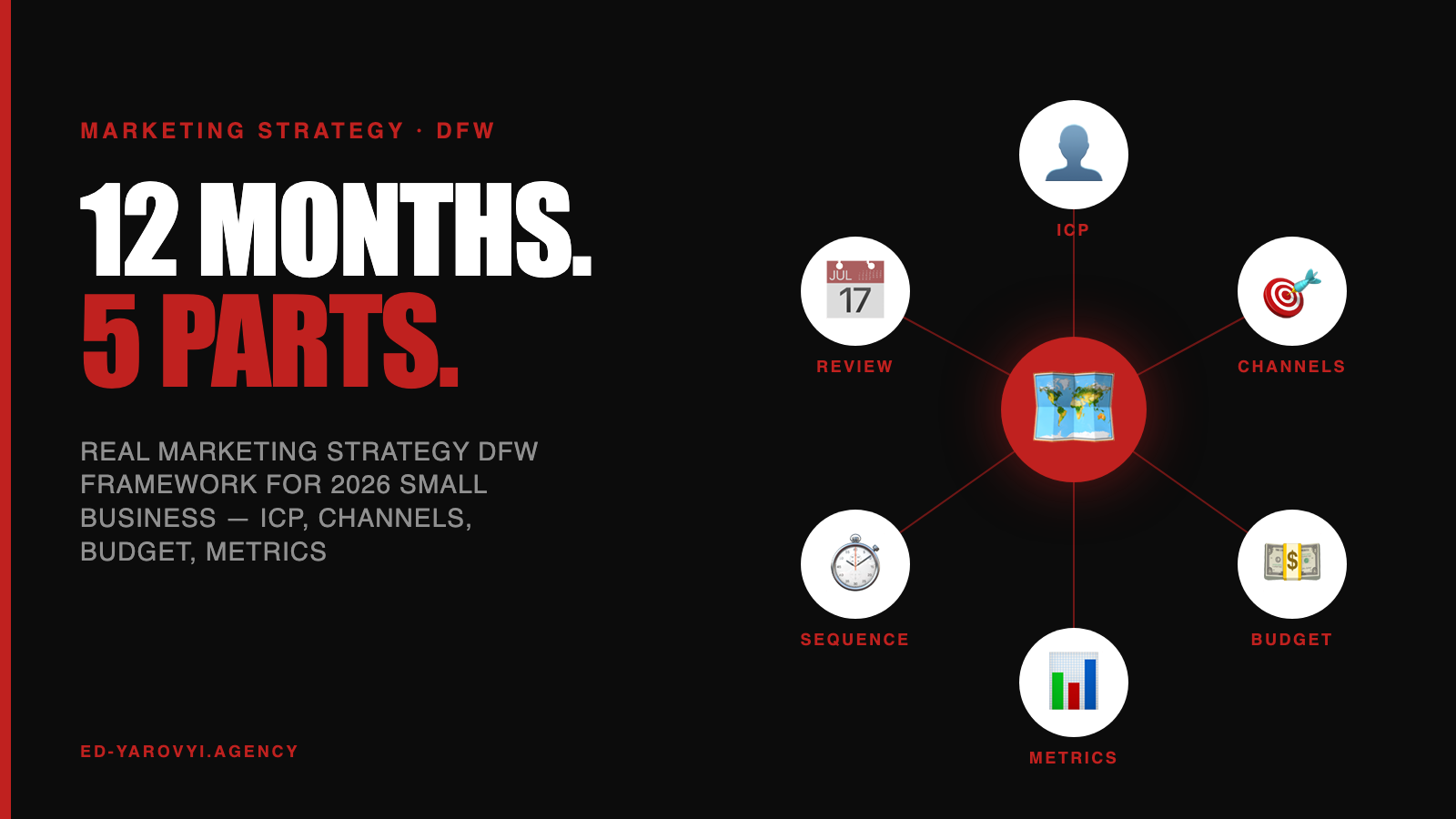
A real marketing strategy in DFW is a written document that defines five things: who you are selling to, which channels reach them, what budget allocates to each channel, what metrics measure success, and what milestones the business commits to over the next 12 months. Without all five, the document is not strategy — it is a marketing wish list.
The five components in detail:
- Ideal customer profile. Specific buyer description — revenue, role, location within DFW, decision triggers, pain points. Generic “small business owners” is not a profile.
- Channel selection with rationale. 2–4 channels chosen deliberately, not 6–8 chosen by default. Each channel justified against the customer profile.
- Budget allocation across channels. Specific dollar amounts or percentages per channel. The marketing budget Dallas piece breaks down typical allocations.
- Success metrics per channel. CPA, LTV, conversion rates, revenue contribution. Numbers that can be measured monthly.
- 12-month milestones. Specific quarterly checkpoints — content pieces published, leads per month, revenue contribution, channel optimization targets.
A strategy document with all five sections is the foundation that lets marketing actually compound. Without it, marketing drifts month to month and the year ends with no clear progress.
The Five-Step Marketing Strategy in DFW Build Process
Step 1: Baseline current state. Document existing CPA, LTV, channel attribution, current marketing spend across all eight categories. 5–10 hours of work. Without baseline, future strategy cannot demonstrate improvement.
Step 2: Define the ideal customer profile. Pull from existing CRM — who are your top 20 customers by lifetime value? What do they share? Revenue, location, role, decision pattern. The ICP comes from data, not assumptions.
Step 3: Map channels to the ICP. For each channel candidate, ask whether your specific ICP lives there. A B2B Plano accounting firm targeting corporate-adjacent buyers does not need TikTok. A Frisco med spa targeting families needs Instagram and Meta. Channel fit comes from buyer behavior, not industry consensus.
Step 4: Build the budget allocation. 4–8% of revenue total, split across selected channels by leverage. The marketing cost Dallas piece walks through typical splits. Reserve 10% for opportunistic spend.
Step 5: Define the monthly tracking rhythm. What gets measured monthly, what gets reviewed quarterly, what triggers strategic adjustment. Most strategies fail not from bad planning but from no tracking discipline after the plan is written.
DFW-Specific Strategic Dynamics
Four factors that shape marketing strategy in DFW differently from generic national approaches.
Suburb specificity. Dallas-Plano-Frisco-McKinney-Allen are not interchangeable markets. Per the Census Bureau DFW area profile, household income, age demographics, and competitive density vary significantly across the metro. Strategy that ignores suburb specificity underperforms strategy that respects it.
Talent cost. The Bureau of Labor Statistics for Dallas-Plano-Irving shows marketing roles paying near coastal rates. Agencies and in-house hires cost 10–20% above national averages, which affects total marketing budget math.
Ad cost density. DFW paid search is among the most competitive markets in Texas. Cost per click is elevated; budget allocation has to account for that.
No state income tax. Texas operators retain more revenue than coastal equivalents, which increases tolerance for marketing investment. That tolerance compresses competitor pricing flexibility, which raises the strategic baseline.
Channel Sequencing — Order Matters
Most failing marketing strategies start everything at once. Working strategies sequence deliberately.
Months 1–2: Foundation. Google Business Profile optimized, website conversion fixed, baseline measurement documented, intake systems tightened. Almost no acquisition spend yet. The 1–2 month foundation phase is what makes acquisition spend efficient later.
Months 3–5: First channel scale. Pick one organic channel (typically local SEO or content) and one paid channel (typically Google Ads or Meta) based on ICP fit. Spend builds, measurement validates.
Months 6–9: Second channel and retention. Layer email and SMS retention. Add a third acquisition channel if the first two are proving out. Refine messaging based on data.
Months 10–12: Optimization and forecast. Tune the existing channels rather than adding new ones. Build the next 12-month plan based on what the data shows. The marketing performance audit framework guides this annual review.
Operators who run two or three channels through the full 12-month sequence outperform operators who run six channels with no sequence by 2–3x in measurable revenue contribution.
Common Marketing Strategy Mistakes
Strategy without baseline. Cannot measure improvement against unknown current state. Always baseline first.
Strategy that ignores ICP data. Channel choices based on industry consensus rather than where the actual best customers live.
No quarterly review built in. Annual strategies need quarterly checkpoints to adjust based on real signal.
No connection to operations. Marketing strategy that brings leads operations cannot handle wastes the strategy. The why small business marketing fails piece walks through the operational disconnect pattern.
Strategy decided by the agency, not the operator. The agency’s strategy maps to the agency’s services. Your strategy should map to your business. Operator ownership of strategy direction is non-negotiable.
Building the Marketing Strategy Document
The actual document should fit on 8–15 pages, not 80. Long strategy documents do not get read; short clear ones do.
Section 1 (1 page): Executive summary — the 5 components in summary form.
Section 2 (2–3 pages): Ideal customer profile with supporting data from CRM.
Section 3 (2–3 pages): Channel selection with rationale per channel.
Section 4 (1–2 pages): Budget allocation by category and by channel.
Section 5 (2–3 pages): Monthly tracking metrics and quarterly milestones.
Section 6 (1 page): Vendor or in-house team structure supporting the strategy.
Sections 7 (1 page): Annual review schedule and trigger conditions for mid-year adjustment.
This document gets updated quarterly and rebuilt annually. The marketing consultant in Plano piece walks through how outside consultants typically run this document-building process when the internal team cannot.
Strategy by Business Stage — What Should Be Different at $500K vs $5M Revenue
Marketing strategy in DFW for a $500K business looks completely different from strategy for a $5M business. Most failing strategies apply the same template across revenue stages.
$300K–$700K revenue. Foundation stage. Strategy focuses on Google Business Profile, reviews, basic local SEO, simple email automation. Two channels max. Total marketing budget $1,200–$4,700 per month. Outside help: solo consultant or boutique freelancer. Strategic ownership stays with the operator.
$700K–$1.5M revenue. Scaling stage. Strategy adds paid search or paid social as a third channel. Content production begins compounding. Total marketing budget $2,800–$10,000 per month. Outside help: boutique agency or solo consultant plus 1–2 freelancers. Strategic ownership still operator-led but informed by consultant input.
$1.5M–$3M revenue. Compounding stage. Strategy adds dedicated content engine, structured email retention, multi-channel paid acquisition. Total marketing budget $5,000–$20,000 per month. Outside help: hybrid setup with consultant directing agency or freelancers. Strategic ownership shared between operator and consultant.
$3M–$8M revenue. Optimization stage. Strategy starts integrating with sales and operations. First in-house marketing hire often appears. Total marketing budget $12,000–$53,000 per month. The marketing agency vs in-house question intensifies. Strategic ownership shifts toward fractional CMO or in-house marketing manager.
$8M+ revenue. Departmental stage. Strategy reflects multiple specialist functions, integration with sales operations, and forward planning for $15M+ scale. Full-time marketing leadership becomes cost-effective. Outside help layered as specialists rather than generalists.
The pattern: strategy complexity should scale with revenue. Below-stage strategy (oversimplifying at $3M) and above-stage strategy (over-complicating at $500K) both fail in predictable ways. Matching strategy depth to business stage is what makes the math work.
Aligning Marketing Strategy in DFW With Sales and Operations
Marketing strategy that ignores sales and operations produces leads that the business cannot convert or fulfill. Three integration points that matter.
Lead handoff cadence. Marketing brings inquiries; sales has to respond within a defined window. For most DFW small businesses, that window is under 2 hours for high-intent leads and under 24 hours for nurture leads. Strategy that produces leads sales cannot service wastes the strategy.
Operations capacity. If marketing scales acquisition 40% without operations scaling fulfillment, the business books revenue it cannot deliver, which damages reputation and reviews. Coordinate marketing growth targets with operations capacity planning every quarter.
Customer feedback loop. The best marketing strategy in DFW pulls insight from sales and customer success teams continuously. What objections come up in sales calls? What problems show up in support tickets? Those signals shape messaging, channel choice, and content topics over time.
The Animal-ID USA case is a useful reference for what marketing-operations integration looks like in practice — retention email work that ran continuously alongside product development, with feedback flowing both directions.
How to Tell If Your Marketing Strategy in DFW Is Working
Five quarterly checkpoints.
Quarter 1: Foundation complete (GBP optimized, website fixed, baseline documented).
Quarter 2: First channel showing signal (paid cost per lead within 30% of target).
Quarter 3: Compounding visible (organic traffic growing, retention layer working).
Quarter 4: Revenue lift measurable (top of funnel and bottom of funnel both moving).
Operators hitting three of four checkpoints are on track. Two of four means intervention needed. One or zero means the strategy is wrong, not just under-executed.
Marketing Strategy in DFW by Industry Vertical — Where Cross-Pollination Helps and Where It Hurts
Generic marketing strategy templates apply across categories at a high level but break down at the tactical layer. Six DFW small business categories and how strategy specifics differ.
Healthcare and dental. Strategy emphasizes Google Business Profile depth, review velocity, insurance acceptance content, and patient-specific testimonial work. Paid ads run high cost-per-click and require fast intake response within 2 hours. Lifetime value justifies acquisition cost in the 0–00 range per new patient depending on practice tier.
Home services (HVAC, plumbing, electrical, roofing). Strategy emphasizes seasonal demand cycles, emergency-intent paid search, sponsored neighborhood content, and same-day response infrastructure. Marketing budget typically peaks in summer for HVAC, in storm season for roofing, and stays steady for plumbing. Retention through annual maintenance contracts is the underbuilt channel in most practices.
Restaurants and food service. Visual content dominates — Reels, photography, menu items photographed in actual restaurant lighting. Reviews drive new diner trial, retention drives revenue. Paid ads run lighter than other categories because intent is lower; organic and social carry more weight.
Legal services. Strategy splits sharply by practice area. Personal injury runs aggressive paid search at 0–00 per click. Family law emphasizes long-form content and empathetic positioning. Business law runs on thought leadership and referral networks. Generic legal marketing fails because the practice areas operate as completely different markets.
Professional services (accounting, financial planning, consulting). LinkedIn and thought leadership carry disproportionate weight. Content marketing compounds over years rather than months. Referral networks drive 40–60% of revenue. Paid acquisition runs lighter; trust takes time to build but compounds longer once established.
Retail and e-commerce. Strategy emphasizes social commerce, influencer partnerships, email automation flows, and inventory-tied paid ads. The DFW retail market is dense; differentiation comes from brand story and product curation, not from generic local SEO. Marketing budget runs higher than service categories because customer acquisition cost is structurally higher for non-recurring purchases.
Strategy that respects category specifics outperforms generic templates by significant margins in every audited DFW small business engagement. The template approach feels efficient up front and produces mediocre results across the board; specific category-aware strategy is more work to design and produces measurably better outcomes.
How Marketing Strategy in DFW Connects to Sales and Operations
Strategy that lives only in the marketing function fails the operator. Three integration touchpoints that determine whether the strategy produces revenue or just activity.
Lead handoff cadence. Marketing brings inquiries; sales has to respond within a defined window. For DFW small businesses, under 2 hours for high-intent and under 24 hours for nurture. The strategy document should specify the handoff SLA explicitly, not assume it.
Operations capacity ceiling. Marketing scaling 40% with operations flat on fulfillment produces overbooked revenue the business cannot deliver. Damages reviews, damages reputation. Quarterly capacity review should align marketing growth targets with operational throughput planning.
Customer feedback loop. Sales call objections, support ticket themes, customer churn reasons — all should flow back into messaging and channel choice. The best DFW marketing strategies pull insight from operations continuously rather than treating marketing as a one-way push function.
One more piece worth building into a 2026 plan: buyers increasingly get answers from AI assistants rather than a list of links. Generative engine optimization is how a business becomes one of the sources those answers get built from.
For the local side in practice, I answered the ten questions owners ask most in how to market a small business locally.
What does a real marketing strategy in DFW include?
Five components: ideal customer profile, channel selection with rationale, budget allocation across channels, success metrics per channel, and 12-month milestones with quarterly checkpoints. Without all five, the document is a wish list, not a strategy.
How long does a marketing strategy document take to build?
15–30 hours for an internal team familiar with the business and data. 4–6 weeks calendar time for an outside consultant producing a written deliverable. Below 15 hours means corners were cut; above 50 hours usually means the strategy is overcomplicated.
Should the agency build my marketing strategy in DFW or should I?
Operator ownership of strategic direction is non-negotiable. Agencies can help build the document and recommend channel choices, but the operator owns the strategic decisions. Agencies that own strategy default to recommending their own services regardless of fit.
How is DFW marketing strategy different from national playbooks?
Four DFW-specific factors. Suburb specificity (Plano vs Frisco vs McKinney are different markets). Marketing talent cost 10–20% above national. Paid ad cost density elevated in competitive categories. No state income tax raising operator marketing spending tolerance. Generic national strategies miss all four.
How often should I review my marketing strategy in DFW?
Quarterly review against milestones, annual rebuild based on data and market changes. Most successful DFW small businesses adjust 1–2 things per quarter and do a full rebuild once a year. Strategies that go untouched for 12+ months drift significantly from market reality.
How many channels should a marketing strategy in DFW commit to?
2–4 channels chosen deliberately. 2 organic channels and 1–2 paid channels is the most common working setup. 6+ channels run by small businesses usually produces mediocre results in all of them; channel discipline beats channel breadth across DFW small business categories.
What is the biggest marketing strategy mistake?
Building strategy without baseline measurement. Cannot demonstrate improvement against an unknown current state. Always document current CPA, LTV, channel attribution, and total marketing spend before designing forward strategy. Baseline is the foundation; everything else builds on it.