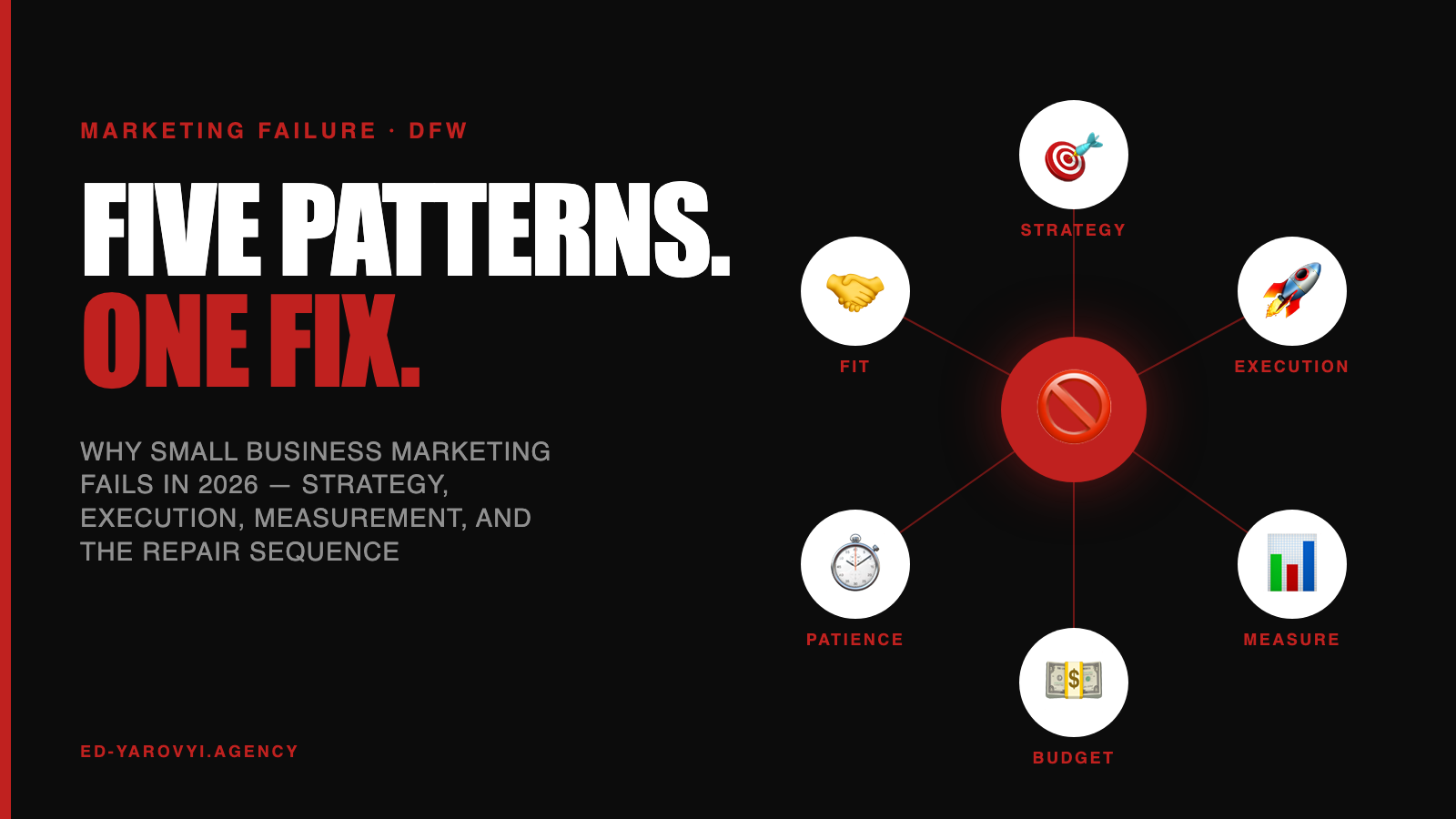
Most small business marketing fails in predictable patterns. Not because the owners are bad operators or the agencies are incompetent. Because the structural setup was wrong from week one and nobody caught it in time to fix. Understanding why small business marketing fails — specifically, in DFW, in 2026 — is the difference between burning $40K–$120K over 12 months and producing measurable revenue lift in the same period. The patterns are repeatable. The failures are avoidable. Most owners just do not know what to watch for.
This piece is the why small business marketing fails diagnostic framework I walk friends through when their marketing is not working and they cannot tell why. Numbers come from 2025–2026 DFW engagements I have either run, audited, or seen up close. The patterns repeat across category, suburb, and agency tier because they reflect structural choices, not bad luck.
What “Why Small Business Marketing Fails” Actually Means
Marketing failure is rarely a single bad decision. It is usually a chain of three or four structural problems that compound over 6–18 months. Three failure modes underneath the surface.
Strategy failures. Wrong channel selection, wrong audience targeting, wrong messaging for the business stage. The marketing produces activity but no revenue because the activity is aimed at the wrong people.
Execution failures. Right strategy, but the work is not getting done well or consistently. Content production stalls, ads run with broken targeting, intake systems lose qualified leads.
Measurement failures. Marketing might actually be working, but nobody can tell because tracking is broken. Without measurement, no fix is possible because the actual problem is invisible.
Most failing DFW small business marketing engagements have at least two of these three categories broken simultaneously. Fixing one without fixing the others rarely produces lasting improvement.
The Five Most Common Why Small Business Marketing Fails Patterns
Patterns I see consistently across audited engagements.
Pattern 1: Spending on too many channels at once. Six channels run poorly burns more cash than two channels run well. Most failing engagements try to do everything — paid search, paid social, content, email, video, influencer, podcasts — and produce mediocre results in all six. The compounding effect of doing two channels excellently outperforms six channels averagely by a wide margin.
Pattern 2: No baseline measurement. Without documented current CPA, LTV, and channel attribution before starting an engagement, no improvement can be measured. Most failing engagements skip baselining and end up unable to prove or disprove whether anything changed.
Pattern 3: Wrong shape of outside help for the problem. Hiring an agency when you needed a consultant. Hiring a freelancer when you needed multi-channel coverage. Hiring a consultant when you needed pure execution. The marketing help Dallas piece walks through how to match shape to problem.
Pattern 4: Quitting before compounding kicks in. SEO and content marketing show meaningful results at 6–12 months. Most failing engagements end at month 4 or 5, just before the work would have started compounding. Time horizon mismatch between the marketing channel and the operator’s patience is one of the most expensive errors in DFW small business.
Pattern 5: Marketing disconnected from operations. Marketing brings leads; operations cannot return calls within an hour; leads cool; revenue does not move. The marketing was working. The business was not ready to handle what marketing produced. Fixing marketing without fixing operations is a common misdiagnosis. According to Census Annual Business Survey data on US small businesses, the small business categories most likely to grow revenue year over year are those that integrate marketing with operational capacity rather than treating them as separate functions — which makes the disconnect pattern especially expensive when it goes unaddressed.
Strategy Failures — Specific Patterns
Five strategic mistakes that derail marketing before execution can save it.
Choosing channels by what is popular, not what fits. “Everyone is doing TikTok” or “we need to be on LinkedIn” without asking whether the target audience actually lives on those platforms. Marketing should follow the buyer; popular platforms are often the wrong place for specific business audiences.
Generic messaging for everyone. A Plano law firm targeting both family law and business law clients with the same generic “we help with legal matters” message converts neither audience effectively. Niche messaging beats broad messaging consistently in DFW small business categories.
Premium positioning for value-conscious buyers. The reverse mistake — luxury positioning targeting McKinney value-conscious shoppers, or budget positioning targeting Highland Park premium buyers. Market fit between positioning and audience matters more than positioning quality on its own.
Ignoring local competitive density. A Dallas dentist treating their marketing as if they were the only dentist in a small town produces messaging that loses to competitors who acknowledge the local competitive context. According to the Bureau of Labor Statistics data for the Dallas-Plano-Irving Metropolitan Division, DFW is one of the densest markets in Texas for professional services, healthcare, and skilled trades — that density requires differentiation, not just visibility.
No customer profile underneath the strategy. Marketing built without specific buyer profiles produces messaging that lands on nobody specifically. Generic appeals to “small business owners” or “homeowners” convert worse than specific appeals to a clearly defined ideal customer.
Execution Failures — Specific Patterns
Six execution patterns that turn good strategy into wasted spend.
Inconsistent posting and production. Bursts followed by silence. Three posts a week for two weeks then nothing for a month. Compounding channels do not compound under inconsistent execution.
Broken intake systems. Marketing brings inquiries; nobody returns calls within 4 hours; qualified leads convert at 10% instead of 25%. Most “marketing is not working” complaints are actually intake failures in disguise.
Slow website that loses qualified visitors. 6-second mobile load time bouncing 40% of visitors before they see your offer. The website conversion gap is the most-fixable execution issue and the most-ignored.
Untracked ad campaigns. Conversion events not firing, attribution broken, ad platforms reporting clicks instead of business outcomes. Money goes out, nobody knows where it goes.
Generic content production. Mediocre 800-word blog posts indistinguishable from competitors. Compounds toward nothing because Google rewards specific expertise, not template content.
Senior pitch then junior execution. Common with mid-market agencies. The strategist or principal who sold you the engagement disappears; juniors handle execution with no senior oversight. The red flags marketing agency piece walks through this pattern.
Measurement Failures — Specific Patterns
Five measurement failures that hide what the marketing is actually producing.
Tracking impressions instead of revenue. “We got 1.2 million impressions this month” with no path back to cost per lead or revenue contribution. Impressions are inputs; revenue is the output. Reports that emphasize inputs hide failures and successes alike.
Trusting the agency’s reporting layer instead of your own data. Even honest agencies present their work favorably. Always pull CPA, LTV, and channel attribution directly from your CRM and analytics. The marketing performance audit framework walks through the data sources to use.
No lead source attribution in the CRM. Leads come in but nobody knows which channel produced them. Marketing budget allocation becomes guessing because the data does not exist.
Vanity metrics on the monthly review dashboard. Engagement rate, follower count, time on page — useful as inputs but useless as outputs without revenue context.
Cherry-picked time windows. “Look at our growth since June” when the engagement started in August and the growth was already happening pre-engagement. Always compare meaningful before-vs-after windows tied to specific marketing actions.
How to Diagnose Which Failure You Are Hitting
A five-question diagnostic for failing marketing.
Question 1: Do you know your current cost per acquisition and customer lifetime value? If no, you have a measurement failure and cannot diagnose anything else until measurement is fixed.
Question 2: Are leads coming in but not converting to customers? If yes, you have either an intake failure (leads go cold before contact) or a sales process failure. Both look like marketing failures from the outside but are not.
Question 3: Has the engagement been running less than 6 months? If yes, the channels may not have had time to compound. Patience is sometimes the diagnosis, especially for SEO and content marketing engagements.
Question 4: Are multiple channels running with no clear strategic owner? If yes, you have a strategy failure dressed up as execution. Pick one strategic owner — consultant, fractional CMO, or in-house lead — and route everything through that ownership.
Question 5: Do you trust the people doing your marketing work? If no, the working relationship is broken regardless of metrics. Bad fit between operator and execution layer fails even with good strategy.
Most failing marketing engagements answer “no” to questions 1 and 4 — they have measurement gaps and strategy ownership gaps simultaneously. Fixing both together usually unblocks the engagement.
Fixing the Most Common Why Small Business Marketing Fails Patterns
The repair sequence that works.
Step 1: Run a marketing performance audit. Document current state across all eight cost categories, measure CPA and LTV from your own data, identify which of the three failure modes are active. Cost: 5–10 hours internal time or $1,500–$5,000 for outside auditor.
Step 2: Narrow channels deliberately. From six to two or three. Pick channels based on what the audit says is working or has potential, not on what the agency wants to keep selling. The marketing cost Dallas piece walks through reasonable channel allocation by category.
Step 3: Fix intake and conversion friction. Most fixable execution problem. Mobile speed, click-to-call placement, simple booking forms, fast response time. Often produces 20–40% lift without changing any acquisition spend.
Step 4: Establish or repair measurement. Conversion events in GA4, ad platform attribution, CRM lead source tracking. Without measurement, no further improvement can be confirmed.
Step 5: Commit to 6 months of disciplined execution before evaluating again. Channels need time to compound; compounding is the entire reason content and SEO are worth doing. Operators who run the fix sequence then evaluate at month 3 typically revert to old patterns out of impatience. Six months minimum before recommitting or exiting.
The marketing consultant in Plano piece walks through how outside operators run this fix sequence when the internal team cannot. Sometimes the fix needs outside perspective; sometimes it just needs documented baseline plus discipline.
Related case: the Rival Sign Company case is a useful counter-example — a DFW small business that succeeded by avoiding most of the failure patterns described above through operator-led marketing discipline.
Why does small business marketing fail most often?
Three categories: strategy failures (wrong channels, wrong messaging, wrong audience), execution failures (inconsistent production, broken intake, slow website), and measurement failures (tracking impressions instead of revenue, no baseline, no attribution). Most failing engagements have two or three of these broken simultaneously.
How do I know if my marketing is actually failing or just needs more time?
Check three things. Has cost per acquisition been flat or rising for 6+ months? Is the marketing producing leads that are not converting (intake problem, not marketing problem)? Have multiple compounding channels been flat for 6+ months when they should compound? Two or three yes answers means failure; one yes means likely patience required.
Can I fix failing marketing without firing the agency?
Sometimes. If the failure is execution or measurement and the agency is willing to course-correct, the same engagement can recover. If the failure is strategy and the agency cannot see it, usually the agency needs to be replaced. Audit first, decide second.
Is six months long enough to judge if marketing is working?
For paid channels and retention, yes. For SEO, content marketing, and Google Business Profile, marginal — these compound over 6–12 months. Most small business marketing engagements that fail at month 6 either had strategy or measurement failures that would have shown signal earlier if measurement were in place.
What is the biggest reason DFW small business marketing fails?
Trying to run too many channels with too little budget and no strategic ownership. Six channels at $1,500 each produces six mediocre channels; the same $9,000 across two channels run well usually produces measurable revenue lift within 6 months. Channel discipline is the single biggest predictor of DFW small business marketing success.
How much does it cost to fix failing marketing?
A marketing performance audit runs 5–10 hours internal time or $1,500–$5,000 outside. Channel narrowing usually saves money rather than costing it. Measurement repair runs $500–$2,500 in tools and setup time. Six months of disciplined execution at reduced channel count typically delivers positive ROI; the fix sequence pays for itself within the same year.
Can the operator fix failing marketing without outside help?
Yes if the operator has time and is willing to follow the fix sequence (audit, narrow channels, fix intake, repair measurement, commit to 6 months). Most operators do not have the time, which is when an outside consultant or fractional advisor helps. The fix sequence is the same either way; the question is just who runs it.