Organic growth for small business is the marketing that keeps working after you stop paying for it. Paid ads are a faucet — the moment you stop, the traffic stops. Organic growth is an asset you build once that compounds for years: content that ranks, a reputation that spreads, and systems that bring customers without a per-click bill. The U.S. Small Business Administration emphasizes building durable customer relationships over one-off spending, and the U.S. Bureau of Labor Statistics reflects how much strategic marketing skill this actually requires.
My whole approach is organic growth systems, built and run end-to-end. So this guide breaks down organic growth for small business in 2026 — what it actually is, why it beats renting attention, and how to build the systems that compound instead of chasing the next ad.
What organic growth for small business really means
Organic growth is customers who find you without you paying for each one — through search, content, reputation, referrals, and word of mouth. It is slower to start than paid ads but fundamentally different: instead of renting attention, you own the channels that produce it. Over time, that ownership is what separates a business that scales from one stuck on the ad treadmill.
Five reasons organic growth wins for small business
- It compounds — content and reputation keep working and stacking, so results grow over time instead of resetting
- It is durable — you own the assets, so a change in ad costs or platform rules does not wipe you out
- It builds trust — customers who find you through content and reviews arrive already believing in you
- It lowers cost over time — the cost per customer falls as the assets mature, the opposite of paid ads
- It creates a moat — a competitor can copy your ad, but not years of content, authority, and reputation
None of this means ignore paid entirely — it means build the durable foundation first, so paid amplifies an asset instead of propping up a business with no organic base.
Organic and paid: how to balance them
Organic growth for small business is not a rejection of paid ads, it is the foundation that makes paid worth running. The two work best together, in the right sequence and ratio, rather than as an either-or choice.
Think of organic as the asset and paid as the accelerator. Early on, most of the effort goes into building organic foundations, because paid spend on an unproven message or a site that does not convert just burns money faster. Once the organic base is producing and the site converts, paid ads amplify what already works, filling the gaps organic is slower to reach and pushing proven offers to more people.
The mistake is running paid to compensate for missing organic. A business with no organic foundation is renting all of its growth, and the moment the ad budget pauses, everything stops. Build the owned assets first, then let paid pour fuel on a fire that is already lit.
How to measure organic growth
Because organic growth for small business compounds slowly, measuring the right things keeps you patient through the early months and honest about what is working.
Watch organic traffic and its trend over months, not days. Track rankings for the terms your customers actually search, review volume and rating, and the share of new customers who found you without an ad. Most importantly, watch the trajectory: organic that is flat after six months of real effort needs a rethink, while organic that is climbing is an asset worth protecting and feeding. The compounding only shows up when you measure over quarters, so give it the timeframe it needs and judge it on the trend.
Why patience is the real competitive advantage
The hardest part of organic growth for small business is not the work, it is the waiting. Most businesses abandon it in the quiet early months, right before the compounding begins, and that impatience is exactly why the ones who stay the course win.
Think about what that means competitively. If most businesses quit organic within a few months, then simply persisting for a year puts you ahead of the majority of your market. The content keeps ranking, the reviews keep accumulating, the reputation keeps spreading, and none of it resets when a budget pauses. Patience turns into a moat that faster-spending competitors cannot buy their way across.
This is why I frame organic as a system to run consistently, not a campaign to judge in weeks. Set the systems up, feed them steadily, measure the trend over quarters, and let time do the compounding. The business that treats organic growth as a long game ends up with lower costs and more durable growth than the one forever chasing the next paid spike, and that durability is the whole point.
Organic discovery is shifting too: more answers now arrive through AI assistants than through a list of links. Generative engine optimization is the part of organic growth aimed at becoming a cited source.
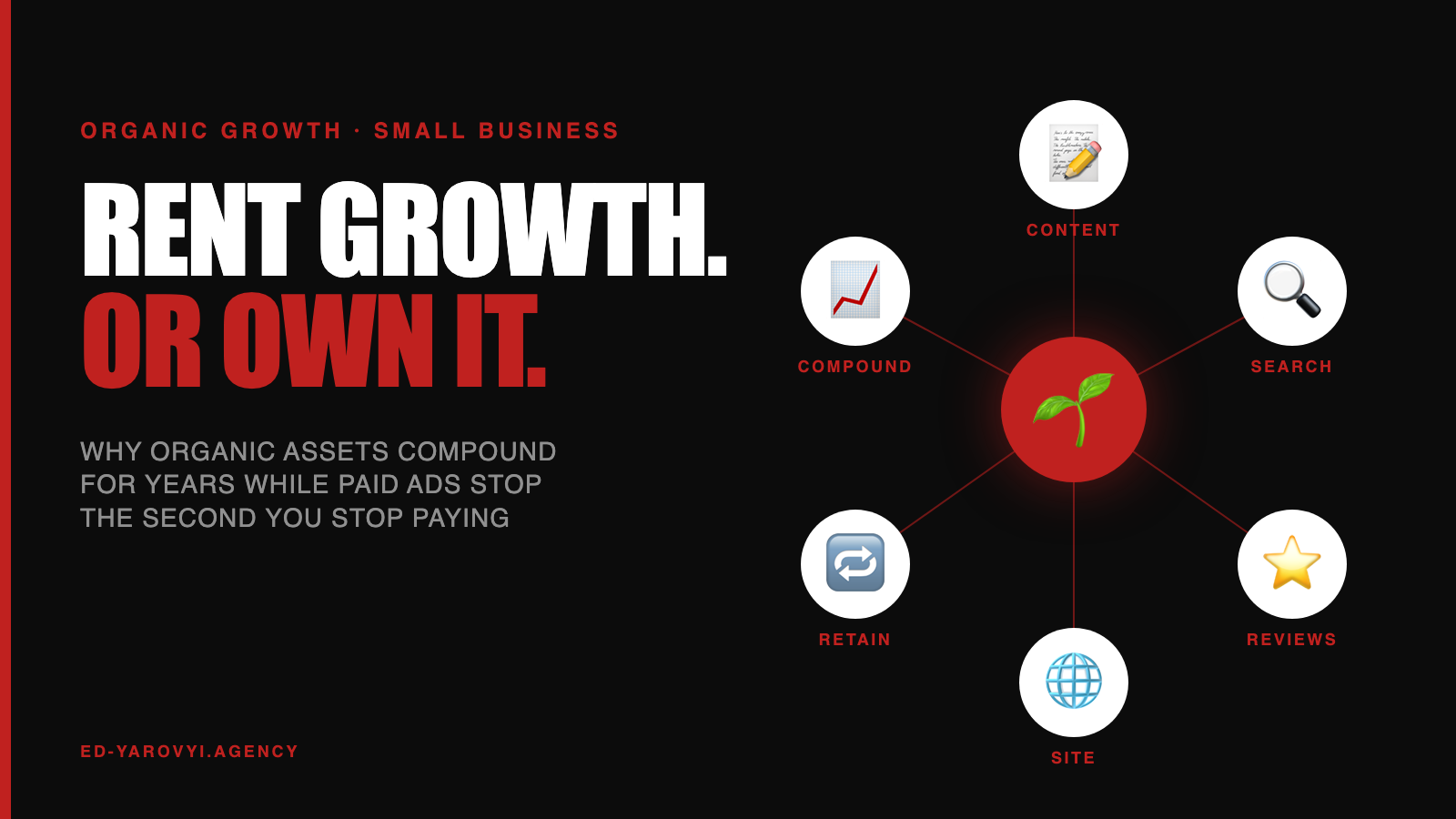
Paid ads stop the second you stop paying. Organic assets keep producing customers for years. For a small business, the question is whether you are renting your growth or building something you own.
The systems that drive organic growth
Organic growth is not luck — it is the output of a few connected systems working together. Here is what actually builds it.
1. A content system that ranks and compounds
Content is the engine of organic growth. Articles and videos that answer what your customers search for keep pulling in traffic for years. Built on a system rather than posted at random, content compounds into an authority that competitors cannot buy. The content marketing system guide covers how to build it.
2. Local search and reputation
For most small businesses, showing up in local search and looking trustworthy through reviews is the highest-return organic channel. A strong profile and steady review velocity bring ready-to-buy customers without a per-click cost, day after day.
3. A website that converts and gets found
Organic traffic is wasted on a site that does not convert. A fast, conversion-focused site with solid on-page SEO turns hard-won organic visitors into customers. The conversion focused web design guide covers what that takes.
4. Retention and referral loops
The most organic growth of all comes from happy customers who return and refer. Email retention, great service, and simple referral systems turn each customer into a source of more, compounding growth without any acquisition cost.
Why organic growth requires patience and a system
The honest trade-off with organic growth is time. It does not produce a flood of leads next week the way a paid campaign can. It produces a rising tide over months that eventually outpaces and outlasts paid — but only if you stay consistent through the slow early stretch.
- Months one to three: foundation — building content, profile, reviews, and systems with little visible return yet
- Months three to six: momentum — rankings move, reviews build, and organic leads start appearing
- Months six to twelve: compounding — the assets mature and organic becomes a steady, growing source of customers
- Beyond: the moat — years of content and reputation become a lead that competitors cannot catch
Here is my honest take: most small businesses quit organic right before it pays off, then complain it does not work. The ones that treat it as a system and stay consistent for a year end up with growth that costs less every month instead of more.
Building organic growth systems that fit your business
The right organic growth plan matches your capacity and market. A local service business leans on local search and reviews; a content-driven business leans on articles and video; most benefit from a mix, sequenced sensibly. The point is a connected system, not scattered tactics.
This is exactly what I build: content, local search, a converting website, and retention loops wired into one organic growth system, run end-to-end by a single operator with no handoffs. The marketing cost Dallas breakdown covers what it costs and how to fund it alongside any paid spend.
For when ads make sense and when they don’t, read organic vs paid marketing.
What is organic growth for a small business?
It is attracting customers without paying for each one — through search, content, reputation, referrals, and word of mouth. Organic growth for small business means owning the channels that produce customers, so results compound over time instead of stopping when the ad budget does.
Is organic growth better than paid ads?
They serve different roles. Paid ads deliver fast but stop the moment you stop paying; organic is slower to start but compounds and lowers cost per customer over time. The strongest approach builds a durable organic foundation first, then uses paid to amplify it.
How long does organic growth take to work?
Foundation work fills the first three months with little visible return, momentum builds from months three to six, and compounding returns arrive over six to twelve months. Most businesses quit right before it pays off; consistency through the slow stretch is what wins.
What drives organic growth for a small business?
A content system that ranks, strong local search and reviews, a website that converts and gets found, and retention and referral loops. Together these connected systems compound into a growing, durable source of customers that no competitor can simply buy past.
Can a small business do organic growth without a big team?
Yes, with systems and automation doing the heavy lifting. The point is not maximum output but a sustainable, connected set of systems — content, local search, website, and retention — that a small team or a single operator can run consistently over the long haul.
What is organic marketing?
Organic marketing brings customers without paying for each click or view: search visibility, useful content, social media posts, reviews, email, and word of mouth. It takes longer to build than paid ads, but the assets keep working after you create them, so the cost per customer tends to fall over time.
How do you calculate organic growth?
Organic growth is revenue growth from your existing business, excluding growth bought through acquisitions. A simple version: take this period’s revenue, subtract revenue added by any acquisitions, subtract last period’s revenue, then divide by last period’s revenue. For marketing, many owners also track growth in customers who found them without ads.
How can I grow my business faster organically?
Focus on the few channels that compound: a website that converts, a strong local search presence with steady reviews, content that answers your customers’ real questions, and a system for repeat business and referrals. Consistency over months, not bursts of activity, is what accelerates organic growth.