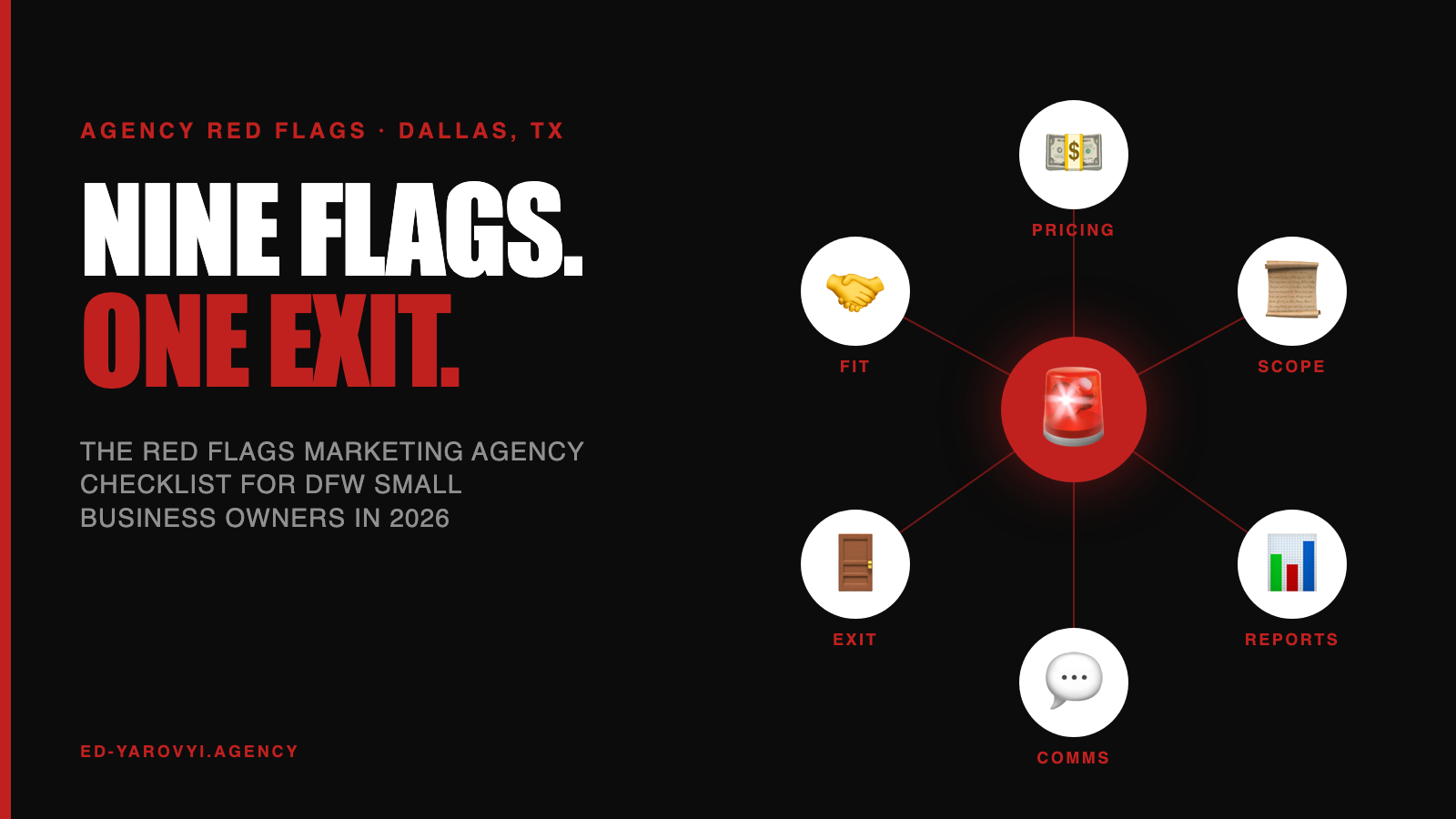
The most expensive marketing agency I have ever watched a friend hire cost her $94,000 over eight months and produced one mediocre landing page and a brand book she will never open. The agency was not incompetent. It was just a bad fit, and the warning signs were there in the first pitch meeting. She missed them because nobody had told her what to look for. That is the entire purpose of this piece.
This is the red flags marketing agency checklist I use when friends in Dallas, Plano, Frisco, and the broader DFW area ask me to second-opinion a pitch or an existing engagement. Nine patterns, sorted by category, with what each one actually signals underneath. If you spot two or more in a single agency, walk away. Three or more and you are about to lose money in a way that is hard to unwind once the contract is signed.
What “Red Flags Marketing Agency” Really Means
A red flag is not “the agency is bad.” A red flag is a signal that the agency’s structure, incentives, or process will produce poor results for your specific business — regardless of how skilled the individuals are. Many of the worst engagements I have seen were run by smart, hard-working agencies who simply did not fit the client’s situation. The red flags marketing agency framework is about pattern recognition, not character judgment.
Three categories cover most of what to watch for:
- Pricing red flags. How the agency charges and what is hidden in the structure.
- Process red flags. How the agency works week to week — communication, reporting, scope handling.
- Strategy red flags. Whether the agency’s recommendations are tied to your business or to their own service stack.
Each red flag below sits in one of these three buckets. Most agencies that fail in Dallas fail because they have multiple red flags layered together, not just one.
Pricing Red Flags
1. One-size-fits-all tier menu. “Starter $1,500, Growth $4,500, Pro $9,500.” If three completely different businesses get the same package at the same price, the package is generic enough that none of them get the work they actually need. Real engagements reflect real scope. A red flags marketing agency pattern I see weekly in Dallas — tiers that exist for the agency’s billing convenience, not for client outcomes.
2. Vague “starting from” pricing. “Marketing starting from $2,000 per month.” Starting from what? Ending at what? When pricing is presented with no upper bound or scope clarity, the agency is leaving room to upcharge later. Honest pricing is presented as a defined scope at a defined price for a defined period.
3. Heavy upfront setup fees with vague deliverables. $5,000–$10,000 upfront for “strategy phase” or “onboarding” with no concrete deliverable list. Real strategy phases produce documented artifacts — competitive analysis, channel recommendations, KPI definitions, content audit. If the setup fee buys you a Zoom call and a Notion page, the fee is buying the agency’s cash flow, not your business outcome.
For deeper pricing context, see marketing agency pricing in Dallas. That piece walks through what reasonable looks like, which makes spotting unreasonable easier.
Contract Red Flags
4. 12-month lock-in with no quarterly review. A 12-month contract structured for the agency’s revenue, not your performance. Reasonable structure: 3-month initial commitment to give the agency time to run a real test, then month-to-month with 30 days notice. Any agency that insists on 12 months with no exit ramp is protecting their cash flow over your results.
5. Vague deliverables in the scope of work. “Social media management” without listing post count, platforms, engagement metrics, and reporting cadence is a blank check. “SEO services” without listing keyword targets, pages produced, links built, and ranking metrics is the same. Specifics protect both sides. Vagueness only protects one side, and it is not yours.
The 12 questions to ask before signing piece walks through the full filter for spotting these patterns in a pitch. Half the questions are designed to surface scope ambiguity before it becomes a billing dispute three months in.
Communication Red Flags
6. The pitcher disappears after signing. The salesperson who wins your business is the only senior person you talk to during pitch. After the contract is signed, you meet the “account team” and the senior person is gone. This is structural in mid-market agencies — the senior pitches, the juniors execute. A red flags marketing agency pattern when the team handing off your account is two or three layers junior to the people who pitched it.
7. No named team members in the proposal. “Our team will handle your account” with no names, no roles, no LinkedIn profiles to verify. A real agency lists who specifically will do your work, what their experience is, and how many hours per week they will spend on your account. Anonymous teams mean the agency is reserving the right to staff your account with whoever is available, regardless of fit.
Reporting Red Flags
8. Vanity metrics only. Monthly reports full of impressions, reach, engagement rate, and “brand awareness” with no path to revenue. Impressions do not pay bills. A real reporting cadence ties marketing activity to cost per lead, cost per acquisition, customer lifetime value, and revenue contribution. According to the Bureau of Labor Statistics data on marketing managers, the median professional in this field earns over $156K annually — they should know how to report on revenue impact, not just activity volume.
9. No baseline measurement before starting. If the agency does not ask for your current marketing performance numbers before signing, they cannot show you whether they improved anything. Baseline measurement is foundational. An agency that skips it is an agency that does not want to be measured.
Strategy Red Flags Worth Knowing About
Beyond the nine core red flags, three strategy patterns to watch for that are subtler but equally damaging.
“We will run all channels.” Agencies that pitch six or seven channels run in parallel — SEO, paid search, paid social, email, content, influencer, video — are usually overselling capacity. Realistic mid-market engagements deliver two or three channels well. Six channels at the price of three means most of them get a junior or get neglected. The marketing consultant in Plano piece covers why channel discipline beats channel breadth in detail.
“Industry benchmarks” as the only goal. “We will get you to industry-benchmark performance” sounds reasonable until you realize industry benchmarks are averages, and being average is not the goal. A real agency sets goals tied to your specific business situation — your margin structure, your lifetime value, your competitive position — not to a generic industry chart.
Recommendations that all map to their service stack. If every recommendation the agency makes happens to require services the agency sells, the recommendations are sales calls, not strategy. A real agency will sometimes tell you to fix operations, hire in-house, or use a different vendor for a specific need. Agencies that recommend only themselves are not advising; they are selling.
What to Do If You Are Already in a Bad Engagement
Spotting red flags after signing is more common than spotting them before. Three moves if you are already in a bad agency engagement.
First, audit what you have actually paid versus what was promised. Pull the original scope of work and the last six months of invoices. Most red flags marketing agency situations involve a scope-versus-delivery gap that the operator has not formally documented. Document it. That alone shifts the conversation.
Second, request a clarifying meeting with the agency’s principal — not your account manager. Bring the gap analysis from step one. Real principals will either fix the situation within 30 days or quietly agree to terminate the engagement. Either way, you stop bleeding cash on uncertain delivery.
Third, plan the exit before announcing it. Make sure you own your hosting accounts, your Google Business Profile, your ad accounts, your social profiles, and your domain. Agencies that own these on your behalf use them as switching-cost leverage. Get credentials transferred in your name before the difficult conversation, not after. The FTC’s advertising and marketing rules of the road are a useful reference if a dispute escalates — they spell out what agencies can and cannot claim on your behalf in advertising and reporting. The Animal-ID USA case is a useful counter-example of what good agency-style execution looks like when ownership of channels and reporting stays with the client throughout.I have walked friends through this exact sequence three times in 2025 alone in Dallas, Plano, and Frisco. The pattern repeats because the upfront red flag screening was skipped. Catching it before signing is cheaper. Catching it after signing is still possible — it just costs more, in time and in lost momentum.
If you are already inside a bad engagement rather than evaluating one, when to fire your marketing agency covers the exit signals and how to leave cleanly.
Most of these red flags trace back to the same root causes — why small business marketing fails lays out the patterns that waste budgets before any agency is even involved.
What are the most important red flags marketing agency owners should watch for?
Three patterns dominate: one-size-fits-all tier menus, vague deliverables in the scope of work, and reporting based on vanity metrics rather than revenue. Any single one is a warning; two or more together usually means the engagement will fail regardless of the agency’s individual skill level.
Is a 12-month marketing agency contract always a red flag?
A 12-month contract with no quarterly review clause is structured for the agency’s cash flow, not your performance. A reasonable alternative is 3 months initial commitment then month-to-month with 30 days notice. If the agency insists on a 12-month lock-in with no exit ramp, that is a red flag worth treating seriously.
How do I tell if a marketing agency’s pricing is reasonable?
Reasonable agency pricing reflects defined scope at a defined price. Vague “starting from” pricing, heavy upfront setup fees with no concrete deliverable list, and tier menus that ignore your specific needs are signals of pricing built for agency convenience, not client outcomes.
What if the agency that pitched me is different from the team I get?
Common in mid-market agencies — senior pitches, juniors execute. Ask in the pitch for named team members who will work on your account, with their LinkedIn profiles or experience. Anonymous teams allow the agency to assign whoever is available regardless of fit, which is a structural red flag.
Are vanity metrics in monthly reports a red flag marketing agency pattern?
Yes when they are the only metrics reported. Impressions, reach, and engagement rate are useful as inputs but cannot prove the marketing produced revenue. Real reporting ties activity to cost per lead, cost per acquisition, and revenue contribution. Reports that skip revenue-tied numbers signal an agency that does not want to be measured on what matters.
Can I fire a marketing agency mid-contract?
Depends on the contract. Most reasonable contracts allow termination with 30 days notice after the initial commitment period. Some contracts include early termination fees. Before any termination, audit what you have actually received versus what was promised — that gap analysis often produces leverage to negotiate exit without penalty.
What should I do before signing with a new marketing agency to avoid red flags?
Three steps. First, ask the 12 specific questions in the agency vetting checklist to surface red flags during the pitch. Second, require named team members and a defined scope of work with specifics, not categories. Third, baseline your current marketing performance before signing so you can measure whether the agency improved anything in 90 days.