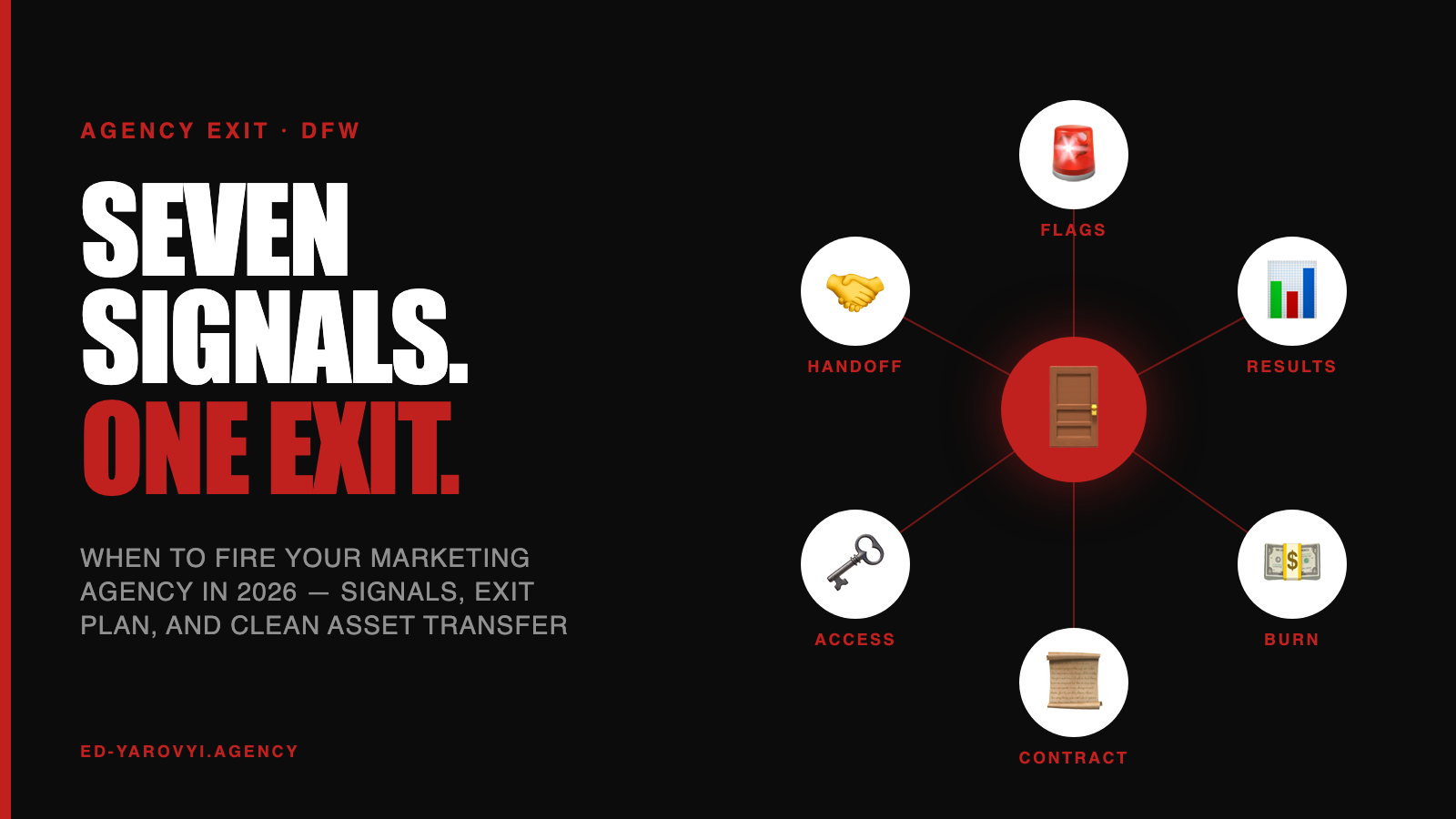
Most Dallas small business owners stay with bad marketing agencies six months too long. The reason is not stupidity. It is sunk cost — money already spent, contracts already signed, the awkwardness of confrontation, and the genuine difficulty of telling whether the agency is failing or whether marketing just takes time. When to fire your marketing agency is the question with the longest delay between “I should probably do this” and actually doing it, and that delay costs roughly $25,000–$80,000 in DFW small business scenarios.
This piece is the seven signals that tell you when to fire your marketing agency, how to plan an exit cleanly, and what to have ready before you make the call. Numbers come from active 2025–2026 engagements I have either run or audited across DFW. Half the friends I have walked through this conversation regretted not doing it earlier; none regretted doing it at all.
What “When to Fire Your Marketing Agency” Really Asks
The question is rarely about agency competence. Most marketing agencies in DFW are competent at what they do. The real question is whether the agency is producing measurable revenue at acceptable cost for your specific business — and whether the relationship is structured in a way that lets that happen.
Three things underneath the question:
- Is the agency producing revenue? Not impressions, reach, or engagement — actual revenue you can trace back to marketing activity.
- Is the cost reasonable for what is being produced? Marketing should be profitable within 4–9 months. Anything beyond that and the math is broken.
- Is the working relationship healthy? Response times, scope clarity, monthly meeting quality, willingness to hear feedback.
An agency can be excellent at marketing and wrong for your business. Both things are true. When to fire your marketing agency is about fit and outcomes, not competence.
Seven Signals It Is Time to Fire Your Marketing Agency
The patterns that consistently appear before a DFW engagement falls apart.
Signal 1: Cost per acquisition has been flat or rising for 6+ months. A healthy agency engagement drives CPA down over the first 12 months as channels optimize. Flat CPA across 6 months means the agency is not learning from the data, or the agency is not getting useful data, or the channels are saturated for that strategy. According to the Bureau of Labor Statistics data on marketing managers, senior marketing professionals earn well over $156K a year specifically because their job is to lower acquisition cost over time. If your agency is not doing that, you are paying senior-level fees for junior-level output. Any of those three failures means it is time to change something — usually the agency.
Signal 2: Reports emphasize vanity metrics with no revenue context. Monthly reports full of impressions, reach, engagement rate, “brand awareness” with no path back to revenue indicate an agency that does not want to be measured on outcomes. Real reports tie activity to cost per lead, cost per acquisition, and revenue contribution. The full pattern is in red flags marketing agency.
Signal 3: The senior person from the pitch is no longer involved. Common in mid-market agencies. The strategist or principal who sold you the engagement disappears after month 2, and your account is run by juniors who do not have the context or authority to make decisions. The relationship you signed for is not the relationship you are getting.
Signal 4: Scope creep has inflated the actual cost 30–60% above the original quote. Tools, ad management fees, setup fees, scope-creep upcharges. A $5,000 retainer that becomes $8,500 effective monthly cost is not the agreement you made. Some inflation is normal; 30–60% inflation with vague explanations means the structure was opaque from the start.
Signal 5: Response times have degraded. 48-hour response time at the start, 5-day response time at month 6. Slack messages going unanswered for days. Emails requiring follow-up to get a reply. This signals the agency has deprioritized your account — usually because they have larger clients who consume their attention.
Signal 6: Recommendations always require buying more from the agency. Every quarterly review concludes with “we need to expand scope to include X service we conveniently sell.” Real agencies sometimes recommend you fix operations, change another vendor, or hire in-house — even when those recommendations reduce their own revenue. Agencies that recommend only themselves are selling, not consulting.
Signal 7: Your team has lost confidence. The most subjective but most reliable signal. If you find yourself avoiding the monthly meeting, dreading the agency report, or rolling your eyes at the latest “strategy” recommendation, the engagement is structurally broken regardless of metrics. Trust the gut signal; it usually precedes the data signal by 60–90 days.
Any one signal is a yellow flag. Two or more is enough to start planning the exit. Three or more and the only question is timing.
How to Exit Cleanly Without Burning Bridges
Firing a marketing agency is straightforward when you have prepared properly. Most ugly exits come from preparation gaps, not from agency obstruction.
Step 1: Audit what you have actually received. Pull the original scope of work and the last 6 months of invoices. Document the gap between promised and delivered. The marketing performance audit framework walks through how to do this in 5–10 hours. Bring this to the conversation rather than vague dissatisfaction.
Step 2: Verify you own your assets. Hosting accounts, domain registration, Google Business Profile, ad accounts (Google Ads, Meta Business Manager), social profiles, CRM access, email marketing platform, design files. Most agency exits hit friction here because the agency owns one or more of these on the client’s behalf. Transfer ownership before announcing the exit, not after.
Step 3: Review your contract for exit terms. Notice period (usually 30 days), early termination fees (sometimes), final invoice expectations, asset transfer obligations. Most reasonable contracts allow termination with 30 days notice after the initial commitment. Some have onerous early-termination clauses that the audit step makes worth disputing.
Step 4: Plan the replacement before announcing the exit. An agency replacement, a freelancer, an in-house hire, or temporary self-management. Going dark on marketing for 60+ days kills momentum. Have the next move lined up — even if it is just a solo consultant covering the gap for 90 days while you decide.
Step 5: Have the conversation directly with the principal. Not your account manager. The owner or senior partner. Explain specifically what is not working, reference the audit findings, and state the timeline for exit. Most principals will either propose fixes within 30 days or quietly agree to a clean transition. Either way, you stop bleeding cash on uncertain delivery.
According to the FTC’s advertising and marketing rules of the road, agencies operating on your behalf have specific obligations around claims, data ownership, and consumer-facing communications. Knowing these obligations gives you leverage if the exit becomes contentious — most do not, but the leverage is useful to have in your back pocket.
What to Have Ready Before You Fire the Agency
The five-item checklist that makes exits smooth.
Asset ownership transferred or verified. Domain registrar account in your name. Hosting in your name. Google Business Profile claimed by your business email, not the agency. Ad accounts owned by your business with the agency as a manager (revocable), not the other way around. CRM, email platform, and analytics accounts all in your business name. If the agency is the primary owner of any of these, fix that first.
Three months of historical data exported. Analytics reports, ad performance data, email campaign results, lead source attribution. The agency might be slow to provide data after the exit conversation; export it before the conversation happens.
Documented gap between scope and delivery. Bullet-point comparison of original promises versus actual delivery. The audit step produces this. It is the document that shifts the conversation from “I am unhappy” to “here is what was missed.”
Replacement plan or transition arrangement. Even if the replacement is “we will run lean for 90 days while we decide,” have an explicit plan. The marketing agency vs in-house piece walks through the alternatives and which fits which revenue stage.
Communication plan for your team and stakeholders. If your team works with the agency directly — content reviews, copy approvals, asset requests — they need to know about the exit and the transition plan. Surprise transitions create internal chaos that compounds the external disruption.
Mistakes to Avoid When Firing Your Marketing Agency
Five patterns that turn smooth exits into expensive ones.
Announcing the exit before transferring asset ownership. Once the agency knows you are leaving, ownership transfers often slow down or become contentious. Always transfer first, announce second. The Animal-ID USA case stayed clean throughout because asset ownership was always with the client; that is the structure to aim for from day one of any agency engagement.
Trying to negotiate fixes after deciding to leave. If you have already decided the engagement is over, do not pretend you are considering staying. Most principals can tell. The pretense costs goodwill and slows the actual transition. Be direct.
Skipping the documented gap analysis. “It just is not working” produces a defensive response from the agency. “Here are six specific deliverables we did not receive and three metrics that have not moved in six months” produces a constructive response — even if that response is acceptance of the exit.
Going scorched-earth on the exit conversation. Even agencies that failed you have other clients, professional networks, and reputations they will defend. Burning bridges produces nothing useful and occasionally produces real downside (negative references, online complaints, unwillingness to cooperate on transition).
Not setting a final transition date. “We will figure out timing” leaves the engagement in limbo for 60+ days. Set a specific final date in writing within 7 days of the exit conversation. Most agencies prefer clarity here too.
After You Fire the Agency — What’s Next
Three patterns for the first 90 days after exit.
Run lean for 30–60 days while diagnosing. Resist the urge to immediately hire another agency. Use the first month to actually understand what your marketing was producing — or not producing — without the agency’s filtered reporting. Most operators are surprised by what they find when they look at the raw data themselves.
Decide replacement structure based on what you learned. The exit usually reveals whether you need another agency, a fractional CMO, an in-house hire, a solo consultant, or some combination. Different from what you might have assumed pre-exit. The marketing agency vs in-house piece breaks down the math for each option.
Re-baseline before signing the next engagement. Whatever replaces the exited agency should start with documented baseline numbers — current CPA, current LTV, current channel performance. Without baseline, the next engagement will be just as opaque as the one you exited. Baseline is the foundation of measurable improvement.
When should I fire my marketing agency?
Two or more of these signals together: cost per acquisition flat or rising for 6+ months, reports full of vanity metrics with no revenue context, the senior pitched-to person no longer involved, scope creep inflating cost 30–60%, response times degrading, recommendations always requiring expanded scope. Any single signal is a yellow flag; two or more is enough to start planning an exit.
How do I exit a marketing agency contract cleanly?
Five steps. Audit what you have actually received versus what was promised. Verify you own your hosting, domains, ad accounts, GBP, and CRM. Review your contract for exit terms and notice period. Plan your replacement before announcing the exit. Have the exit conversation directly with the principal, not the account manager.
Can I fire an agency mid-contract without penalty?
Depends on the contract. Most reasonable contracts allow termination with 30 days notice after the initial commitment period. Some contracts include early termination fees. Audit the gap between promised and delivered first — that gap analysis often produces leverage to negotiate exit without penalty even when fees are technically owed.
What should I have ready before firing my marketing agency?
Asset ownership transferred to your business (domains, hosting, ad accounts, GBP, CRM). Three months of historical data exported. Documented gap between scope and delivery. Replacement plan or transition arrangement. Internal communication plan for your team. Preparation in these five areas is what separates smooth exits from expensive ones.
Should I hire another agency immediately after firing one?
Usually not. Run lean for 30–60 days first to actually understand what your marketing was producing without the agency’s filtered reporting. The exit often reveals whether you need another agency, a fractional CMO, an in-house hire, or a solo consultant — different from what you might have assumed before exiting.
How long does a clean agency exit typically take?
2–4 weeks from the exit conversation to final transition when prepared properly. Asset transfers usually take 1–2 weeks. Final billing and data handoff add another 1–2 weeks. Faster than this means corners get cut; slower usually means asset ownership was not in order before the exit conversation.
Will firing a marketing agency hurt my SEO or rankings?
Short term: minor disruption if content production pauses. Long term: no impact if asset ownership transferred cleanly and the replacement maintains channel activity. The biggest risk is going 60+ days with no marketing activity at all — that pause can cost organic momentum that takes months to rebuild. Always have a transition plan before exiting.