Most Dallas small business owners enter their first marketing agency engagement with wrong expectations on both ends. Some expect leads within two weeks. Others expect strategy magic that revolutionizes the business by month two. Both expectations cause exits in month three or four, before the engagement has had time to produce the kind of compounding return that justifies the cost. Understanding what to expect marketing agency engagements should produce in the first 90 days is the single biggest predictor of whether the relationship will work for 12 months or more.
This piece is what to expect marketing agency engagements actually look like during the first 90 days in 2026 DFW — month by month, signal by signal, including the common disappointments that turn out to be normal and the red flags that turn out to be real problems. Numbers come from real engagements I have either run or audited across DFW small businesses.
What “What to Expect Marketing Agency” Really Asks
The question is rarely about specific deliverables in the first 90 days. The real question is whether the agency is doing the foundation work that will produce returns in months 4–12, or whether they are running a generic playbook that will collapse by month 6.
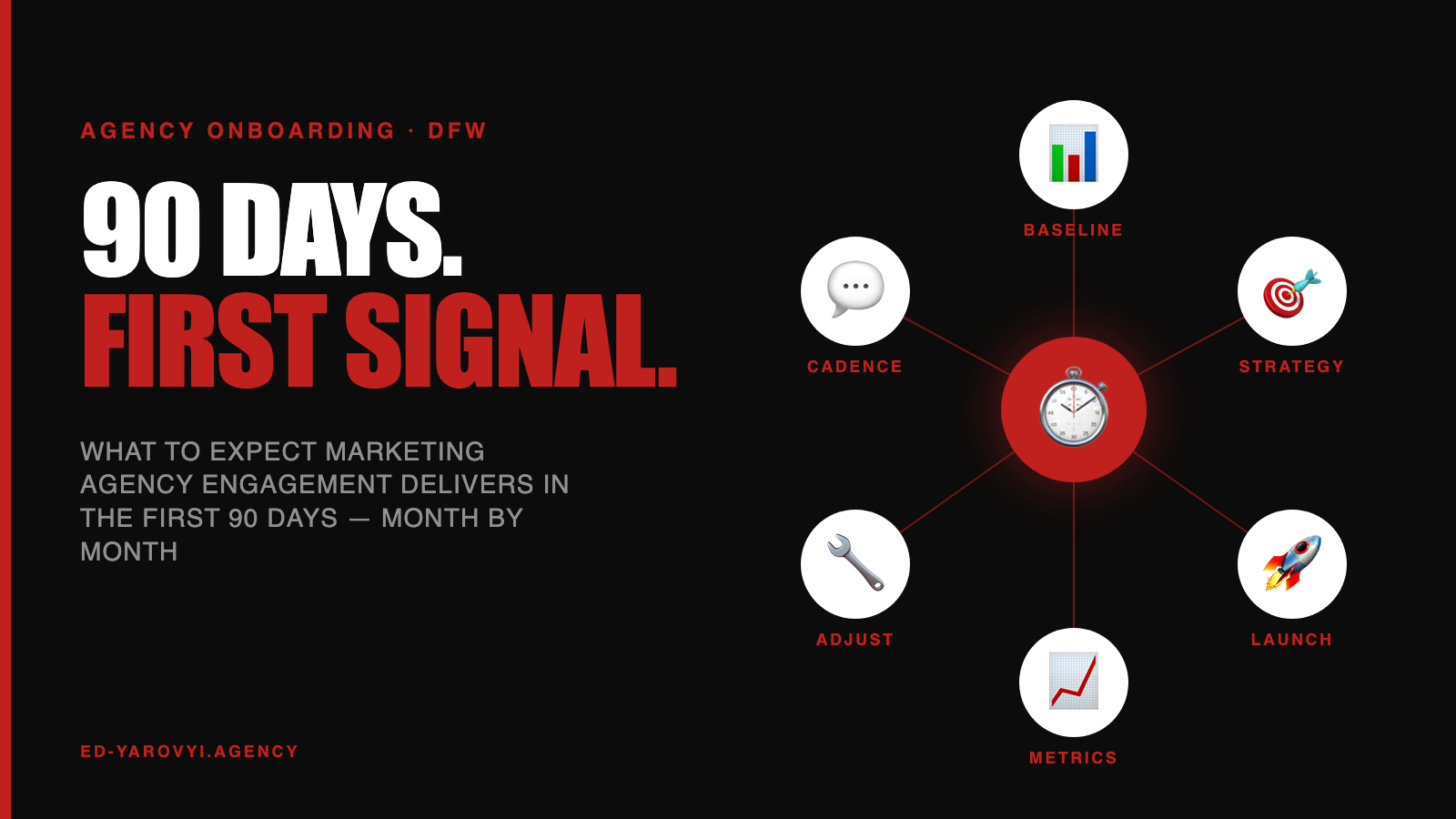
Three things any healthy first 90 days produces:
- Baseline measurement. Documented current performance across channels — current CPA, current LTV, current channel attribution. Without baseline, no future performance can be measured.
- Strategy aligned to your specific business. Not generic templates. Channel selection, scope, and sequencing tailored to your revenue, category, and competitive context.
- Initial execution with measurable first signal. Not full results — first signal. Paid channels showing initial ad performance, organic channels showing first ranking movement, retention channels showing first email response data.
An agency that produces these three by day 90 is on track even if the headline metrics are not impressive yet. Marketing compounds; the first 90 days build the foundation for that compounding.
First 30 Days — Onboarding and Baseline
Days 1–30 should focus on understanding what already exists, what is already working, and where the gaps live. Real agencies spend significant calendar time here. Agencies in a hurry skip this and pay for it later.
Discovery and audit. Two to four sessions with the operator covering business model, customer profile, current marketing performance, competitive context, and goals. The output is a written discovery document that captures everything. If your agency does not produce a discovery document by day 21, the first 30 days are not being used well.
Asset inventory and ownership transfer. The agency needs access to Google Business Profile, Google Analytics, Search Console, ad accounts, CRM, email platform. Verify you own each of these in your business name, with the agency as a manager — not the other way around. Asset ownership patterns become contentious months later if not set correctly at the start.
Baseline measurement. Current CPA, current LTV, current channel attribution, current organic traffic, current paid performance. Pulled from your CRM and analytics directly, not from the agency’s reporting layer. Without baseline numbers documented at day 30, the agency cannot demonstrate improvement at day 180.
Strategy outline. Initial channel selection, scope, budget allocation, 90-day milestones. Not finalized but documented in writing. The strategy will adjust based on first execution signals; the initial version still needs to exist.
Communication cadence. Weekly check-ins set up, monthly review structure defined, named team members assigned. If you do not know who specifically is doing your work by day 30, the engagement is starting with a structural gap.
Days 31–60 — Strategy and Initial Execution
The second 30 days move from understanding to action. Foundation building, channel setup, content production starts.
Final strategy document delivered. Channel-by-channel plan with specific tactics, KPIs per channel, monthly milestones, and 90-day expected outputs. The strategy should look specific to your business, not pulled from a template.
Channel setup completed. Google Business Profile optimized, paid ad accounts structured, email platform integrated, content engine staffed, photography or video production scheduled if applicable. The work that has to happen before campaigns can run.
First content or campaign assets produced. First 4–8 pieces of content drafted, first paid ad campaigns set up (not necessarily live yet), first email sequences mapped, first GBP photo batch uploaded. The visible early outputs that prove the agency is doing the work.
Tracking and analytics fully wired. Conversion events firing correctly in Google Analytics 4, ad platform conversions tied to revenue events, CRM tracking lead source attribution. According to Google Analytics 4 documentation, multi-touch attribution requires deliberate setup to produce useful data — agencies that skip this step cannot measure their own work properly. The Bureau of Labor Statistics data on marketing managers shows median wages above $156,000 nationally for senior marketing professionals; that level of compensation should produce measurable output, and proper analytics setup is the foundation of that measurement. Look for the Animal-ID USA case as a useful reference for what proper baseline measurement plus retention layering looks like in practice.
First monthly report. End of month 2 should produce a report comparing baseline to current activity. Not results yet — too early — but the foundation that future results will measure against.
Days 61–90 — First Signal and Adjustment
The third 30 days show first signal. Not full results — first signal. Knowing the difference between healthy first signal and not-working-yet is the hardest part of evaluating an engagement at day 90.
Paid channels showing initial performance. Google Ads and Meta campaigns running long enough to produce 3–6 weeks of data. Cost per lead numbers becoming statistically meaningful. Initial optimization passes happening on creative, targeting, and bidding. A reasonable target: cost per lead within 30–40% of the eventual target by day 90.
Organic channels showing first movement. Google Business Profile ranking improvements visible. First content pieces indexed by Google. First few keyword positions tracked. Organic traffic typically up 10–25% over baseline, but most of the lift comes later.
Email and SMS retention showing early data. First email sequences sent to existing customers. Open rates, click rates, and revenue per send measurable. Often the first channel to show clean ROI because retention compounds fastest.
Strategy adjustments based on what the data shows. Healthy engagements adjust between day 60 and day 90 based on first signal. The agency that locked in the original strategy and refuses to revisit is not learning from the data. Adjustments do not mean the original plan was wrong; they mean the agency is reading the data.
Day 90 review meeting. Comprehensive review of baseline vs current performance, strategy adjustments, expectations for months 4–6, and any blockers. This meeting is the moment to surface concerns and recalibrate before sliding into a flat ongoing engagement.
Common First-90-Day Disappointments (That Are Often Normal)
Five patterns that feel like agency failure but are usually structural reality of the first 90 days.
Cost per lead higher than target. The first 60–90 days of any paid channel are learning periods. Costs are typically 30–60% above the eventual target while the agency optimizes. By month 5–6, costs drop significantly if the foundation is right. Not a red flag at day 90; it is a red flag at day 180 if costs have not moved.
Organic traffic still flat. Organic SEO and content marketing show meaningful traffic at 3–6 months, not in the first 90 days. Some businesses see initial ranking lift from Google Business Profile work in the first 60 days; broader organic compounds later. Not a red flag at day 90.
Strategy feels generic. Sometimes the strategy at day 60 does feel template-driven. The fix is asking specific questions — why this channel, what was learned from baseline, what would change if our revenue doubled. Real agencies have specific answers; template agencies do not.
Multiple team members involved without clear ownership. Mid-market agencies layer team members. Account manager + strategist + content writer + media buyer + designer. By day 30 you should know who specifically owns what. If by day 90 you still do not know who is responsible for what output, that is a real concern.
Reports emphasizing inputs over outputs. Early reports often emphasize content produced, ad campaigns launched, posts published. By day 90, reports should start including revenue-tied measurement even if numbers are small. The shift from inputs to outputs is what to watch for.
Red Flags That Are Actually Red Flags at Day 90
Five patterns that signal real problems and warrant a difficult conversation before day 120.
No baseline measurement documented. If by day 90 the agency cannot show you the documented current CPA, LTV, and channel attribution from day 30, they cannot measure their own work. The marketing performance audit framework walks through what proper baselining looks like.
The senior person from pitch is no longer involved. Common in mid-market agencies. The strategist or principal disappears after onboarding, juniors handle execution with no senior oversight. Real agencies maintain senior involvement through at least the first 90 days. The red flags marketing agency piece walks through the full pattern.
No first signal in any channel. Three months in with zero measurable activity in any channel means the agency is either underdelivering or running a strategy that does not match your business. By day 90, paid channels should show data, organic should show ranking movement, retention should show early response. Total absence of signal is a real concern.
Scope creep already started. If by day 90 the agency is already proposing additional services, the original scope was either underspecified or the agency is upselling reflexively. Either way the structural relationship is unhealthy.
Communication degraded. Weekly calls becoming biweekly, response times slipping from 24 hours to 5 days, meetings rescheduled repeatedly. The first 90 days set the tone for the engagement; degradation here signals worse to come.
How to Tell If You Are On Track at Day 90
Five questions to answer before the day 90 review.
First, do you have a written discovery document and strategy that feels specific to your business? Yes means the foundation is solid; no means the engagement is starting with a structural gap.
Second, do you know the named team members doing your work? Yes means accountability is clear; no means whoever is available is on your account.
Third, has the agency documented your baseline numbers and committed to specific 6-month targets? Yes means the engagement will be measurable; no means future performance will be opaque.
Fourth, are paid channels showing initial signal and is organic showing first movement? Yes means execution is happening; no means money is going out without work coming back.
Fifth, does the working relationship feel productive? Subjective but reliable. The first 90 days set the tone; if it feels off, the next 9 months usually feel worse. The marketing consultant in Plano piece walks through fit signals from the solo-operator angle — same principles apply to agency engagements.
According to Census Annual Business Survey data on US small businesses, the businesses tracking marketing performance systematically outpace peers — first-90-day measurement discipline is the foundation of that pattern.
If day 90 comes and the answers are still vague, when to fire your marketing agency covers what happens next.
What should I expect from a marketing agency in the first 30 days?
Discovery and audit completed, asset ownership transferred to your business, baseline measurement documented, initial strategy outline written, communication cadence established, and named team members assigned. If by day 30 you do not have these six items, the engagement is starting with structural gaps that compound.
When should a marketing agency produce first results?
First signal in paid channels by day 60–90. First organic ranking movement by day 90. First email retention data by day 60. First measurable revenue contribution typically by month 4–5. Anyone promising “results in 30 days” for the full marketing stack is selling expectations they cannot deliver.
Is it normal for cost per lead to be high in the first 90 days?
Yes. The first 60–90 days of paid channels are learning periods; costs are typically 30–60% above the eventual target while the agency optimizes. By months 5–6, costs drop significantly if the foundation is right. High costs at day 90 are not a red flag; high costs at day 180 are.
What should the day 90 review meeting cover?
Comprehensive comparison of baseline versus current performance, strategy adjustments based on first signal, written expectations for months 4–6, identification of blockers, and recalibration of any milestones that have shifted. The meeting is the moment to surface concerns and align before sliding into a flat ongoing engagement.
How do I know if my marketing agency is on track at day 90?
Five questions. Written discovery and specific strategy in hand? Named team members assigned to your work? Baseline numbers documented and 6-month targets committed? Paid channels showing initial signal and organic showing first movement? Working relationship feels productive? Five yeses means on track; three or more nos means the engagement needs intervention.
Should I fire a marketing agency at day 90 if results are not visible?
Usually not. Day 90 is too early for results; day 90 is the time for first signal and foundation evaluation. Real concerns at day 90: no baseline documented, senior person from pitch gone, no signal in any channel, scope creep already started, communication degraded. These five patterns together justify exit planning; one in isolation usually does not.
What is the biggest mistake operators make in the first 90 days with a marketing agency?
Expecting results too early and either intervening prematurely or losing patience entirely. The first 90 days build the foundation that produces results in months 4–12. Operators who expect results at day 60 either disrupt the foundation work by demanding pivots or quit the engagement before it can pay back. Patience with the foundation phase predicts long-term success.